
Home › People › Revolutionary War People › William Howe
Revolutionary War · British commander in chief · 1729–1814
William Howe: The British General Who Took New York and Philadelphia
Sir William Howe was the British commander in chief in America from 1775 to 1778. He led the bloody attack at Bunker Hill, captured New York City in 1776 and took Philadelphia, the American capital, in 1777. Yet he never managed to destroy Washington’s army, and many historians believe he let the best chances to end the war slip away.
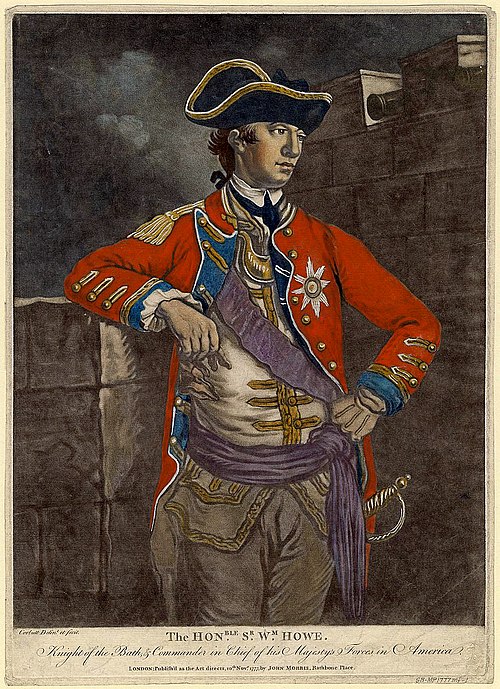
Sir William Howe in a color print published in 1777.
Quick facts
William Howe at a glance
- Born: August 10, 1729, in England
- Brothers: George, killed in America in 1758, and Admiral Richard Howe, who commanded the fleet in America
- Quebec, 1759: Led the soldiers who climbed the cliffs to the Plains of Abraham
- Politics: Member of Parliament, who said before the war that he did not want to fight Americans
- Commander in chief: October 1775 to May 1778
- Victories: Long Island, White Plains, Fort Washington, Brandywine and Germantown
- Honor: Made a knight (Sir William) after taking New York in 1776
- Died: July 12, 1814, in Plymouth, England, aged 84
The big picture in 30 seconds
Why William Howe matters
- He won almost every battle he fought against Washington.
- He captured the two biggest American cities.
- His slow pursuit let Washington’s army escape again and again.
- His 1777 move on Philadelphia left Burgoyne alone at Saratoga.
About 32,000
soldiers in his 1776 New York invasion
About 2,800
Americans captured at Fort Washington
2½ years
as commander in chief
Early life
A brave officer from a famous family
William Howe was born in 1729 into a well-connected English family. He joined the army at 17. His older brother George, a popular general, was killed near Fort Ticonderoga in 1758, and the people of Massachusetts paid for a monument to him in Westminster Abbey. His other brother, Richard, became an admiral.
In 1759, at Quebec, William led the light infantry up a steep path to the Plains of Abraham, helping General James Wolfe win Canada from France. He became known as a skilled and daring soldier.
Bunker Hill
Howe arrived in Boston in May 1775. On June 17 he led the attack on Breed’s Hill. His men charged three times before taking the hill, and almost all of his personal staff were killed or wounded. Many believe the slaughter made him much more careful afterward.

A peace meeting
In September 1776 the Howe brothers met Benjamin Franklin, John Adams and Edward Rutledge on Staten Island to talk peace. The talks failed because Britain would not accept independence.
The map
New York and Philadelphia
In the summer of 1776 Howe landed the largest British force ever sent overseas at Staten Island. He beat Washington on Long Island in August, took New York City in September and captured Fort Washington in November. But he stopped to rest at key moments, and Washington’s army escaped across New Jersey.
In 1777 Howe put his army on ships, sailed south and landed at Head of Elk, Maryland. He beat Washington at Brandywine and marched into Philadelphia on September 26.
Simplified map with today’s coastline. Red dots mark his battles. Land outlines from Natural Earth.
His life
William Howe’s life, step by step
Howe won battles but could not win the war.
1759: Quebec
He leads the climb up the cliffs to the Plains of Abraham.
1775: Bunker Hill
He leads the costly attack on Breed’s Hill.
1776: New York
He drives Washington out of Long Island and New York City.
1776: Fort Washington
He captures the fort and about 2,800 American soldiers.
1777: Philadelphia
He wins at Brandywine and Germantown and takes the American capital.
1778: Going home
He resigns and is replaced by Sir Henry Clinton.
Summer and fall 1777
Philadelphia instead of Saratoga
London’s plan for 1777 had General John Burgoyne marching south from Canada toward Albany. Instead of moving up the Hudson River to meet him, Howe decided to capture Philadelphia. He spent weeks at sea and did not land until late August.
On September 11 he outflanked Washington at Brandywine Creek, and on September 26 his troops entered Philadelphia. But far to the north, Burgoyne, with no help coming, was surrounded at Saratoga and surrendered on October 17.
Why it mattered
Saratoga brought France into the war. Howe spent a comfortable winter in Philadelphia while Washington’s army trained at Valley Forge. In the spring Howe resigned.

The Mischianza
Before Howe left, his officers threw him a famous farewell party in Philadelphia, with a mock tournament and fireworks.
Key people
Howe’s brother, rivals and enemy

George Washington
1732–1799
Commander in chief
Lost many battles to Howe but kept his army alive.

Richard Howe
1726–1799
British admiral
His older brother, commander of the fleet in America.


Lord Cornwallis
1738–1805
British general
His most aggressive general in 1776 and 1777.
Legacy
Why didn’t he win?
Back in England, Howe faced angry questions in Parliament about why he had not crushed the rebellion. He defended himself, and historians still argue. Some say he hoped to win the Americans back with mercy rather than destroy them. Others think Bunker Hill made him too cautious.
He later held commands in England, became the 5th Viscount Howe in 1799 and died in Plymouth in 1814.
1775
Bunker Hill
1776
takes New York
1777
takes Philadelphia
1778
resigns
Timeline
The life of William Howe, 1729–1814
- August 10, 1729 William Howe is born in England.
- 1746 He joins the army.
- 1758 His brother George is killed in America.
- September 13, 1759 He leads the climb at Quebec.
- June 17, 1775 He leads the attack at Bunker Hill.
- October 1775 He replaces Thomas Gage as commander in chief.
- March 17, 1776 He leaves Boston after American cannon appear on Dorchester Heights.
- August 27, 1776 He wins the Battle of Long Island.
- November 16, 1776 He captures Fort Washington.
- September 11, 1777 He wins the Battle of Brandywine.
- September 26, 1777 His army enters Philadelphia.
- May 1778 He hands over command to Henry Clinton.
- 1799 He becomes the 5th Viscount Howe.
- July 12, 1814 William Howe dies in Plymouth, England.
“When I look to the consequences of it, in the loss of so many brave officers, I do it with horror. The success is too dearly bought.”
William Howe, writing about Bunker Hill
June 1775
The bigger story
Key People of the Revolutionary War
Meet the leaders, soldiers, spies and enemies who decided the war for American independence, all on one page.
Go deeper
Sources and further reading
- The Men Who Lost America, by Andrew Jackson O’Shaughnessy (2013)
- The Battle for New York: The City at the Heart of the American Revolution, by Barnet Schecter (2002)
- The Howe Brothers and the American Revolution, by Ira D. Gruber (1972)
- More recommended books
Keep exploring
More people of Colonial America and the Revolution
Use the Earlier and Later buttons to read these biographies in order, from the first Virginia colonists to the generals of the Revolutionary War.