
Home › People › Revolutionary War People › John Burgoyne
Revolutionary War · British general · 1722–1792
John Burgoyne: The British General Who Surrendered at Saratoga
General John Burgoyne, nicknamed “Gentleman Johnny,” was a British officer, politician and playwright. In 1777 he led an army south from Canada to cut New England off from the other colonies. Instead he was surrounded and surrendered his whole army at Saratoga, the turning point of the Revolutionary War.

John Burgoyne, painted by Sir Joshua Reynolds about 1766.
Quick facts
John Burgoyne at a glance
- Born: February 24, 1722, in Bedfordshire, England
- Marriage: Ran away with Lady Charlotte Stanley, an earl’s daughter, in 1751
- Cavalry: Raised a regiment of light dragoons and won fame in Portugal in 1762
- Politics: Member of Parliament from 1761 until his death
- Playwright: Wrote plays that were hits on the London stage
- 1777: Led the British invasion from Canada
- Saratoga: Surrendered about 5,900 soldiers on October 17, 1777
- Died: August 4, 1792, in London; buried in Westminster Abbey
The big picture in 30 seconds
Why John Burgoyne matters
- He planned the 1777 invasion to split the colonies in two.
- His surrender at Saratoga was the first time a whole British army gave up.
- Saratoga convinced France to join the war on the American side.
- He was a colorful soldier, politician and writer in his own time.
About 8,000
soldiers, Native allies and Loyalists at the start
4 months
from Canada to surrender
About 200 miles
from Canada to Saratoga
Early life
Gentleman Johnny
John Burgoyne was born in 1722 and joined the army as a teenager. In 1751 he ran away with Lady Charlotte Stanley, the daughter of the Earl of Derby. Her father was furious at first but later helped Burgoyne’s career.
In the Seven Years’ War he raised a regiment of fast light cavalry and treated his men with unusual kindness, telling officers to talk to soldiers rather than beat them. In 1762 he won a daring victory in Portugal. He also sat in Parliament and wrote plays, such as The Maid of the Oaks (1774).
To America
Burgoyne arrived in Boston in May 1775 with Generals Howe and Clinton and watched the Battle of Bunker Hill. In 1776 he served in Canada. Back in London that winter, he persuaded the government to let him lead a great invasion from Canada in 1777.
A general on the stage
Burgoyne’s comedy The Heiress (1786) was one of the most popular plays of its day in London.
The plan
Burgoyne would march south from Canada down Lake Champlain and the Hudson River to Albany. British forces were also supposed to come up from New York, cutting New England off from the other colonies.
The map
From Canada to Saratoga
In June 1777 Burgoyne set off down Lake Champlain. On July 6 he took Fort Ticonderoga without a fight. But the next stretch, through thick woods where the Americans had cut down trees across the roads, took weeks. His supplies ran low, and a raid for horses and food ended in defeat near Bennington in August.
Meanwhile General William Howe, who was meant to help from New York, sailed south to take Philadelphia. Burgoyne was on his own.
Simplified map. Red dots mark places in his story. His goal was Albany, which he never reached.
His life
John Burgoyne’s life, step by step
Burgoyne was famous before Saratoga, and even more famous after it.
1762: Portugal
His light dragoons win a bold victory against the Spanish.
1774: Playwright
His first play is a hit in London.
1775: Boston
He arrives with Howe and Clinton and sees Bunker Hill.
July 1777: Ticonderoga
His invasion starts well when he takes the fort.
October 1777: Saratoga
Surrounded and outnumbered, he surrenders his army.
1778–1792: Home
He defends himself in Parliament and returns to writing.
September and October 1777
The Battles of Saratoga
Burgoyne crossed the Hudson River and pushed south toward Albany. American soldiers under General Horatio Gates were dug in on Bemis Heights, near Saratoga. On September 19, at Freeman’s Farm, Burgoyne won the field but lost about 600 men. On October 7 he attacked again and was beaten. Benedict Arnold led the American charge, and General Simon Fraser, one of Burgoyne’s best officers, was shot and killed.
Burgoyne retreated to Saratoga, where the Americans surrounded him. On October 17, 1777, his army of about 5,900 men laid down its weapons.
The Convention Army
The surrender terms said the soldiers would be shipped home, but Congress refused to let them go. Most stayed prisoners for the rest of the war and became known as the “Convention Army.”

A turning point
When news of Saratoga reached Paris, France agreed to an alliance with the United States in February 1778.
Key people
Burgoyne’s enemies and his ally

Horatio Gates
1727–1806
American general
Commanded the army that accepted Burgoyne’s surrender.

Benedict Arnold
1741–1801
American general
Led the attack that broke Burgoyne’s lines on October 7.

Daniel Morgan
1736–1802
American rifle commander
His riflemen fought Burgoyne’s soldiers at both battles.
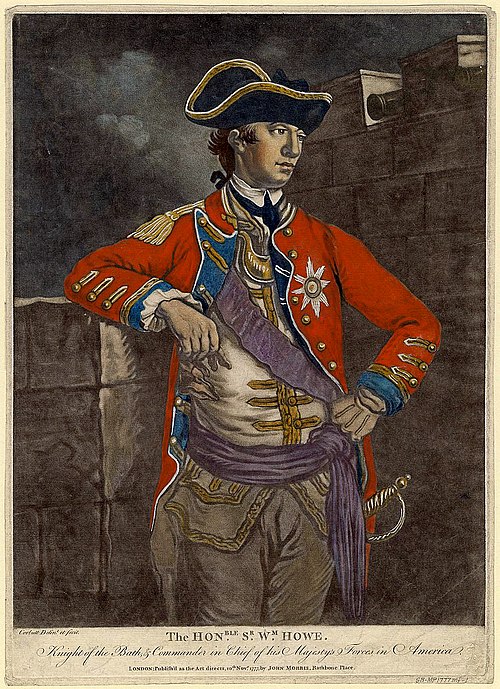
William Howe
1729–1814
British commander in chief
Went to Philadelphia instead of coming north to help.
Legacy
After Saratoga
Burgoyne was allowed to return to England in 1778. Many blamed him for the disaster, and he blamed the government’s plan and General Howe. He spoke against the war in Parliament and briefly served as commander in Ireland in 1782–1783.
He spent his last years writing plays. He died in London in 1792 and was buried in Westminster Abbey. In America his surrender is remembered at Saratoga National Historical Park.
1762
victory in Portugal
1777
takes Ticonderoga
1777
surrenders at Saratoga
1786
The Heiress
Timeline
The life of John Burgoyne, 1722–1792
- February 24, 1722 John Burgoyne is born in England.
- 1751 He elopes with Lady Charlotte Stanley.
- 1759 He raises a regiment of light dragoons.
- 1762 He wins a victory in Portugal.
- 1774 His play The Maid of the Oaks opens in London.
- May 1775 He arrives in Boston.
- July 6, 1777 His army takes Fort Ticonderoga.
- August 16, 1777 His raiders are defeated near Bennington.
- September 19, 1777 The Battle of Freeman’s Farm.
- October 7, 1777 The Battle of Bemis Heights.
- October 17, 1777 He surrenders at Saratoga.
- 1778 He returns to England.
- 1786 His comedy The Heiress is a hit.
- August 4, 1792 John Burgoyne dies in London.
“This army must not retreat.”
General John Burgoyne, orders to his army
July 30, 1777
The bigger story
Key People of the Revolutionary War
Meet the leaders, soldiers, spies and enemies who decided the war for American independence, all on one page.
Go deeper
Sources and further reading
- Saratoga: Turning Point of America’s Revolutionary War, by Richard M. Ketchum (1997)
- The Men Who Lost America, by Andrew Jackson O’Shaughnessy (2013)
- Gentleman Johnny Burgoyne, by Max M. Mintz (1990)
- More recommended books
Keep exploring
More people of Colonial America and the Revolution
Use the Earlier and Later buttons to read these biographies in order, from the first Virginia colonists to the generals of the Revolutionary War.