
Home › People › US Presidents › George Washington
1st President · 1789–1797 · No party
George Washington: Facts, Life and Presidency
George Washington led the Continental Army to victory in the American Revolution, presided over the convention that wrote the Constitution, and became the first president of the United States. Elected twice without a single vote against him, he set the patterns every later president followed, then gave up power and went home.
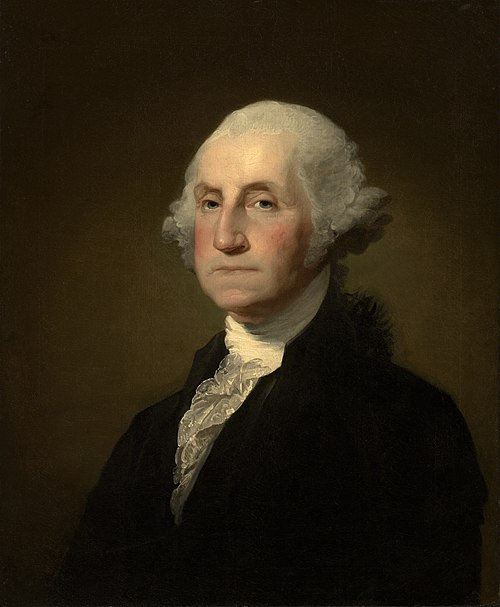
George Washington, painted by Gilbert Stuart in 1797
Quick facts
George Washington at a glance
| Born | February 22, 1732, at Popes Creek, Westmoreland County, Virginia | |
| Died | December 14, 1799, at Mount Vernon, Virginia, aged 67 | |
| President | 1st, from April 30, 1789, to March 4, 1797 (two terms) | |
| Vice president | John Adams | |
| Party | None. He disliked parties, though he leaned toward the Federalists | |
| Education | Local schooling only; trained as a land surveyor | |
| Military | Commander in Chief of the Continental Army, 1775–1783 | |
| Before the White House | Virginia House of Burgesses, Continental Congress, president of the Constitutional Convention | |
| Wife | Martha Dandridge Custis, married January 6, 1759 | |
| Children | None of his own; raised Martha's children John and Patsy Custis, and two grandchildren | |
| Elections | 1789 and 1792, both unanimous in the Electoral College | |
| Buried | Family tomb at Mount Vernon, beside Martha |
The big picture in 30 seconds
Why he matters
- Kept a ragged army alive for eight years and beat the strongest military power in the world.
- Lent his huge prestige to the Constitutional Convention of 1787, which made the new government possible.
- The only president elected unanimously, twice.
- Created the cabinet, the title “Mr. President” and the two-term tradition.
- Kept the young country out of the war between Britain and France.
- Gave up power twice, as general in 1783 and as president in 1797, which amazed the world.
100%
of electoral votes in both 1789 and 1792, a record no one has matched
8 years
as commander of the Continental Army, 1775 to 1783
3 states
joined the Union while he was president: Vermont, Kentucky and Tennessee
317
enslaved people lived at Mount Vernon in 1799; his will freed the 123 he owned
Early years
A Virginia surveyor and soldier
George Washington was born on February 22, 1732, at Popes Creek in Westmoreland County, Virginia, the eldest son of planter Augustine Washington and his second wife, Mary Ball Washington. His father died when George was 11, so he never went to school in England like his older half-brothers. Instead he learned math and surveying, and at 17 he became the official surveyor of Culpeper County.
His older half-brother Lawrence, whom he admired, owned the estate of Mount Vernon on the Potomac River. After Lawrence died, George leased the estate in 1754 and inherited it in 1761. It remained his home for the rest of his life.
The French and Indian War
In 1754, as a 22-year-old officer of the Virginia militia, Washington led the skirmish at Jumonville Glen that helped start the French and Indian War, and then had to surrender Fort Necessity. In 1755 he rode with British General Edward Braddock, whose army was ambushed near the Monongahela River. Washington had two horses shot from under him and four bullets through his coat, but he rallied the survivors and became a hero in Virginia.
Planter and burgess
On January 6, 1759, he married Martha Dandridge Custis, a wealthy young widow with two children. He served in Virginia’s House of Burgesses for 16 years and grew angry at British taxes and trade rules that hurt planters like him.

The Revolution
Commander in Chief
When the Revolutionary War began at Lexington and Concord in April 1775, Washington went to the Second Continental Congress in his militia uniform. On June 15, 1775, Congress chose him to command the new Continental Army. He took command at Cambridge, Massachusetts, in July and forced the British out of Boston in March 1776.
The British then drove him out of New York, and by December 1776 the army was melting away. On Christmas night Washington led his men across the icy Delaware River and won surprise victories at Trenton and Princeton that saved the Revolution.
From Valley Forge to Yorktown
After losing Philadelphia in 1777, the army spent a hungry winter at Valley Forge, where Baron von Steuben drilled it into a professional force. In 1781 Washington and the French general Rochambeau marched south and, with a French fleet blocking the coast, trapped Lord Cornwallis at Yorktown. Cornwallis surrendered on October 19, 1781.
Giving up power
In March 1783 Washington talked angry officers at Newburgh, New York, out of a possible revolt against Congress. On December 23, 1783, he handed his commission back to Congress at Annapolis and went home. King George III reportedly said that if he did that, he would be “the greatest man in the world.”

A new government
The Constitution and the first election
The Articles of Confederation left the national government too weak to pay its debts or keep order. In 1787 Washington agreed to attend the Constitutional Convention in Philadelphia, and the delegates elected him its president. He said little, but his presence gave the meeting weight, and everyone expected him to be the first president under the new Constitution.
He was. Every elector voted for him in 1789, and he took the oath of office on the balcony of Federal Hall in New York City on April 30, 1789.

Election of 1789
A unanimous choice
Electoral votes: 69 electors, each casting two votes; 35 needed to win
Election of 1792
Unanimous again
Electoral votes: 132 electors, each casting two votes; 67 needed to win
The presidency, 1789–1797
Building a government from nothing
Washington knew that whatever he did would become a precedent. He picked a cabinet of strong advisers, including Thomas Jefferson as Secretary of State, Alexander Hamilton at the Treasury, Henry Knox as Secretary of War and Edmund Randolph as Attorney General. Hamilton and Jefferson soon clashed so bitterly that their followers formed the first political parties.
1789
Courts and a Bill of Rights
The Judiciary Act set up the federal courts, and Washington named John Jay the first Chief Justice. Congress sent the states the Bill of Rights, which was ratified on December 15, 1791.
1790–1791
Hamilton's financial plan
Washington backed Hamilton’s plan to pay off the war debts and charter the First Bank of the United States, over Jefferson’s objection that the Constitution did not allow a bank.
July 1790
A capital on the Potomac
The Residence Act placed the permanent capital on the Potomac River. Washington chose the site himself; the city was later named for him. Philadelphia served as the capital in the meantime.
April 22, 1793
Staying out of Europe's war
When Britain and revolutionary France went to war, Washington declared the United States neutral, even though France had helped win the Revolution.
1794
The Whiskey Rebellion
Farmers in western Pennsylvania attacked tax collectors over a federal tax on whiskey. Washington called up about 13,000 militia and rode out with them, the only sitting president to lead troops in the field. The revolt collapsed.
1795
Jay's and Pinckney's treaties
The Jay Treaty got British troops out of forts in the Northwest and avoided war, but many Americans hated it. Pinckney’s Treaty with Spain opened the Mississippi River and the port of New Orleans to American trade.
Precedents
The firsts that became traditions
The Constitution said little about how a president should act, so Washington invented it. He chose the simple title “Mr. President” instead of grand ones like “His Highness.” He met his department heads as a group, creating the cabinet. He toured all thirteen states so ordinary people could see their president.
Most important, he stepped down after two terms. Every president followed that example until Franklin D. Roosevelt in 1940, and the 22nd Amendment made it law in 1951.
The Farewell Address
Washington’s Farewell Address, printed in a Philadelphia newspaper on September 19, 1796, warned Americans against bitter party politics, against splitting along regional lines, and against “permanent alliances” with foreign nations. The Senate still reads it aloud every year.
“First in war, first in peace, and first in the hearts of his countrymen.”
Henry “Light-Horse Harry” Lee, eulogy for Washington
December 26, 1799
Mount Vernon
Last years and a troubled legacy
Washington spent his last years running Mount Vernon, where he built a large whiskey distillery. In 1798, during the Quasi-War with France, President John Adams made him commander of a new army, but no fighting came. On December 12, 1799, he rode around the estate in sleet and snow. He developed a severe throat infection and died on the night of December 14, 1799.
Washington and slavery
Washington owned enslaved people from the age of 11. Over the years his views changed, and he privately wished for slavery to end. He was the only slaveholding founding father to free the people he owned: his will freed his 123 enslaved people after Martha’s death, and provided for the old and the young. Martha freed them on January 1, 1801. The people owned by the Custis estate stayed enslaved.

His life at a glance
Life timeline
People
Who's who in Washington's story


Visit
George Washington's Mount Vernon
Washington’s estate on the Potomac River, south of Alexandria, Virginia, is open every day. You can tour the mansion, the gardens, the reconstructed distillery and gristmill, the slave memorial, and the tomb where George and Martha Washington are buried.