
Home › People › Revolutionary War People › Molly Pitcher
Revolutionary War · Pennsylvania and New Jersey · about 1754–1832
Molly Pitcher: The Heroine of the Battle of Monmouth
“Molly Pitcher” is the name Americans gave to a woman who carried water to soldiers at the Battle of Monmouth in 1778 and then helped fire a cannon when her husband fell. She is usually identified as Mary Ludwig Hays of Carlisle, Pennsylvania. Historians debate how much of her story is true, but she stands for the thousands of women who served with the Continental Army.

Molly Pitcher at the cannon, a Currier & Ives print from the 1800s.
Quick facts
Molly Pitcher at a glance
- Real name: Most likely Mary Ludwig Hays, later Mary McCauly
- Born: About 1754; her birthplace is uncertain
- Home: Carlisle, Pennsylvania
- Husband: William Hays, a gunner in the Continental artillery
- With the army: Followed her husband to camp, including the winter at Valley Forge
- Her nickname: “Molly” was a common nickname for Mary; soldiers shouted for the water pitcher
- Reward: Pennsylvania granted her $40 a year in 1822 for her services in the war
- Died: January 22, 1832, in Carlisle, Pennsylvania
The big picture in 30 seconds
Why Molly Pitcher matters
- She is the best-known woman soldier of the Revolution.
- Her story shows that women served on the battlefield.
- Thousands of women cooked, nursed and carried water for the army.
- Her legend has inspired Americans for more than 200 years.
June 28, 1778
Battle of Monmouth
$40
yearly pension from Pennsylvania, 1822
Thousands
women who traveled with the army
Early life
A working woman from Carlisle
Very little is known for certain about Mary’s early life. Tradition says she was born around 1754 to a German-speaking family, and that as a young woman she worked as a servant in Carlisle, Pennsylvania. There she married William Hays, a barber.
In 1777 William joined the Continental artillery. Like many soldiers’ wives, Mary followed him. These “camp followers” washed clothes, cooked, nursed the sick and carried water, and they were given food rations in return.
Women in the army
Thousands of women traveled with the Continental Army. Most never fired a gun, but a few did. In 1776 Margaret Corbin took her dead husband’s place at a cannon at Fort Washington, New York, and was badly wounded. She later became the first woman to receive a soldier’s pension from Congress.
_-_E._Percy_Moran_LCCN96516279.jpg/960px-Molly_Pitcher_firing_cannon_at_Battle_of_Monmouth)_-_E._Percy_Moran_LCCN96516279.jpg)
Water for the guns
Gun crews needed water to drink in the heat and to soak the sponge used to clean out the cannon after each shot. Women like Mary often brought it.
The map
From Valley Forge to Monmouth
In June 1778 the British left Philadelphia and marched across New Jersey toward New York. Washington’s army, newly trained by Baron von Steuben at Valley Forge, followed and caught up with them near Monmouth Court House (today Freehold, New Jersey).
The battle on June 28 was fought in terrible heat. Many soldiers on both sides collapsed or died from sunstroke. After the battle the British slipped away to Sandy Hook and sailed to New York.
Simplified map with today’s coastline. Land outlines from Natural Earth.
Her life
Molly Pitcher’s life, step by step
The facts are few, but they show a hard-working woman who served her country.
Before 1777: Carlisle
Mary works as a servant and marries William Hays.
1777–1778: With the army
She follows William’s artillery regiment and spends the winter at Valley Forge.
June 28, 1778: Monmouth
She carries water to the soldiers in the blazing heat.
The same day: At the cannon
When William falls, she takes his place helping to load and fire his gun.
After the war
Back in Carlisle she works as a servant and cleaner; after William dies she marries John McCauly.
1822: Recognized
The Pennsylvania legislature grants her a payment for her service in the war.
June 28, 1778
At the cannon at Monmouth
According to the story, Mary spent the morning of the battle carrying water from a nearby spring to the gunners, who shouted “Molly! Pitcher!” when they needed more. When William was wounded or overcome by the heat, she stepped up to his cannon and helped keep it firing for the rest of the battle.
A soldier named Joseph Plumb Martin later wrote of seeing a woman working at a cannon there. A British cannonball passed between her legs and tore away the bottom of her petticoat. She looked down, he said, and remarked that it was lucky it had not passed a little higher.
Legend or history?
Some historians think “Molly Pitcher” blends the stories of several women. A popular tale says Washington made her a sergeant, but there is no record of it. What is certain is that women were at Monmouth, and at least one served a gun under fire.

Remembered in Carlisle
A statue of Molly Pitcher with a cannon stands over her grave in Carlisle, and a cannon marks the battlefield where she served.
Key people
Leaders at Monmouth

George Washington
1732–1799
Commander in chief
Led the attack on the British at Monmouth.

Charles Lee
1732–1782
American general
Ordered a retreat at Monmouth and was later court-martialed.
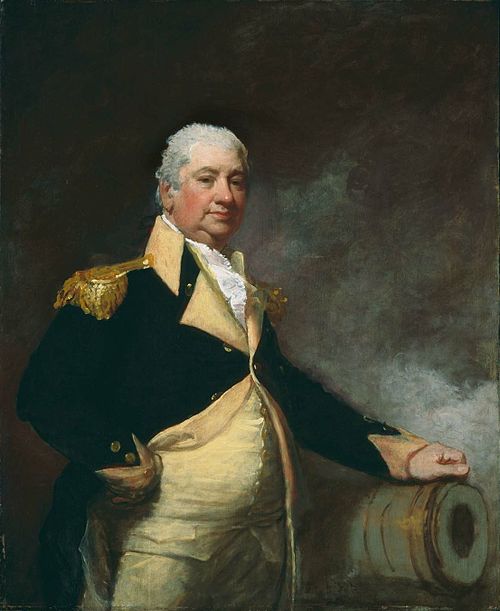
Henry Knox
1750–1806
Chief of artillery
Commanded the cannon crews, including William Hays’s.

Baron von Steuben
1730–1794
Drillmaster
His training at Valley Forge helped the army stand firm.
Legacy
A symbol of women in the Revolution
Mary’s life after the war was hard. She worked as a servant and cleaner in Carlisle, and in 1822 the Pennsylvania legislature voted to give her $40 a year “for services rendered” in the war. She died in 1832.
In the 1800s her story grew into a legend, retold in paintings, prints and school books. In 1928 the U.S. Post Office printed “MOLLY PITCHER” on a stamp, and in World War II a Liberty ship was named after her. Today she stands for all the women who served in the war for independence.
1778
Monmouth
1822
Pennsylvania rewards her
1916
statue in Carlisle
1928
her name on a U.S. stamp
Timeline
The life of Molly Pitcher, about 1754–1832
- About 1754 Mary is born; her exact birthplace is unknown.
- Before 1777 She marries William Hays in Carlisle, Pennsylvania.
- 1777 William joins the Continental artillery and Mary follows the army.
- Winter 1777–1778 The army camps at Valley Forge.
- June 28, 1778 The Battle of Monmouth.
- After 1783 The couple returns to Carlisle.
- 1786 William Hays dies.
- 1790s Mary marries John McCauly.
- February 21, 1822 Pennsylvania grants her $40 a year.
- January 22, 1832 Mary Hays McCauly dies in Carlisle.
- 1876 A monument is placed at her grave.
- 1916 Her statue is unveiled in Carlisle.
“While in the act of reaching a cartridge and having one of her feet as far before the other as she could step, a cannon shot from the enemy passed directly between her legs without doing any other damage than carrying away all the lower part of her petticoat.”
Joseph Plumb Martin, a Continental soldier at Monmouth
from his memoir, 1830
The bigger story
Key People of the Revolutionary War
Meet the leaders, soldiers, spies and enemies who decided the war for American independence, all on one page.
Go deeper
Sources and further reading
- Revolutionary Mothers: Women in the Struggle for America’s Independence, by Carol Berkin (2005)
- Belonging to the Army: Camp Followers and Community during the American Revolution, by Holly A. Mayer (1996)
- A Narrative of a Revolutionary Soldier, by Joseph Plumb Martin (first published 1830)
- More recommended books
Keep exploring
More people of Colonial America and the Revolution
Use the Earlier and Later buttons to read these biographies in order, from the first Virginia colonists to the generals of the Revolutionary War.