
Home › People › Revolutionary War People › Nathanael Greene
Revolutionary War · Rhode Island · 1742–1786
Nathanael Greene: The General Who Won Back the South
Nathanael Greene was a Rhode Island Quaker’s son who taught himself to be a soldier from books. He rose to become George Washington’s most trusted general, kept the army supplied at Valley Forge, and in 1780–1782 led a brilliant campaign that drove the British out of most of the Carolinas and Georgia, even though he never won a big battle there.

Nathanael Greene, painted by Charles Willson Peale in 1783.
Quick facts
Nathanael Greene at a glance
- Born: August 7, 1742, in Potowomut (Warwick), Rhode Island
- Family: Quakers who owned an iron forge; he was expelled from the Quakers for his military interest
- Training: Taught himself from books on war; walked with a limp
- Rank: Youngest brigadier general in the Continental Army (1775); major general from 1776
- Quartermaster general: In charge of the army’s supplies, 1778–1780
- Southern command: Took over the Southern army in December 1780 after Gates’s defeat at Camden
- Reward: Georgia gave him Mulberry Grove, a plantation near Savannah
- Died: June 19, 1786, at Mulberry Grove, aged 43
The big picture in 30 seconds
Why Nathanael Greene matters
- He was Washington’s most trusted general.
- He kept the army fed and supplied after Valley Forge.
- His Southern campaign wore out Cornwallis’s army.
- By 1782 the British held only Charleston and Savannah in the South.
32
his age when made a general
About 200 miles
in the Race to the Dan
4
big battles in the South, none a clear win
1
campaign that won back three states
Early life
The Quaker who studied war
Nathanael Greene was born in 1742 in Rhode Island, into a family of Quakers who ran an iron forge. His father did not believe in much schooling, so Nathanael taught himself, buying books on history, math and war. He had a stiff knee and walked with a limp all his life.
As trouble with Britain grew, Greene helped form a militia company, the Kentish Guards, in 1774. His fellow members would not make him an officer because of his limp, so he joined as a private. The Quakers, who opposed war, expelled him.
Rapid rise
In May 1775, Rhode Island made the 32-year-old private the commander of its army. A month later he became the youngest general in the Continental Army. He met a young Boston bookseller, Henry Knox, and the two became lifelong friends.

Feeding the army
Greene did not want to be quartermaster general, saying no one had ever heard of a quartermaster in history. But after Valley Forge, his work kept the army alive.
The map
Winning by losing
When Greene arrived in Charlotte, North Carolina, in December 1780, the Southern army was small, hungry and beaten. He boldly split it, sending Daniel Morgan west, where Morgan won at Cowpens. Then Greene led Cornwallis on a 200-mile chase north to the Dan River and safety in Virginia.
Rested and reinforced, Greene turned back and fought Cornwallis at Guilford Courthouse. He then moved into South Carolina, fighting at Hobkirk’s Hill, Ninety Six and Eutaw Springs and taking British outposts one by one, until the British were penned up in Charleston and Savannah.
Simplified map with today’s coastline. Red dots mark Greene’s battles in the South. Land outlines from Natural Earth.
His life
Nathanael Greene’s life, step by step
Greene fought in almost every major campaign of the war, first in the North and then in the South.
1775: General at 32
He leads Rhode Island’s troops to Boston and becomes a Continental general.
1776–1777: Washington’s right hand
He fights at Trenton, Brandywine and Germantown, and loses Fort Washington in New York.
1778–1780: Quartermaster
He reorganizes the army’s supplies after the hungry winter at Valley Forge.
1780: Arnold’s treason
He takes over West Point after Arnold flees and leads the trial of Major André.
1781: The Race to the Dan
He escapes Cornwallis across North Carolina, then fights him at Guilford Courthouse.
1782–1786: Peace
The British leave Charleston. Greene moves to Georgia, where he dies of sunstroke.
March 15, 1781
Guilford Courthouse
Greene copied Morgan’s plan from Cowpens and lined up his army in three lines near Guilford Courthouse, North Carolina. Cornwallis attacked with about 2,000 men against Greene’s 4,400. After two hours of hard fighting, Greene pulled his army back rather than risk losing it, leaving the field to the British.
Cornwallis won the battle but lost about a quarter of his army killed or wounded. He could no longer hold the Carolinas and marched into Virginia, where he was trapped at Yorktown seven months later.
“Another such victory”
In London, a member of Parliament said, “Another such victory would ruin the British army.”

Named for Greene
Greensboro, North Carolina, near the battlefield, is named after him, along with Greenville and many counties across the country.
Key people
Greene’s friends and foes

George Washington
1732–1799
Commander in chief
Chose Greene to save the South and called him his most trusted general.
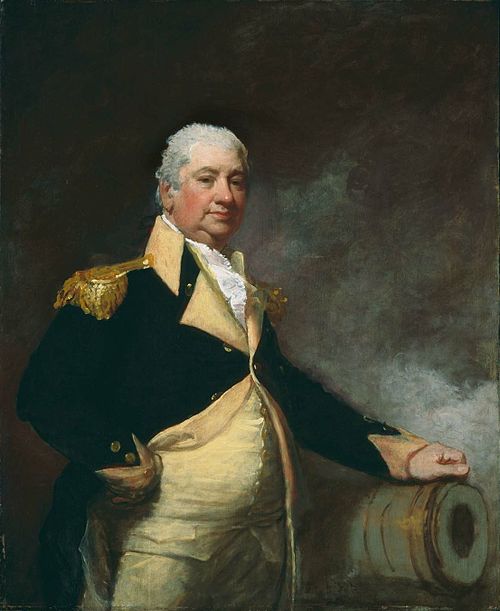
Henry Knox
1750–1806
His closest friend
Artillery chief and fellow self-taught officer.

Daniel Morgan
1736–1802
His best field commander
Won the Battle of Cowpens on Greene’s campaign.

Lord Cornwallis
1738–1805
British general
Chased Greene across North Carolina and was worn down by him.
Legacy
Washington’s best general
Greene lost every major battle he fought in the South, yet he won the campaign. By keeping his army alive and always moving, he wore down the British, cut their outposts off, and gave local patriot fighters such as Francis Marion room to strike. Many historians rank him second only to Washington among American generals of the war.
He spent much of his own money feeding his soldiers and died deep in debt at only 43. His wife, Catharine Greene, stayed on at Mulberry Grove, where a visiting teacher named Eli Whitney built the cotton gin in 1793.
1775
general at 32
1781
the Race to the Dan
1782
the British leave Charleston
1786
dies at Mulberry Grove
Timeline
The life of Nathanael Greene, 1742–1786
- August 7, 1742 Nathanael Greene is born in Rhode Island.
- 1774 He joins the Kentish Guards as a private and marries Catharine Littlefield.
- June 22, 1775 Congress makes him a brigadier general.
- August 1776 He is promoted to major general.
- November 16, 1776 Fort Washington falls to the British.
- December 26, 1776 He fights at Trenton.
- March 1778 He becomes quartermaster general at Valley Forge.
- June 28, 1778 He fights at Monmouth.
- September 1780 He leads the court that tries Major André.
- December 1780 He takes command in the South.
- February 1781 The Race to the Dan.
- March 15, 1781 The Battle of Guilford Courthouse.
- September 8, 1781 The Battle of Eutaw Springs.
- December 14, 1782 The British leave Charleston.
- June 19, 1786 Nathanael Greene dies at Mulberry Grove, Georgia.
“We fight, get beat, rise, and fight again.”
Nathanael Greene
letter to the French minister, the Chevalier de la Luzerne, 1781
The bigger story
Key People of the Revolutionary War
Meet the leaders, soldiers, spies and enemies who decided the war for American independence, all on one page.
Go deeper
Sources and further reading
- Washington’s General: Nathanael Greene and the Triumph of the American Revolution, by Terry Golway (2005)
- The Road to Guilford Courthouse: The American Revolution in the Carolinas, by John Buchanan (1997)
- General Nathanael Greene and the American Revolution in the South, edited by Gregory D. Massey and Jim Piecuch (2012)
- More recommended books
Keep exploring
More people of Colonial America and the Revolution
Use the Earlier and Later buttons to read these biographies in order, from the first Virginia colonists to the generals of the Revolutionary War.