
Home › People › Revolutionary War People › Henry Knox
Revolutionary War · Boston, Massachusetts · 1750–1806
Henry Knox: The Bookseller Who Became Washington’s Artillery Chief
Henry Knox was a young Boston bookseller who taught himself about cannon from books. In the winter of 1775–1776 he hauled 59 heavy guns from Fort Ticonderoga to Boston on ox sleds, forcing the British to leave the city. He became George Washington’s chief of artillery, one of his closest friends, and the first Secretary of War of the United States.
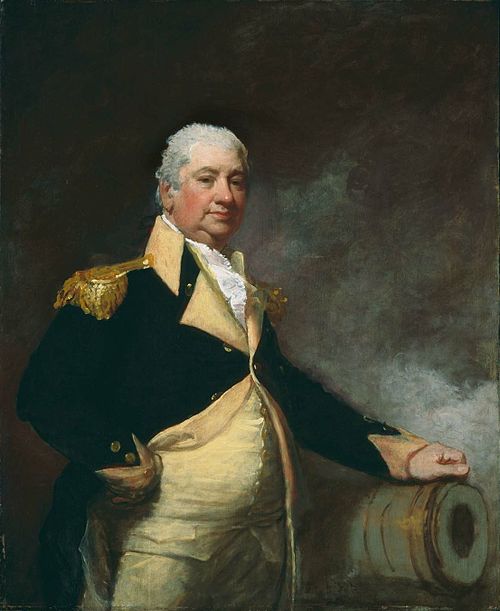
Henry Knox, painted by Gilbert Stuart in 1806.
Quick facts
Henry Knox at a glance
- Born: July 25, 1750, in Boston, Massachusetts
- Before the war: Ran the London Book Store in Boston and read every military book he could find
- Married: Lucy Flucker, the daughter of a Loyalist official, in 1774
- Famous feat: The “noble train of artillery”: 59 cannon from Ticonderoga to Boston, 1775–1776
- Role: Chief of artillery of the Continental Army, 1775–1783
- Rank: Youngest major general in the Continental Army, 1782
- After the war: Secretary of War, 1785–1794, under Congress and then President Washington
- Died: October 25, 1806, in Thomaston, Maine, aged 56
The big picture in 30 seconds
Why Henry Knox matters
- His cannon drove the British out of Boston in March 1776.
- He ran Washington’s artillery in every major battle.
- He planned the school that led to West Point.
- He was the first Secretary of War under the Constitution.
59
cannon brought from Ticonderoga
About 60 tons
of guns and supplies
About 300 miles
over snow and frozen rivers
25
his age when he did it
Early life
A bookseller who studied war
Henry Knox was born in Boston in 1750. When he was nine his father, a ship captain, left the family, and Henry went to work in a bookshop to support his mother. At 21 he opened his own shop, the London Book Store.
Knox read everything he could about artillery and engineering, and British officers in Boston liked to talk with him in his shop. He joined a local artillery company. In 1773 a hunting gun burst in his hand and he lost two fingers, which he hid with a scarf for the rest of his life.
A runaway marriage
In 1774 Knox married Lucy Flucker, whose father was the royal secretary of Massachusetts. Her family disapproved of the bookseller and his politics. When war came in 1775, the young couple slipped out of Boston. The story goes that Lucy carried Henry’s sword sewn into the lining of her cloak.

Learned from books
Knox had no military training. Almost everything he knew about cannon came from the books he sold.
The map
Ticonderoga to Boston
In 1775 the American army had Boston surrounded but lacked the big guns to drive the British out. Knox proposed fetching the cannon that had been captured at Fort Ticonderoga, on Lake Champlain.
He reached the fort in early December 1775. His men loaded the guns onto boats down Lake George, then onto sleds pulled by oxen and horses. They crossed the frozen Hudson River near Albany, where some guns broke through the ice, and dragged them over the Berkshire mountains, reaching the army at Cambridge in late January 1776.
Simplified map. The route ran down Lake George and the Hudson to Albany, then east over the Berkshire mountains through Springfield.
His life
Henry Knox’s life, step by step
Knox was at Washington’s side from the siege of Boston to the end of the war.
1775–1776: The noble train
He hauls 59 cannon some 300 miles in winter to the army at Boston.
March 1776: Dorchester Heights
The guns appear overnight on the hills above Boston, and the British sail away.
December 25, 1776: The Delaware
His booming voice directs the night crossing of the icy river before the victory at Trenton.
1779: An artillery school
At Pluckemin, New Jersey, he opens a school to train officers, a model for West Point.
1781: Yorktown
His guns pound the British lines until Cornwallis surrenders.
1785–1794: Secretary of War
He builds the small army and navy of the new nation and handles relations with Native nations.
March 4–17, 1776
The guns on Dorchester Heights
On the night of March 4, 1776, thousands of American soldiers quietly hauled Knox’s cannon and ready-made wooden walls up Dorchester Heights, the hills overlooking Boston from the south. By morning they had built a fort.
The British commander, General William Howe, was stunned. He is said to have remarked that the rebels had done more in one night than his army could have done in months. With the guns now able to fire on the city and the harbor, Howe decided to leave. On March 17 the British army and about 1,000 Loyalists sailed for Canada.
Evacuation Day
Boston still celebrates March 17 as Evacuation Day, the day the British left without another battle.

Washington’s friend
Knox was one of the few generals who served with Washington through the whole war. At their farewell in 1783, Washington embraced him first.
Key people
Knox’s world

George Washington
1732–1799
Commander in chief
Trusted Knox completely and made him Secretary of War.

Nathanael Greene
1742–1786
General, his close friend
Another self-taught officer who met Knox in his bookshop.

Lord Cornwallis
1738–1805
British general
Surrendered at Yorktown after days of fire from Knox’s guns.
Legacy
Father of American artillery
Knox turned a few untrained gun crews into a skilled artillery corps that fought in every major battle of the war. His school for officers helped lead to the founding of the U.S. Military Academy at West Point in 1802.
As the first Secretary of War under the Constitution, he organized the army, planned coastal forts and backed the building of the first navy frigates, including USS Constitution. He also founded the Society of the Cincinnati for Revolutionary War officers. Fort Knox in Kentucky, home of the U.S. gold reserve, is named after him.
1776
the British leave Boston
1781
Yorktown
1789
Secretary of War under Washington
1802
West Point founded
Timeline
The life of Henry Knox, 1750–1806
- July 25, 1750 Henry Knox is born in Boston.
- 1759 He goes to work in a bookshop at age nine.
- 1771 He opens the London Book Store.
- 1774 He marries Lucy Flucker.
- 1775 He joins the American army besieging Boston and plans its earthworks.
- December 1775 He reaches Fort Ticonderoga.
- January 1776 The noble train reaches Cambridge.
- March 17, 1776 The British leave Boston.
- December 25, 1776 He directs the crossing of the Delaware.
- 1779 He opens his artillery school at Pluckemin.
- October 1781 His guns help win the siege of Yorktown.
- 1785 Congress makes him Secretary of War.
- 1789 He becomes Secretary of War under President Washington.
- 1794 He retires to Maine.
- October 25, 1806 Henry Knox dies at Thomaston, Maine.
“I hope in sixteen or seventeen days to be able to present your Excellency a noble train of artillery.”
Henry Knox to George Washington
Fort George, December 17, 1775
The bigger story
Key People of the Revolutionary War
Meet the leaders, soldiers, spies and enemies who decided the war for American independence, all on one page.
Go deeper
Sources and further reading
- Henry Knox: Visionary General of the American Revolution, by Mark Puls (2008)
- 1776, by David McCullough (2005)
- The Revolutionary War Lives and Letters of Lucy and Henry Knox, by Phillip Hamilton (2017)
- More recommended books
Keep exploring
More people of Colonial America and the Revolution
Use the Earlier and Later buttons to read these biographies in order, from the first Virginia colonists to the generals of the Revolutionary War.