
Home › US History › Revolutionary War › Brandywine and Germantown
Revolutionary War · Pennsylvania · September 11 and October 4, 1777
The Battles of Brandywine and Germantown
The Battles of Brandywine and Germantown decided the fate of Philadelphia. In the fall of 1777 the British set out to capture Philadelphia, the American capital. Washington met them on Brandywine Creek and was beaten by the same kind of flank march that had won Long Island. Three weeks later the British marched into Philadelphia. Washington struck back at Germantown in a daring dawn attack that nearly worked, until fog and a stone mansion stopped it.

Lafayette, wounded in the leg, at the Battle of Brandywine
Quick facts
Brandywine and Germantown at a glance
| When | Brandywine: September 11, 1777. Germantown: October 4, 1777 | |
| Where | Chadds Ford on Brandywine Creek, about 25 miles southwest of Philadelphia; Germantown, a village just north of the city | |
| Americans | Gen. George Washington, with Nathanael Greene, John Sullivan, Anthony Wayne, the Marquis de Lafayette and Henry Knox | |
| British | Gen. William Howe, with Lord Cornwallis and Hessian Gen. Wilhelm von Knyphausen | |
| Soldiers | Brandywine: about 15,000 on each side, the most of any single-day battle of the war. Germantown: about 11,000 Americans, 9,000 British | |
| Losses | Brandywine: about 1,300 American and 590 British casualties. Germantown: about 1,000 American and 530 British | |
| Turning point | At Germantown, thick fog and a British stand in the stone Chew House threw Washington’s attack into confusion | |
| Result | British victories. Howe captured Philadelphia on September 26, 1777, and Congress fled to York, Pennsylvania |
The big picture in 30 seconds
Why Brandywine and Germantown matter
- Britain captured the American capital, but it did not end the war.
- Washington’s army lost, but fought hard and kept itself together.
- Germantown, together with Saratoga, convinced France the Americans could win.
- The campaign led straight to the hard winter at Valley Forge.
About 30,000
soldiers at Brandywine
11 hours
of fighting at Brandywine
About 2,300
American casualties in the two battles
Sept. 26, 1777
British enter Philadelphia
How it began
Howe sails for Philadelphia
For 1777, the British had two plans that never fit together. General John Burgoyne would march south from Canada down the Hudson River. General William Howe, instead of helping him, decided to capture Philadelphia, where the Continental Congress met and the Declaration of Independence had been signed.
Howe loaded about 15,000 soldiers onto ships in New York in July. Rather than march across New Jersey, where Washington waited, he sailed south and up the Chesapeake Bay. The voyage took more than a month in summer heat, and many of the horses died. On August 25 the army landed at Head of Elk, Maryland, and began marching north toward Philadelphia.
Washington makes a stand
Washington marched his army through Philadelphia on August 24 to show the city its defenders, with sprigs of green in their hats. He chose to fight behind Brandywine Creek, guarding the fords on the road to the city. His main force waited at Chadds Ford.

Where it happened
Brandywine Creek and Germantown
Brandywine Creek runs south through rolling farm country to the Delaware River at Wilmington. In 1777 it could be crossed only at fords. Germantown was a long village of stone houses strung out along the main road, about five miles north of Philadelphia, where Howe kept about 9,000 men after taking the city.
Simplified map. Howe’s army had sailed from New York to the top of the Chesapeake Bay.
How the battle unfolded
Two battles, one campaign
Howe won both battles, but the campaign cost him the summer, and Burgoyne, left on his own in New York, surrendered at Saratoga on October 17.
Knyphausen’s Hessians attack at Chadds Ford to hold Washington in place. Meanwhile Howe and Cornwallis march about 17 miles north, cross at unguarded fords and come down behind the American right.
Sullivan’s divisions turn to face Cornwallis near the Birmingham Meeting House and are pushed back. Lafayette is shot in the leg rallying the troops. Greene’s division races four miles to cover the retreat.
British troops surprise Anthony Wayne’s camp at night and attack with bayonets. Howe slips past Washington and marches into Philadelphia on September 26.
Four American columns march all night to attack Germantown at dawn. In fog, they push the British back, then stall at the Chew House. Two American divisions fire on each other, and the army retreats.
Fog and stone walls
The fight at the Chew House
Washington’s plan for Germantown was bold: four columns, marching 16 miles through the night, would strike the British camp at dawn from different directions, as he had done at Trenton. At first it worked. The British light infantry broke and ran, and some redcoats fled through the streets.
Then about 120 men of the British 40th Regiment ran into Cliveden, the big stone country house of Benjamin Chew, barred the doors and fired from the windows. Henry Knox insisted that a fortress could not be left in the army’s rear. For about an hour American cannon and infantry attacks failed to take the house, while the rest of the army lost its momentum. Smoke and a heavy fog made it impossible to see. One American division fired into another, panic spread, and the army fell back.
Why a defeat helped
The French noticed that an American army beaten at Brandywine had come back three weeks later and nearly won. When news of Germantown and of Burgoyne’s surrender at Saratoga reached Paris, the French foreign minister was impressed by both. France signed its alliance with the United States in February 1778.

Commanders and soldiers
The commanders

Outmaneuvered at Brandywine, he struck back three weeks later at Germantown and kept the army in the field.
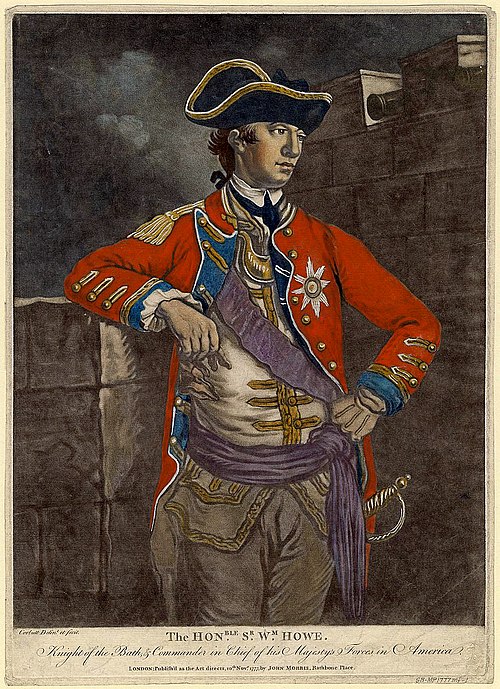
Won both battles and took Philadelphia, but left Burgoyne to be trapped at Saratoga. He resigned in 1778.

Just 20 years old, he was shot in the leg at Brandywine in his first battle. Washington told the doctors to treat him like his own son.

His division marched four miles in under an hour to hold off the British and save the army at Brandywine.

Held Chadds Ford at Brandywine. His camp was surprised at Paoli, and his men attacked hard at Germantown.

Led a charge that helped cover the retreat at Brandywine. He was killed at Savannah in 1779.
Why it mattered
Lose the battles, keep the war
Losing Philadelphia stung, but it did not decide anything. Congress kept meeting in York, Pennsylvania, and the American army stayed in the field, close enough to watch the British all winter. Howe had spent the whole campaign season taking one city, while Burgoyne’s army in the north was trapped and forced to surrender at Saratoga.
Washington’s army marched into winter camp at Valley Forge in December 1777. Among its young officers were Alexander Hamilton, who rode ahead to warn Congress to leave Philadelphia, and Lieutenant James Monroe, an aide who fought at both battles. In June 1778 the British gave up Philadelphia and marched back toward New York.
Week by week
Philadelphia campaign timeline
“Upon the whole, it may be said the day was rather unfortunate than injurious.”
George Washington
Report to Congress on the Battle of Germantown, October 5, 1777
The bigger story
Revolution and Founding, 1770–1819
Our U.S. History era page puts the war in context: the road to independence, the Constitution and the first presidents.
Go deeper
Books and sources
- The Philadelphia Campaign, by Thomas J. McGuire (2006–2007, two volumes)
- Washington’s War, by Michael Stephenson (2007)
- His Excellency: George Washington, by Joseph J. Ellis (2004)
- More recommended books