
Home › US History › The Great Depression
US History · 1929–1941
The Great Depression
The stock market crash of October 1929 opened the worst economic collapse in American history. Banks failed, farms blew away, and one worker in four lost his job. Then Franklin Roosevelt’s New Deal changed what Americans expected from their government. Here is the whole story, from the boom of the Twenties to the war that finally ended the hard times.
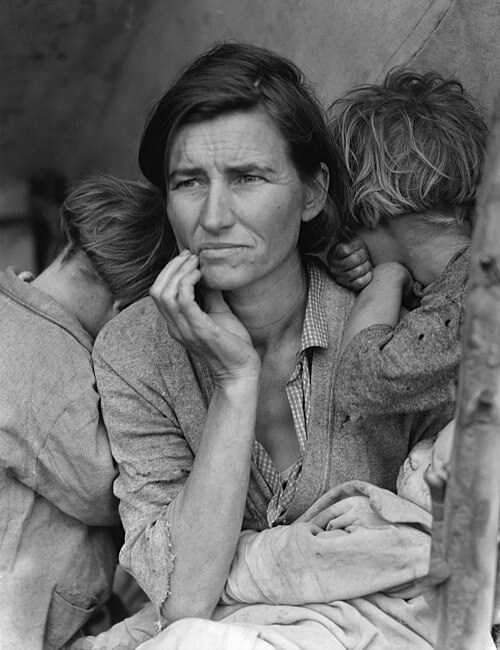
Migrant Mother, Nipomo, California, 1936. Photo by Dorothea Lange
Quick facts
The Great Depression at a glance
| When | From the crash of October 1929 until the U.S. entered World War II in December 1941; the worst years were 1930–1933 | |
| The crash | Black Thursday, October 24, 1929, and Black Tuesday, October 29, 1929 | |
| Jobless | About 25 percent of the workforce, some 12 to 13 million people, in 1933 | |
| Banks | About 9,000 banks failed between 1930 and 1933, wiping out millions of savings accounts | |
| Presidents | Herbert Hoover (1929–1933) and Franklin D. Roosevelt (1933–1945) | |
| Dust Bowl | Drought and dust storms on the southern Plains, worst from 1934 to 1938 | |
| Response | The New Deal: relief, recovery and reform programs passed from 1933 to 1938 | |
| Ended by | War production for World War II, which brought full employment by 1942–1943 |
The big picture in 30 seconds
Why the Depression matters
- It was the longest and deepest economic collapse in modern American history.
- The New Deal created programs still with us today: Social Security, the FDIC and the SEC.
- It made the federal government a permanent part of everyday economic life.
- It reshaped politics, building the Democratic “New Deal coalition” that lasted for decades.
25%
of American workers were out of a job in 1933
9,000
banks failed from 1930 to 1933
89%
drop in the Dow from its 1929 peak to its 1932 low
2.5 million
people moved out of the Plains states in the 1930s
From boom to bust
The Roaring Twenties and the Crash
The 1920s were a decade of cars, radios, movies and easy credit. Factories turned out goods faster than ever, and millions of Americans bought stock for the first time, often “on margin,” paying only 10 to 20 percent down and borrowing the rest. Stock prices doubled and doubled again. The Dow Jones average peaked at 381 on September 3, 1929.
Then confidence cracked. On Black Thursday, October 24, a record 12.9 million shares changed hands as panicked investors sold. On Black Tuesday, October 29, the market collapsed again on 16 million shares. Investors who had borrowed to buy stock were wiped out overnight. By July 1932 the Dow stood at 41, a loss of 89 percent.
The crash did not cause the Depression by itself, but it destroyed fortunes and confidence. People stopped buying, factories cut back, and workers lost their jobs, so people bought even less.

Why it got so bad
The causes of the Great Depression
Economists still argue about the exact mix, but most agree that several weaknesses fed on each other and turned a downturn into a disaster.
Wall Street
Speculation and the crash
Buying stock with borrowed money pushed prices far above what companies were worth. When prices fell, the loans came due.
Banks
Bank runs and failures
With no deposit insurance, rumors sent crowds to pull out their money. Thousands of banks failed and savings vanished.
Farms and factories
Too much, too few buyers
Farmers had been in trouble since the early 1920s. Factories made more than workers could afford to buy.
World trade
Tariffs and a world slump
The Smoot-Hawley Tariff of 1930 raised taxes on imports. Other nations struck back, and world trade shrank by about two thirds.
Life in the Depression
Hard times
For millions of families, the Depression meant lost jobs, lost homes and lost farms. Men walked the streets looking for work or rode freight trains from town to town. Families doubled up with relatives, patched their clothes and planted gardens. Charities and city governments ran out of money to help. In 1932 there was still no federal unemployment insurance, no Social Security and no deposit insurance.
Homeless people built shantytowns of scrap wood and tin that they called “Hoovervilles,” blaming President Herbert Hoover. Hoover believed in voluntary action and local relief, and he started public works and loans to banks and railroads, but to many Americans he seemed out of touch.

Hungry men lined up for free soup, bread and coffee. This Chicago kitchen was paid for by the gangster Al Capone, trying to polish his image.

Seattle’s Hooverville grew to about 1,200 people. Shantytowns like it sprang up on vacant land in nearly every city.

World War I veterans camped in the capital to demand early payment of a promised bonus. Army troops under Douglas MacArthur drove them out and burned their camp.
Black blizzards
The Dust Bowl
On the southern Great Plains, farmers had plowed up millions of acres of native grassland to grow wheat. When years of drought hit in the 1930s, nothing held the dry soil down. Strong winds lifted it into enormous dust storms, called “black blizzards,” that buried fences and machinery, killed livestock and choked people with “dust pneumonia.” Dust from the Plains fell on Chicago, New York and ships far out in the Atlantic.
The worst storm came on Black Sunday, April 14, 1935, when a wall of dust rolled across Oklahoma and Texas and turned day into night. Thousands of farm families gave up. Many of the so-called “Okies” loaded everything they owned into old cars and headed west on Route 66 to California, where they often found only low-paid work picking crops. John Steinbeck told their story in The Grapes of Wrath (1939).
The government answered with the Soil Conservation Service (1935), which taught farmers to plow along contours, rotate crops and plant “shelterbelts” of trees to break the wind.

A New Deal for the American people
Roosevelt takes charge
In the 1932 election, voters turned to New York Governor Franklin D. Roosevelt, who won 42 of 48 states. By the time he took office on March 4, 1933, banks in most states had closed their doors. In his inaugural address he told the nation that “the only thing we have to fear is fear itself.”
Roosevelt moved fast. He closed every bank for a “bank holiday,” reopened the sound ones, and explained what he was doing over the radio in the first of his fireside chats. In his first Hundred Days, Congress passed 15 major laws. The New Deal aimed at the three Rs: relief for the jobless and hungry, recovery for business and farms, and reform so a crash like 1929 could not happen again.
The New Deal did not end the Depression, and critics on the right said it spent too much while critics on the left said it did too little. But it put millions to work, saved the banking system and built roads, bridges, dams, schools and parks that Americans still use.

The alphabet agencies
What the New Deal built
So many new agencies went by their initials that people called them Roosevelt’s “alphabet soup.” Here are the ones that mattered most.
1933 · Relief
CCC: Civilian Conservation Corps
Put about 3 million young men to work planting trees, fighting fires and building trails and parks. They sent most of their $30 a month home.
1933 · Reform
FDIC: deposit insurance
Insured bank deposits so savers would never again lose everything when a bank failed. Bank runs nearly stopped.
1933 · Recovery
TVA: Tennessee Valley Authority
Built dams to control floods and bring cheap electricity to one of the poorest regions of the country.
1934 · Reform
SEC: Securities and Exchange Commission
Policed the stock market and made companies tell the truth about their finances.
1935 · Relief
WPA: Works Progress Administration
Employed about 8.5 million people over its life, building roads, bridges, schools and airports, and paying artists and writers.
1935 · Reform
Social Security
Created old-age pensions and unemployment insurance, still the largest federal program today.

“The only thing we have to fear is fear itself.”
Franklin D. Roosevelt
First inaugural address, March 4, 1933
Key people
Who shaped the Depression years
Presidents and reformers, a firebrand senator, and the photographer and novelist who showed America what hard times looked like.

Took office months before the crash. Relied on voluntary action and loans to business; lost badly in 1932.
Launched the New Deal and restored the nation’s confidence with his fireside chats.

Traveled the country as FDR’s eyes and ears and spoke up for the poor, women and Black Americans.

The first woman in a Cabinet. The driving force behind Social Security and the minimum wage.

Ran federal relief and the WPA, putting millions of jobless Americans to work.

“The Kingfish” attacked FDR with his “Share Our Wealth” plan until his assassination in 1935.

Her pictures for the Farm Security Administration, including Migrant Mother, became the face of the Depression.

Wrote The Grapes of Wrath (1939) about a Dust Bowl family heading for California.
Year by year
Great Depression timeline
How it ended
War and recovery
The New Deal eased the suffering, but unemployment was still above 14 percent in 1940. What finally ended the Depression was World War II. Orders for ships, planes and tanks poured into American factories, first for Britain under Lend-Lease and then for America’s own forces. Millions of men joined the military, and millions of women went to work in war plants. By 1944, unemployment had fallen to about 1 percent.
The Depression left a deep mark on the generation that lived through it. Many stayed careful with money for the rest of their lives, and the programs of the New Deal became part of the foundation of modern America.
The whole era
Depression and World War II, 1920–1945
Our era overview ties together the Twenties, the Depression and the war years, with links to every page on the period.
Go deeper
Books and sources
- Freedom from Fear, by David M. Kennedy (1999)
- The Worst Hard Time, by Timothy Egan (2006)
- Hard Times: An Oral History of the Great Depression, by Studs Terkel (1970)
- The Grapes of Wrath, by John Steinbeck (1939, novel)
- More recommended books