
Home › World History › The Renaissance
World History · about 1300–1600
The Renaissance: History, Art and Famous People, about 1300 to 1600
The Renaissance was a great rebirth of art, learning and ideas that began in Italy in the 1300s and spread across Europe over the next 300 years. Scholars rediscovered the books of ancient Greece and Rome, artists like Leonardo da Vinci and Michelangelo painted and carved masterpieces, and the printing press carried new ideas everywhere. The Renaissance bridged the Middle Ages and the modern world.
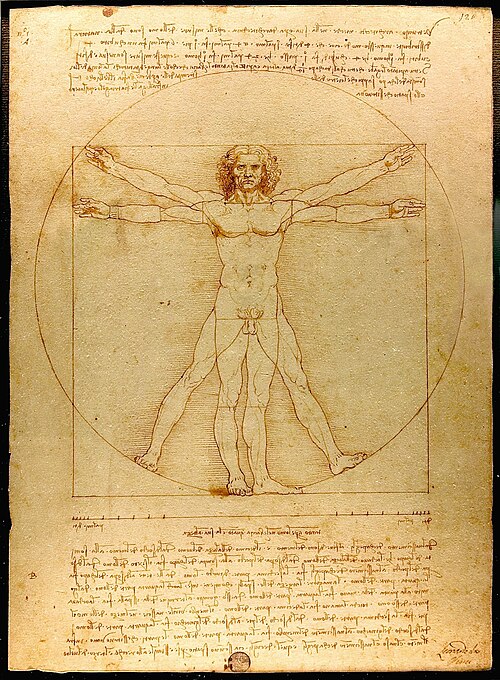
Leonardo da Vinci’s Vitruvian Man, about 1490, a symbol of the Renaissance.
Quick facts
The Renaissance at a glance
- Dates: About 1300 to 1600; at its height from about 1400 to 1550
- Began in: Florence and other city-states of northern Italy
- The word: French for “rebirth”: the rebirth of the learning of ancient Greece and Rome
- Big idea: Humanism: the study of ancient texts and a new focus on human talent and life on Earth
- Famous artists: Leonardo da Vinci, Michelangelo, Raphael, Botticelli, Titian, Dürer and van Eyck
- Key invention: Johannes Gutenberg’s printing press with movable metal type, about 1450
- Great patrons: The Medici family of Florence, the popes in Rome, and kings and dukes across Europe
- What followed: The Protestant Reformation, the Age of Exploration and the Scientific Revolution
The big picture in 30 seconds
Why the Renaissance matters
- It turned Europe from the Middle Ages toward the modern world.
- Its art is still among the most famous in the world.
- Printing put books in millions of hands.
- Its questions led to modern science.
About 300 years
from Petrarch to Galileo
About 20 million
books printed in Europe by 1500
About 60,000
people in Florence in 1450
Rebirth
How did the Renaissance begin?
In the 1300s, after the terrible years of the Black Death, Italian scholars such as Petrarch began hunting for the lost books of ancient Greece and Rome. They called the centuries since the fall of Rome a “dark age” and wanted to bring the wisdom of the ancient world back to life. Their way of learning, built on history, poetry, speech and ethics, became known as humanism.
Why Italy?
Italy was the richest and most city-filled part of Europe. Florence, Venice, Milan and Rome grew wealthy from trade and banking, and their rulers and merchants competed to show off by paying artists and scholars. Roman ruins stood all around them as a daily reminder of the past.
When the Ottoman Turks captured Constantinople in 1453, Greek scholars fled west with their books, adding fuel to the new learning.
Spreading north
After 1450 the printing press spread Renaissance ideas to France, Germany, the Low Countries and England, where they inspired painters like Albrecht Dürer, thinkers like Erasmus and writers like Shakespeare.

Where does the word come from?
“Renaissance” is French for rebirth. Historians in the 1800s made it the name of the age; the Italian artist-writer Giorgio Vasari had already used the Italian word rinascita in 1550.
Big ideas
What made the Renaissance new
Renaissance people did not throw away their Christian faith, but they looked at the world in fresh ways.
Humanism
Scholars studied Greek and Latin classics to learn how to live well, speak well and serve their cities.
Realism and perspective
Artists used straight-line perspective, light and shadow, and the study of anatomy to make paintings look real and three-dimensional.
The individual
Artists signed their work and became famous. The ideal “Renaissance man” was skilled in many fields at once.
Patrons and money
Bankers, popes and princes paid for paintings, statues, churches and libraries to show their wealth and piety.
Cheap printed books spread ideas faster than ever, from the Bible to science and travel stories.
Questioning
Trust in old authorities weakened, opening the way to the Reformation and the Scientific Revolution.
The map
Renaissance Europe
The Renaissance began in the wealthy city-states of northern Italy, above all Florence, and reached Rome when the popes hired the greatest artists of the day. From Mainz in Germany, printing spread across Europe in a few decades.
Red dots mark the stories with their own pages: Florence of the Medici, Gutenberg’s Mainz, Leonardo’s Milan, Michelangelo’s Rome, Luther’s Wittenberg, and Padua, where Galileo first turned a telescope to the sky.
The key stories
The people and events that shaped the Renaissance
Each of these has its own page, with a red “Read the full story” button.
The Medici Family and Florence
A banking family ruled Florence and paid for the art of Botticelli and Michelangelo.
Gutenberg and the Printing Press
Around 1450 a German goldsmith invented a way to print books quickly and cheaply.
Leonardo da Vinci
Painter of the Mona Lisa and The Last Supper, and an inventor centuries ahead of his time.
Michelangelo
Sculptor of David and painter of the Sistine Chapel ceiling.
The Protestant Reformation
Martin Luther challenged the Catholic Church in 1517 and split Western Christianity.
The Scientific Revolution
Copernicus, Galileo and Newton showed that the Earth goes around the Sun.
Key people
Famous people of the Renaissance

Lorenzo de’ Medici
1449–1492
Ruler of Florence
“Lorenzo the Magnificent,” the greatest patron of Renaissance art.

Johannes Gutenberg
about 1400–1468
Inventor and printer
Invented printing with movable metal type in Mainz.

Leonardo da Vinci
1452–1519
Artist and inventor
Painter of the Mona Lisa; filled notebooks with inventions.

Michelangelo
1475–1564
Sculptor, painter, architect
Carved David and painted the Sistine Chapel ceiling.
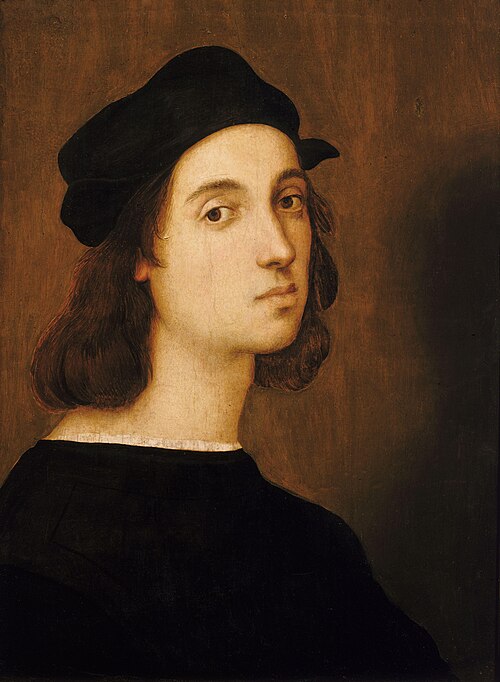
Raphael
1483–1520
Painter
Painted The School of Athens in the Vatican.

Erasmus
about 1466–1536
Humanist scholar
The most famous scholar in Europe; published a new Greek New Testament.


Galileo Galilei
1564–1642
Scientist
Used the telescope to prove Copernicus right.

Renaissance art
How Renaissance art changed painting
Medieval paintings were often flat, with gold backgrounds and stiff saints. Renaissance artists studied nature, the human body and ancient statues. In Florence, the architect Brunelleschi worked out the rules of linear perspective around 1415, letting painters create the illusion of deep space.
Raphael’s School of Athens shows it all: real-looking people, a deep arched hall drawn in perfect perspective, and the great thinkers of ancient Greece honored as heroes.
- Perspective: lines that meet at a vanishing point
- Oil paint, perfected in Flanders by Jan van Eyck
- Anatomy studied from life and from dissection
- Classical subjects from Greek and Roman myth
Why it mattered
The legacy of the Renaissance
The Renaissance changed how Europeans saw the world and themselves. Its artists created works that millions still travel to see, from the Mona Lisa in Paris to David in Florence. Its printed books made reading common and helped build modern languages and nations.
Renaissance curiosity also led straight to the great changes that followed: the Protestant Reformation, the voyages of the Age of Exploration and the Scientific Revolution. The idea that a well-rounded person should study history, literature and the arts lives on today as the liberal arts.
1350s
Petrarch’s humanism takes hold
About 1450
Gutenberg’s printing press
1517
Luther’s 95 Theses
1543
Copernicus puts the Sun at the center
Timeline
The Renaissance, about 1300–1600
- About 1305 Giotto paints the Arena Chapel in Padua with life-like figures.
- 1347–1351 The Black Death kills about a third of Europe’s people.
- 1350s Petrarch and Boccaccio lead the revival of ancient learning.
- 1418–1436 Brunelleschi builds the great dome of Florence Cathedral.
- 1434 Cosimo de’ Medici becomes the leading man of Florence.
- About 1450 Johannes Gutenberg begins printing with movable type in Mainz.
- 1453 The Ottoman Turks capture Constantinople.
- 1469 Lorenzo the Magnificent takes charge in Florence.
- About 1485 Botticelli paints The Birth of Venus.
- 1492 Columbus crosses the Atlantic; Lorenzo de’ Medici dies.
- 1495–1498 Leonardo paints The Last Supper in Milan.
- 1501–1504 Michelangelo carves David.
- About 1503–1519 Leonardo works on the Mona Lisa.
- 1508–1512 Michelangelo paints the Sistine Chapel ceiling.
- 1517 Martin Luther posts his 95 Theses.
- 1527 Imperial troops sack Rome.
- 1543 Copernicus publishes his Sun-centered universe.
- 1564 Michelangelo dies; Galileo and Shakespeare are born.
- 1610 Galileo publishes what he saw through his telescope.
“A man can do all things if he will.”
Leon Battista Alberti
Renaissance architect and writer (1404–1472), as quoted by his biographer
The bigger story
All of World History
See how the Renaissance fits into the bigger story, from Ancient Greece and Rome to Medieval Europe, the Age of Exploration and beyond.
Go deeper
Sources and further reading
- The Renaissance: A Short History, by Paul Johnson (2000)
- The Swerve: How the World Became Modern, by Stephen Greenblatt (2011)
- The Civilization of the Renaissance in Italy, by Jacob Burckhardt (1860)
- More recommended books