
Home › US History › Revolutionary War
US History · 1775–1783
The American Revolutionary War
Thirteen British colonies took up arms against the most powerful empire on earth, declared themselves a new nation and, after eight hard years, won their independence. Start here for the causes, the battles, the people, the weapons and the ships of the war that created the United States.

Washington Crossing the Delaware, Emanuel Leutze, 1851 (Metropolitan Museum of Art)
Quick facts
The Revolutionary War at a glance
| When | April 19, 1775 (Lexington and Concord) to September 3, 1783 (Treaty of Paris); major fighting ended at Yorktown in October 1781 | |
| Where | The Thirteen Colonies from Massachusetts to Georgia, plus Canada, the frontier, the Caribbean and the seas around Europe | |
| American side | The Continental Army and state militias, joined by France (1778), Spain (1779) and the Dutch Republic (1780) | |
| British side | Great Britain and its army and navy, about 30,000 hired German troops (“Hessians”), Loyalists and many Native American nations | |
| Commanders | George Washington (Continental Army) vs. Gage, Howe, Clinton and Cornwallis for Britain | |
| Independence | Declared July 4, 1776; recognized by Britain in the Treaty of Paris, 1783 | |
| American dead | About 25,000 Patriot soldiers and sailors, most from disease and in British prison ships | |
| Result | American victory; the United States becomes an independent nation |
The big picture in 30 seconds
Why the Revolution matters
- It created the United States and its ideas of liberty, equality and government by consent.
- It was the first successful colonial revolt against a European empire.
- It made George Washington the “Father of His Country” and set the stage for the Constitution.
- Its ideals inspired the French Revolution and independence movements around the world.
8 years
of war, 1775–1783
13
colonies became states
About 230,000
served in the Continental Army
About 25,000
American military deaths
How it started
The road to revolution
After winning the French and Indian War in 1763, Britain was deep in debt and decided the colonies should help pay for their own defense. Colonists, who had no members in Parliament, saw the new taxes as a threat to their rights as Englishmen. Their slogan said it all: “No taxation without representation.”
1765
The Stamp Act
A tax on newspapers, legal papers and even playing cards. Protests, boycotts and the Stamp Act Congress forced Parliament to repeal it in 1766.
1767
Townshend Acts
Duties on glass, lead, paint, paper and tea. Boston merchants boycotted British goods and redcoats were sent to occupy the city.
1773
The Boston Tea Party
On December 16, Sons of Liberty dressed as Mohawks dumped 342 chests of East India Company tea into Boston Harbor.
1774
Intolerable Acts
Parliament closed Boston’s port and curbed self-government in Massachusetts. Twelve colonies sent delegates to the First Continental Congress.
Blood in the streets
The Boston Massacre and the Tea Party
On the night of March 5, 1770, a crowd taunted and threw snowballs at British soldiers outside the Custom House in Boston. The soldiers fired, killing five colonists, including Crispus Attucks, a sailor of African and Native American descent. Paul Revere’s famous engraving of “the Bloody Massacre” spread the news across the colonies. John Adams, believing every man deserved a fair trial, defended the soldiers in court, and most were acquitted.
Three years later the Tea Act gave the East India Company a monopoly on tea sales in America. When tea ships arrived in Boston, Samuel Adams and the Sons of Liberty refused to let the tea land. Parliament’s harsh response, the “Intolerable” or Coercive Acts, united the colonies against Britain. By the spring of 1775, Massachusetts militias were drilling and gathering gunpowder, and General Thomas Gage was ordered to stop them.


A new nation
“All men are created equal”
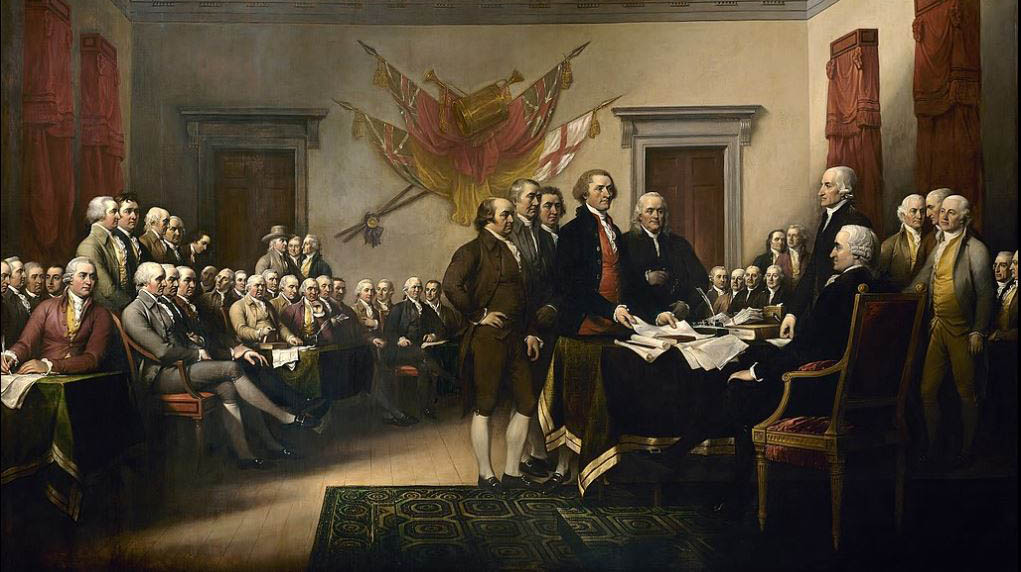
When fighting broke out in 1775, most colonists still hoped to make peace with King George III. That changed in 1776. Thomas Paine’s pamphlet Common Sense, published in January, sold well over 100,000 copies and argued plainly for independence. On July 2, 1776, the Second Continental Congress voted to break with Britain, and on July 4 it adopted the Declaration of Independence, written mainly by Thomas Jefferson with help from John Adams and Benjamin Franklin.
The Declaration listed the colonists’ complaints against the king and stated the idea at the heart of the new nation: that governments get their power from the consent of the governed. Signing it was an act of treason against the Crown. As Franklin is said to have joked, “We must all hang together, or most assuredly we shall all hang separately.”
Who fought and where
A war across a continent
The war began in New England, moved to New York, New Jersey and Pennsylvania in 1776–1778, and then shifted to the South, where Britain hoped thousands of Loyalists would rise to help. It ended in Virginia, at Yorktown, in October 1781. There was also fighting in Canada, on the western frontier, in the Caribbean and at sea.
Not every colonist was a Patriot. Historians estimate that perhaps 15 to 20 percent of white colonists stayed loyal to the Crown, and many more tried to stay out of it. Thousands of enslaved people escaped to the British, who promised them freedom, while about 5,000 Black soldiers served the Patriot cause.
- ■Continental Army (created June 14, 1775)
- ■State militias and minutemen
- ■Continental Navy, Marines and privateers
- ■France (treaty of alliance, February 1778)
- ■Spain (1779) and the Dutch Republic (1780)
- ■Oneida and Tuscarora nations
- ■British Army (“redcoats”) and Royal Navy
- ■About 30,000 German soldiers from Hesse-Kassel and other states
- ■Loyalist regiments raised in America
- ■Most of the Iroquois nations, Cherokee and others
- ■Formerly enslaved Black Loyalists
Simplified map. Red dots mark battles with their own pages.
Key battles
The battles that won independence
Each card opens a full page with quick facts, a map, the story of the fighting, the commanders and why it mattered.

The “shot heard round the world.” Minutemen fought redcoats on Lexington Green and at Concord’s North Bridge, and the war began.

The British took the hill, but only after losing more than 1,000 men. Americans learned they could stand up to the redcoats.

Washington crossed the icy Delaware on Christmas night and won two quick victories that saved the Revolution.

A whole British army surrendered. The victory convinced France to enter the war on the American side.

Trapped by a French fleet and an allied army, Cornwallis surrendered. Britain soon gave up the fight.

Britain captured Savannah and Charleston, but Kings Mountain, Cowpens and Guilford Courthouse wore Cornwallis down. Full page coming soon.
The hardest winter
Valley Forge, 1777–1778
After losing Philadelphia to General Howe in the fall of 1777, Washington marched about 12,000 ragged soldiers to winter camp at Valley Forge, Pennsylvania, on December 19. Many had no shoes or blankets. They built some 1,500 log huts, but food and clothing ran short, and typhus, smallpox and other diseases killed about 2,000 men by spring.
Yet the army came out of Valley Forge stronger than it went in. A Prussian volunteer, Baron Friedrich von Steuben, drilled the troops in marching, loading and bayonet fighting, and wrote the army’s first drill manual. Washington had smallpox inoculations given to the army. In May 1778 came the best news of all: France had signed a treaty of alliance. A month later the retrained Continentals fought the British to a standstill at Monmouth, New Jersey.

Help from abroad
France joins the fight
Benjamin Franklin arrived in Paris in December 1776 and charmed the French court. France, still smarting from its defeat by Britain in 1763, sent secret shipments of muskets, gunpowder and money. After the American victory at Saratoga, King Louis XVI signed a treaty of alliance on February 6, 1778, and France went to war with Britain.
French help changed the war. French money paid American soldiers, French muskets armed them, and in 1781 a French army under the Comte de Rochambeau and a French fleet under the Comte de Grasse made the victory at Yorktown possible. Spain joined the war against Britain in 1779 and the Dutch in 1780, turning the American rebellion into a world war.
Key people
Patriots, allies and redcoats
Generals and kings, spies and sailors. Meet many more on the full Key People page.

Held the army together for eight years, through defeat, hunger and mutiny, and led it to victory at Yorktown.

A Rhode Island Quaker turned soldier. His southern campaign of 1781 wore down Cornwallis.

A Boston bookseller who hauled the cannon of Fort Ticonderoga to Boston and later became the first Secretary of War.

Arrived at 19, served without pay, became like a son to Washington and helped trap Cornwallis.

Served four years on Washington’s staff, then led the night attack on Redoubt 10 at Yorktown.

A hero at Quebec, Valcour Island and Saratoga who, in 1780, plotted to hand West Point to the British.

Britain’s most aggressive commander. His surrender at Yorktown in 1781 effectively ended the war.

Insisted the colonies be kept in the empire by force. The Declaration called him a tyrant.
Weapons and ships
Muskets, cannon and frigates
The Revolution was fought with flintlock muskets and bayonets, long rifles, smoothbore cannon and wooden sailing ships. America had to build an army and a navy almost from nothing, against the greatest navy in the world.

How a musket was loaded, why the long rifle scared British officers, and how Henry Knox’s cannon drove the British out of Boston.

John Paul Jones, the Battle of the Capes that doomed Cornwallis, and the privateers who captured hundreds of British ships.
The human cost
The price of independence
For its size, the Revolution was one of the deadliest wars in American history. Disease killed far more soldiers than bullets did: smallpox, typhus and dysentery swept through crowded camps. The worst place of all was a British prison ship. On hulks such as HMS Jersey in New York harbor, thousands of captured Americans died of starvation and disease.
Civilians suffered too. Towns were burned, families were split between Patriots and Loyalists, and after the war about 60,000 Loyalists left the United States for Canada, Britain and the Caribbean.
“These are the times that try men’s souls.”
Thomas Paine
The American Crisis, December 23, 1776, read aloud to Washington’s troops before Trenton
Year by year
Revolutionary War timeline
After the war
Peace and a new nation
News of Yorktown brought down the British government of Lord North. In Paris, American diplomats John Adams, Benjamin Franklin and John Jay negotiated a peace that gave the United States more than independence: the Treaty of Paris, signed September 3, 1783, set the new nation’s western border at the Mississippi River. The last British troops left New York City on November 25, 1783.
Then Washington did something that amazed the world. Instead of seizing power, he resigned as commander and went home to farm. Winning the peace proved nearly as hard as winning the war. The weak Articles of Confederation led, in 1787, to the Constitution, and in 1789 Washington became the first President.

The bigger story
Revolution and Founding, 1770–1819
Our U.S. History era page covers the road to independence, the Constitution and the first presidents.
Go deeper
Books and sources
- 1776, by David McCullough (2005)
- Washington’s Crossing, by David Hackett Fischer (2004)
- The Glorious Cause, by Robert Middlekauff (1982)
- Paul Revere’s Ride, by David Hackett Fischer (1994)
- More recommended books