
Home › US History › Revolutionary War › Lexington & Concord
Revolutionary War · Massachusetts · April 19, 1775
The Battles of Lexington and Concord
Before dawn on April 19, 1775, about 700 British soldiers marched out of Boston to seize the militia’s gunpowder and cannon in Concord. Warned by Paul Revere and other riders, farmers and townsmen were waiting. Shots on Lexington Green and at Concord’s North Bridge began the American Revolution, and by nightfall the redcoats had been chased all the way back to Boston.

The Battle of Lexington, April 19, 1775, as pictured in a 19th-century print
Quick facts
Lexington and Concord at a glance
| When | April 19, 1775, from about 5 a.m. at Lexington to after sunset at Charlestown | |
| Where | Lexington, Concord, Lincoln and Menotomy (now Arlington), along the road west of Boston, Massachusetts | |
| Sides | Massachusetts militia and minutemen vs. British regulars | |
| American leaders | Capt. John Parker (Lexington); Col. James Barrett and Maj. John Buttrick (Concord); Gen. William Heath | |
| British leaders | Lt. Col. Francis Smith and Maj. John Pitcairn; Brig. Gen. Lord Hugh Percy led the relief column | |
| Troops | About 700 British at first, 1,700 after Percy arrived; about 4,000 militiamen fought during the day | |
| Casualties | British 73 killed, 174 wounded, 53 missing; Americans 49 killed, 39 wounded, 5 missing | |
| Result | American victory; the British retreat to Boston and the siege of Boston begins |
The big picture in 30 seconds
Why Lexington and Concord matter
- They were the first battles of the American Revolutionary War.
- Ordinary farmers and tradesmen proved they would fight the king’s soldiers.
- Within days some 15,000 New England militiamen surrounded Boston.
- News of the fighting pushed the colonies toward the Continental Congress, an army and, in 1776, independence.
About 700
redcoats on the march
About 4,000
militiamen who answered the alarm
About 40 miles
marched by the British in one day
About 300
British killed, wounded or missing
The road to war
Powder, cannon and spies
By the spring of 1775, Massachusetts was close to open revolt. Its colonial assembly had been shut down, so Patriots ran their own Provincial Congress and trained militia companies, including “minutemen” who could be ready to fight at a minute’s notice. They hid muskets, gunpowder and cannon in the town of Concord, about 18 miles from Boston.
General Thomas Gage, the British commander and royal governor, received orders from London to act. He planned a secret night march to destroy the supplies in Concord. But Boston was full of Patriot spies, and the secret did not last.
“One if by land, two if by sea”
On the night of April 18, Dr. Joseph Warren sent Paul Revere and William Dawes riding to warn Samuel Adams and John Hancock in Lexington and to alarm the countryside. Two lanterns hung in the steeple of Boston’s Old North Church signaled that the troops were crossing the Charles River by boat. Revere reached Lexington around midnight. Riding on toward Concord with Dawes and Dr. Samuel Prescott, he was captured by a British patrol near Lincoln, but Prescott escaped and carried the warning to Concord. Church bells, drums and alarm guns spread the news from town to town.

Where it happened
From Boston to Concord and back
The British crossed the Charles River by boat to Cambridge and marched west through Menotomy and Lexington to Concord. On the way back, militia fired from behind stone walls, trees and houses along the road. At Lexington Percy’s relief column of about 1,000 men with two cannon saved the exhausted troops, and the whole force fought its way through Menotomy to safety at Charlestown.
Simplified map; Boston was then almost an island.
How the battle unfolded
A long, bloody day
The fighting started with a few dozen men on a village green and grew into a running battle along nearly 20 miles of road.
About 77 militiamen under Capt. John Parker face the British advance guard. Someone fires, no one knows who. A British volley and bayonet charge kill eight militiamen and wound ten.
The British search Concord but find little; most supplies have been moved. About 400 militiamen advance on the North Bridge. The British fire, the Americans fire back, and the regulars fall back.
The march back turns into a nightmare. At Meriam’s Corner and the “Bloody Angle” in Lincoln, militia fire from cover, then run ahead to fire again.
Lord Percy’s brigade meets the retreating troops at Lexington. The fiercest fighting of the day comes in Menotomy, where house-to-house combat leaves dozens dead on both sides.
“The shot heard round the world”
At the North Bridge
In Concord, militiamen gathering on a hill above the North Bridge saw smoke rising from the town and feared the British were burning it. (The soldiers were actually burning gun carriages they had found.) Colonel James Barrett ordered his men forward. As they marched to the bridge, the British light infantry fired. Captain Isaac Davis of Acton and private Abner Hosmer fell dead. Major John Buttrick shouted, “Fire, for God’s sake, fellow soldiers, fire!”
The militia volley killed or wounded about a dozen redcoats, and the British broke and ran back to town. It was the first time Americans had been ordered to fire on the king’s troops. Sixty-two years later Ralph Waldo Emerson’s Concord Hymn called it “the shot heard round the world.”


Commanders and soldiers
Who was there

Silversmith and messenger for the Sons of Liberty. His ride warned Adams and Hancock, though he never reached Concord.

Boston’s top Patriot left in the city. He sent the riders out and fought in the battle himself. Killed at Bunker Hill two months later.

Royal governor of Massachusetts who ordered the raid on Concord. Recalled to Britain after Bunker Hill.
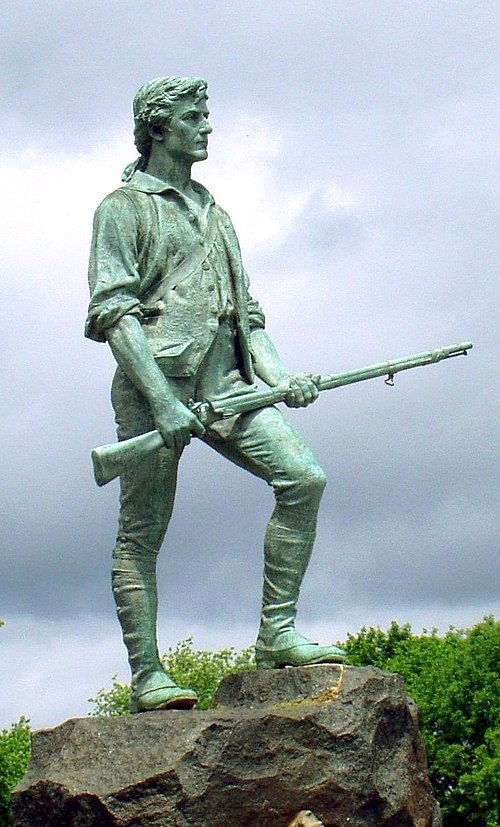
A veteran of the French and Indian War who led the men on Lexington Green. He died of illness that September. His statue (above) stands on the Green.
Why it mattered
The war begins
When the sun rose on April 19, the colonies were still part of the British Empire. By nightfall they were at war with it. Militia from all over New England poured toward Boston and penned the British army inside the city. Within two months the Second Continental Congress had created the Continental Army and chosen George Washington to lead it.
“Stand your ground; don’t fire unless fired upon, but if they mean to have a war, let it begin here.”
Attributed to Capt. John Parker
On Lexington Green, April 19, 1775, as remembered by his grandson decades later
The bigger story
Revolution and Founding, 1770–1819
Our U.S. History era page puts the war in context: the road to independence, the Constitution and the first presidents.
Go deeper
Books and sources
- Paul Revere’s Ride, by David Hackett Fischer (1994)
- 1775: A Good Year for Revolution, by Kevin Phillips (2012)
- The Glorious Cause, by Robert Middlekauff (1982)
- More recommended books