
Home › People › US Presidents › Franklin D. Roosevelt
32nd President · 1933–1945 · Democrat
Franklin D. Roosevelt: The New Deal and World War II
Franklin D. Roosevelt was a wealthy New Yorker who was paralyzed by polio at 39 and still became the only president elected four times. He led the country out of the depths of the Great Depression with the New Deal, then led it through World War II, dying just weeks before victory in Europe.
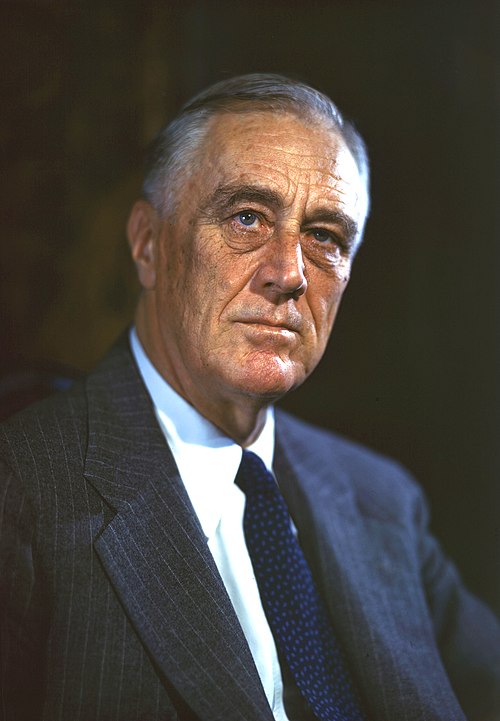
Franklin D. Roosevelt, 1944
Quick facts
Franklin D. Roosevelt at a glance
| Born | January 30, 1882, in Hyde Park, New York | |
| Died | April 12, 1945, in Warm Springs, Georgia, aged 63, while still in office | |
| President | 32nd, from March 4, 1933, to April 12, 1945 (elected four times) | |
| Vice presidents | John Nance Garner (1933–1941), Henry A. Wallace (1941–1945), Harry S. Truman (1945) | |
| Party | Democratic | |
| Education | Groton School; Harvard College, 1903; Columbia Law School | |
| Profession | Lawyer | |
| Before the White House | New York state senator, Assistant Secretary of the Navy (1913–1920), governor of New York (1929–1932) | |
| Wife | Anna Eleanor Roosevelt, a distant cousin, married March 17, 1905 | |
| Children | Anna, James, Franklin (died as a baby), Elliott, Franklin Jr. and John | |
| Elections | Won in 1932, 1936, 1940 and 1944 | |
| Buried | Rose Garden of his home, Springwood, in Hyde Park, New York |
The big picture in 30 seconds
Why he matters
- Restored confidence in the banks within days of taking office in 1933 and launched the New Deal.
- Created Social Security, the minimum wage, bank deposit insurance and dozens of other programs still with us.
- Spoke directly to Americans in his radio “fireside chats.”
- Built the “arsenal of democracy” and led the Allies in World War II with Churchill and Stalin.
- Planned the United Nations, though he died before it was founded.
- Ordered the internment of about 120,000 Japanese Americans in 1942, one of the gravest wrongs of his presidency.
4 times
elected president, the only one ever; the 22nd Amendment now limits presidents to two terms
12 years
in office, longer than any other president
About 30
fireside chats on the radio, from 1933 to 1944
15
major laws passed in his first hundred days
Early years
A Hudson Valley aristocrat
Franklin Delano Roosevelt was born on January 30, 1882, at Springwood, his family’s estate above the Hudson River in Hyde Park, New York. He was the only child of James Roosevelt, a wealthy businessman, and Sara Delano Roosevelt, who doted on him all her life. Tutored at home and taken to Europe almost every year, he went to Groton School and Harvard, where he edited the student newspaper.
He idolized his fifth cousin Theodore Roosevelt, who became president while Franklin was at Harvard. In 1905 he married Theodore’s niece, Eleanor, and the president gave the bride away.
Rising star
After Columbia Law School and a few years at a Wall Street firm, Roosevelt won a seat in the New York State Senate in 1910. Woodrow Wilson named him Assistant Secretary of the Navy, the same post his cousin had held, and he served through World War I. In 1920 he ran for vice president with James M. Cox, and lost to Harding and Coolidge.

Polio
“He was never the same”
In August 1921, at the family’s summer home on Campobello Island in Canada, the 39-year-old Roosevelt fell ill with a fever and lost the use of his legs. Doctors diagnosed polio. He never walked again without help, but he spent years exercising, and with heavy steel leg braces, a cane and a son’s arm he learned to appear to walk short distances in public.
In 1926 he bought a run-down resort in Warm Springs, Georgia, whose warm mineral water eased his legs, and turned it into a treatment center for other polio patients. Eleanor and his adviser Louis Howe kept his name alive in politics while he recovered.
Governor of New York
In 1928 Roosevelt was narrowly elected governor of New York. When the Depression struck, he set up the first state relief agency in the nation, run by a social worker named Harry Hopkins. In 1932 he flew to Chicago to accept the Democratic nomination in person, the first candidate to do so, and promised “a new deal for the American people.”
Election of 1932
“A new deal”
Electoral votes: 531 electors; 266 needed to win. Popular vote: Roosevelt 22.8 million (57.4%), Hoover 15.8 million (39.6%)
Election of 1936
The biggest landslide in a century
Electoral votes: 531 electors; 266 needed to win. Popular vote: Roosevelt 27.8 million (60.8%), Landon 16.7 million (36.5%)
Election of 1940
Breaking the two-term tradition
Electoral votes: 531 electors; 266 needed to win. Popular vote: Roosevelt 27.3 million (54.7%), Willkie 22.3 million (44.8%)
Election of 1944
A fourth term in wartime
Electoral votes: 531 electors; 266 needed to win. Popular vote: Roosevelt 25.6 million (53.4%), Dewey 22.0 million (45.9%)
The New Deal, 1933–1939
“Action, and action now”
When Roosevelt took office on March 4, 1933, a quarter of workers had no job and banks in most states had closed. He declared a national bank holiday, and Congress passed his emergency banking law in a single day. Eight days after the inauguration, he explained the crisis to the nation in his first fireside chat, and when banks reopened, people lined up to put money back in. In his first hundred days he signed 15 major laws, and more followed in the “Second New Deal” of 1935.
1933
Saving the banks
The Emergency Banking Act reopened sound banks under federal watch, and the Glass-Steagall Act created the FDIC to insure deposits. Bank runs, a regular nightmare for a century, almost disappeared.
1933–1943
Jobs for millions
The Civilian Conservation Corps put three million young men to work planting trees and building parks. The Works Progress Administration (1935) employed 8.5 million people building roads, schools and bridges, and even paid artists and writers.
1933 and 1935
Power to the people
The Tennessee Valley Authority built dams that tamed floods and brought electricity to one of the poorest regions. The Rural Electrification Administration wired farms across America; in 1935 only about one farm in ten had power.
August 14, 1935
Social Security
The Social Security Act created old-age pensions, unemployment insurance and aid for poor children and the disabled. Roosevelt called it the cornerstone of his administration.
1935 and 1938
Rights for workers
The Wagner Act guaranteed workers’ right to form unions and bargain, and union membership soared. The Fair Labor Standards Act of 1938 set the first national minimum wage (25 cents an hour), a 40-hour week and limits on child labor.
1937
Defeat in court
After the Supreme Court struck down key New Deal laws, Roosevelt proposed adding up to six new justices. The “court-packing” plan was seen as a power grab, and even his own party defeated it.
More on our site
The Depression era
Recovery
Unemployment under Roosevelt
The New Deal cut unemployment by more than a third by 1937, but a new recession in 1937–38 pushed it back up. Only the huge buildup for World War II brought full employment.
Estimates by economist Stanley Lebergott (Census Bureau, Historical Statistics of the United States). These figures count workers on emergency relief jobs such as the WPA as unemployed; counting them as employed lowers the 1930s rates by several points. War years shown in red.
“So, first of all, let me assert my firm belief that the only thing we have to fear is fear itself.”
Franklin D. Roosevelt, first inaugural address
March 4, 1933
The road to war
The arsenal of democracy
Most Americans wanted to stay out of the wars in Europe and Asia, and Congress passed Neutrality Acts in the 1930s. Roosevelt worried about Nazi Germany and Japan but moved carefully. After France fell in June 1940, he traded 50 old destroyers to Britain for bases, and signed the first peacetime draft in American history.
In December 1940 he told the nation it must become “the great arsenal of democracy.” The Lend-Lease Act of March 1941 let him send weapons to Britain, and later the Soviet Union and China, with payment put off. In August he met Winston Churchill on warships off Newfoundland, and they issued the Atlantic Charter, a statement of their goals for the world after the war.
“A date which will live in infamy”
On December 7, 1941, Japan attacked the US Pacific Fleet at Pearl Harbor, killing more than 2,400 Americans. The next day Roosevelt asked Congress to declare war, and it did within the hour. Germany and Italy declared war on the United States on December 11.

World War II, 1941–1945
Commander in chief
Roosevelt and Churchill agreed to defeat Germany first while holding the line against Japan. American factories turned out an astonishing flood of planes, tanks and ships, and more than 16 million Americans served in uniform. Roosevelt chose the generals, approved the atomic bomb project and met the other Allied leaders to plan the war and the peace.
1942–1945
Victory through production
In 1942 Roosevelt set goals for 60,000 planes and 45,000 tanks that most thought impossible. By 1944 American plants built a plane about every five minutes. Millions of women, like “Rosie the Riveter,” went to work in war plants.
February 19, 1942
Japanese American incarceration
Executive Order 9066 led to the forced removal of about 120,000 people of Japanese ancestry, most of them US citizens, to remote camps. In 1988 Congress formally apologized and paid reparations to survivors.
1943–1945
Meeting the Big Three
Roosevelt met Churchill at Casablanca and Quebec, and both men met Joseph Stalin at Tehran in 1943 and Yalta in February 1945. There they planned D-Day, the occupation of Germany and the United Nations.
June 22, 1944
The GI Bill
The Servicemen’s Readjustment Act paid for college and job training for millions of veterans and helped them buy homes, building the postwar middle class. It largely left out Black veterans in practice, especially in the South.

April 12, 1945
Death at Warm Springs
Roosevelt came back from Yalta exhausted. He went to rest at his cottage in Warm Springs, Georgia, known as the Little White House. On the afternoon of April 12, 1945, while sitting for a portrait, he said, “I have a terrific pain in the back of my head,” and collapsed. He died within hours of a massive stroke, aged 63.
The nation was stunned. Crowds lined the tracks as his funeral train carried him to Washington and then to Hyde Park, where he was buried in his mother’s rose garden. Germany surrendered less than four weeks later, on May 8, and the United Nations held its founding conference in San Francisco that spring.
How he is remembered
Historians almost always rank Roosevelt among the three greatest presidents, with Washington and Lincoln, for leading the nation through its worst depression and its greatest war. Critics fault the New Deal’s growth of federal power, its failure to end the Depression on its own, his attempt to pack the Supreme Court and, above all, the internment of Japanese Americans. His long tenure led to the 22nd Amendment, ratified in 1951.

His life at a glance
Life timeline
People
Who's who in Roosevelt's story


Visit
Hyde Park and Warm Springs
At Hyde Park, New York, you can tour Springwood, Roosevelt’s lifelong home, see his grave in the rose garden, and visit the Franklin D. Roosevelt Presidential Library and Museum, the first presidential library. Eleanor’s cottage, Val-Kill, is nearby. In Georgia, the Little White House at Warm Springs is kept as it was on the day he died, with his unfinished portrait. The FDR Memorial stands beside the Tidal Basin in Washington.