
Home › World History › World War II › US Command
Who ran America's war, 1941–1945 · Commanders
The US High Command in World War II
Winning a war fought on six continents and every ocean took more than generals in the field. In Washington, a small group of leaders under President Roosevelt set the strategy, built the armies and fleets, and chose the commanders. This page explains who they were and how the American command system worked.
Quick facts
The high command at a glance
| Commander in chief | President Franklin D. Roosevelt, until his death on April 12, 1945; then President Harry S. Truman | |
| Joint Chiefs of Staff | Formed in February 1942: Adm. William Leahy (presiding from July 1942), Gen. George Marshall (Army), Adm. Ernest King (Navy) and Gen. Hap Arnold (Army Air Forces) | |
| War Department | Secretary of War Henry L. Stimson, with Robert Patterson, John McCloy and Robert Lovett as his top deputies | |
| Navy Department | Secretary of the Navy Frank Knox, until his death in April 1944; then James Forrestal | |
| Combined Chiefs of Staff | The American and British chiefs together, set up in Washington in early 1942 to direct the joint war effort | |
| Headquarters | The Pentagon, the world's largest office building, built in just 16 months and finished in January 1943 | |
| Theater commanders | Eisenhower in Europe, MacArthur in the Southwest Pacific, Nimitz in the Pacific Ocean Areas, Stilwell in China-Burma-India |
The big picture in 30 seconds
Why it matters
- The Joint Chiefs gave the United States, for the first time, a single body to plan the whole war across the Army, Navy and air forces.
- Working with the British as the Combined Chiefs, they made the closest military alliance in history.
- Their decisions, from Germany First to D-Day to the island-hopping drive, shaped how and where the war was fought.
- The system they built became the model for the Department of Defense and the permanent Joint Chiefs after the war.
16 million
Americans served in uniform
4
members of the Joint Chiefs of Staff
7
officers promoted to five stars in December 1944
6
major theaters of war
How it worked
The chain of command
The President set the goals. The Joint Chiefs turned them into plans and orders for the theater commanders, and met with the British chiefs to agree on Allied strategy. The War and Navy Departments raised, equipped and supplied the forces.
Behind the chart
Reorganizing for war
When Japan attacked Pearl Harbor, the United States had no unified high command at all. The Army and Navy planned separately and often competed for men and money. The British arrived in Washington in December 1941 with a well-practiced Chiefs of Staff Committee, and the Americans quickly formed the Joint Chiefs to match it. They first met as a group on February 9, 1942.
The Marshall reorganization
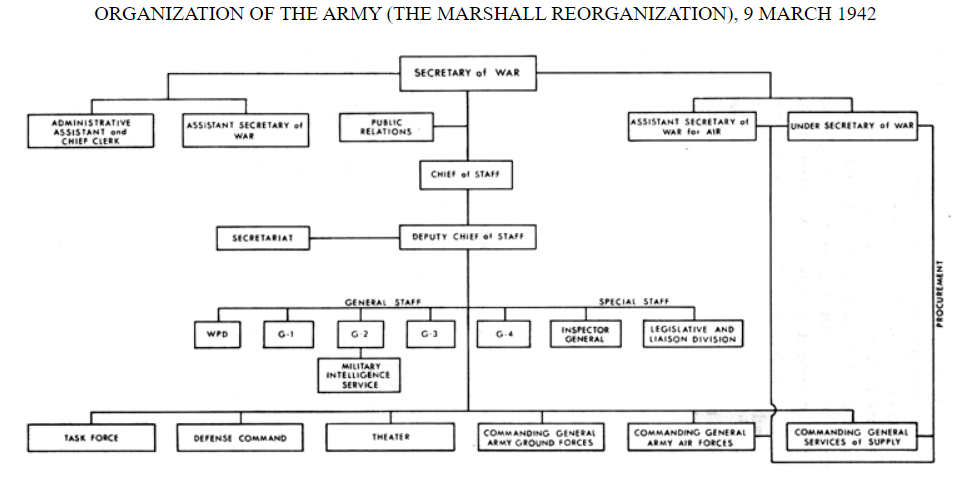
On March 9, 1942, General Marshall reorganized the entire War Department. He cut the number of officers who reported directly to him from dozens to a handful, and split the Army into three great commands: Army Ground Forces to train the troops, Army Air Forces to build air power, and the Services of Supply to equip and feed them. A small Operations Division, at first led by Dwight Eisenhower, became his command post for running the war worldwide.
The Combined Chiefs
Every major Allied decision went through the Combined Chiefs of Staff, the American and British chiefs sitting together. Their debates could be fierce, especially over when to invade France, but they met some 200 times during the war and always settled on a common plan.
The War Department after March 9, 1942
The leaders
The men at the top
Six of the leaders who directed America’s war from Washington.
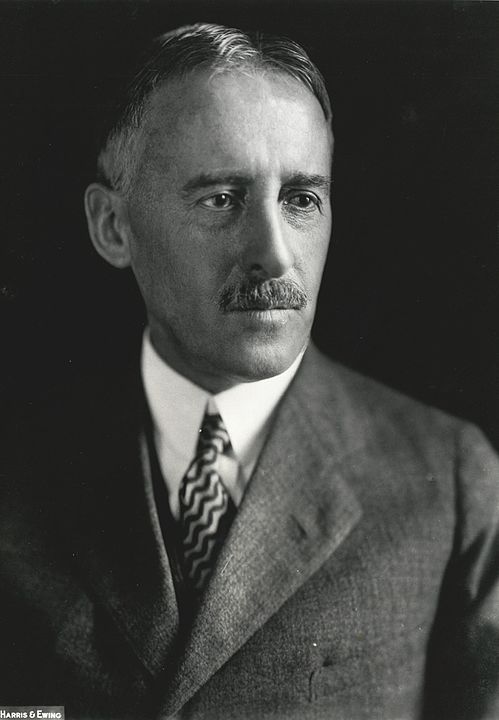
Henry L. Stimson
Secretary of War, 1940–1945. A Republican elder statesman who had already served as Secretary of War under Taft and Secretary of State under Hoover. In his seventies, he ran the Army’s civilian side, oversaw the Manhattan Project and advised Truman on the atomic bomb.
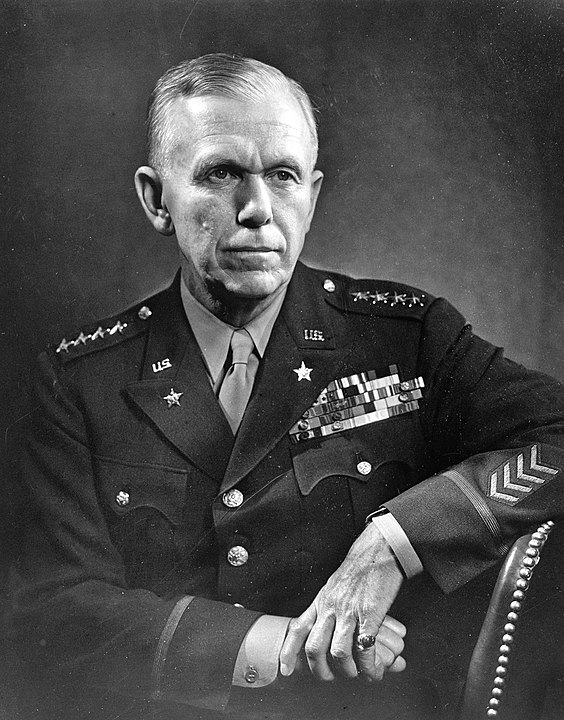
George C. Marshall
Army Chief of Staff, 1939–1945. Built the Army from 189,000 to more than eight million, chose its commanders and argued for the invasion of France. Churchill called him “the organizer of victory.”
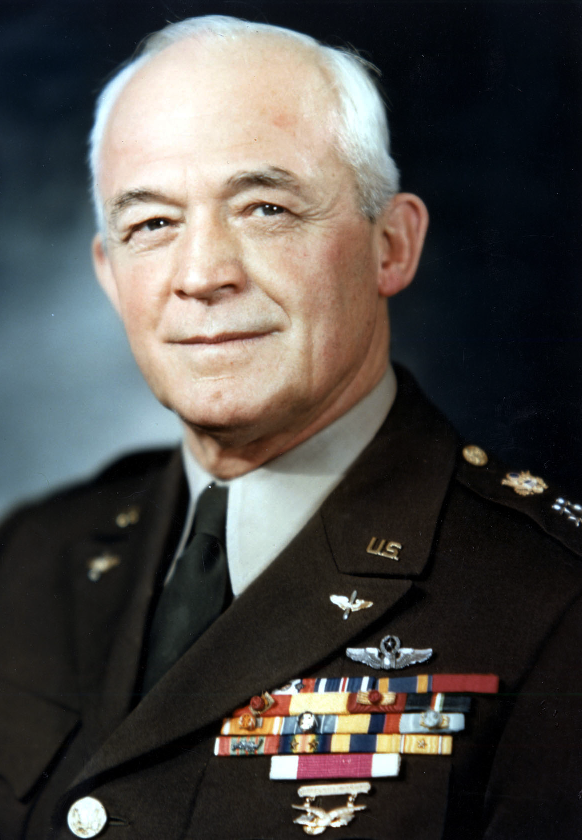
Commanding General, Army Air Forces. Taught to fly by the Wright brothers in 1911, he built the air forces into a giant of 2.4 million people and nearly 80,000 aircraft. He is the only officer ever to hold five-star rank in two services.
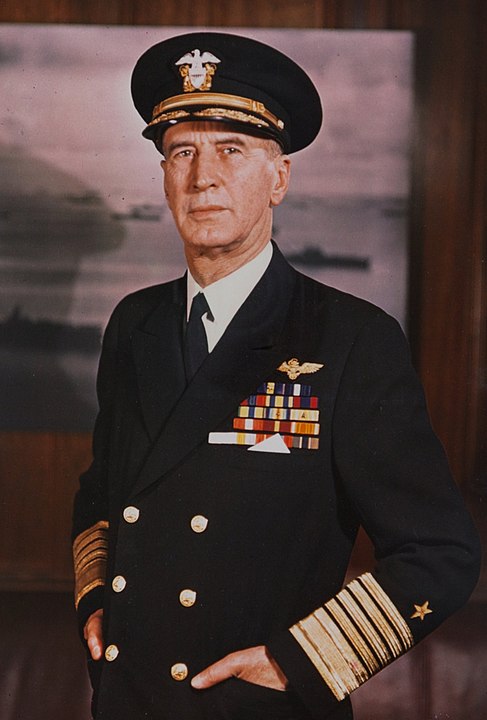
Commander in Chief, US Fleet, and Chief of Naval Operations. The only officer ever to hold both jobs at once. Tough and abrasive, he fought to send more ships and men to the Pacific and oversaw a Navy that grew to more than 6,700 ships.
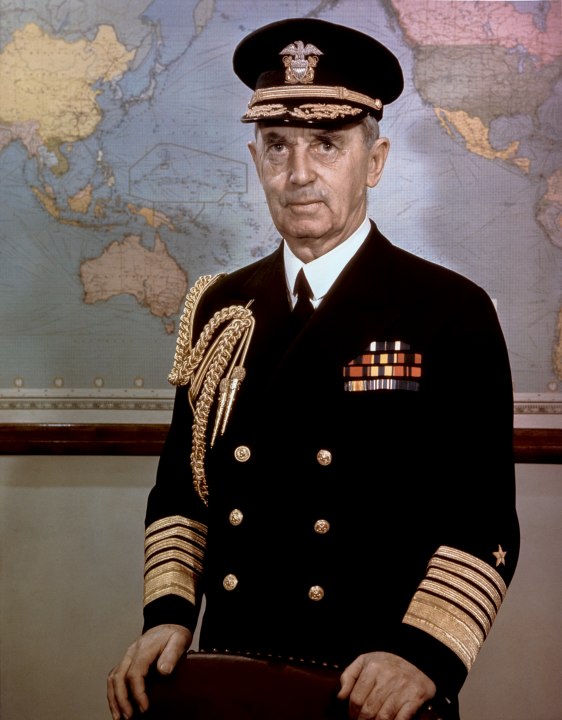
William D. Leahy
Chief of Staff to the Commander in Chief. A retired admiral and former ambassador to Vichy France, he presided over the Joint Chiefs and was Roosevelt’s daily link to them. He was the first American officer promoted to five stars.
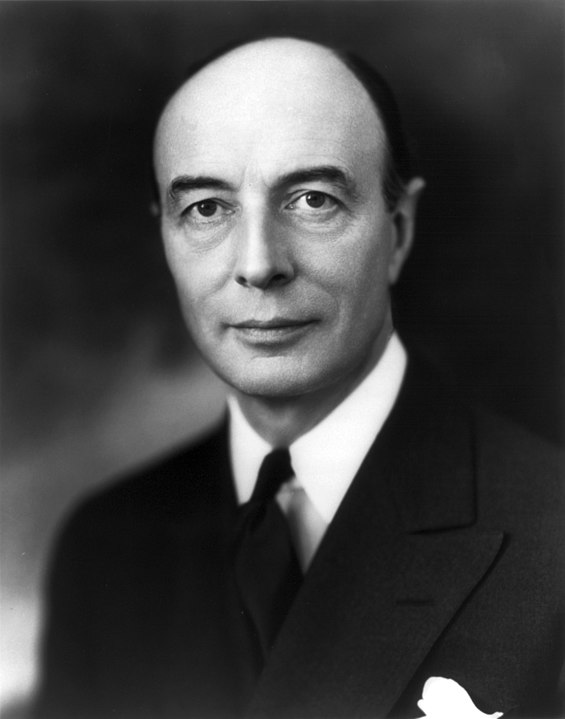
Robert A. Lovett
Assistant Secretary of War for Air, 1941–1945. A World War I Navy pilot turned banker, he pushed American industry to build planes by the tens of thousands. He later served as Secretary of Defense.
1941
Germany first
Even before Pearl Harbor, American and British planners agreed that Germany was the more dangerous enemy and must be beaten first. The Joint Chiefs held to that rule, while still sending enough strength to the Pacific to take the offensive there.
1942–45
Two commanders in the Pacific
Neither the Army nor the Navy would serve under the other in the Pacific, so the Joint Chiefs split it in two: MacArthur’s Southwest Pacific and Nimitz’s Pacific Ocean Areas. The two drives competed for resources but together closed in on Japan.
1942–45
Arsenal of democracy
The high command had to balance the needs of its own forces with Lend-Lease aid to Britain, the Soviet Union and China. American factories turned out some 300,000 aircraft, 86,000 tanks and thousands of ships during the war.
Dec. 1944
Five-star ranks
Congress created the ranks of General of the Army and Fleet Admiral so that American leaders would equal their British counterparts. Leahy, Marshall, King, MacArthur, Nimitz, Eisenhower and Arnold were promoted between December 15 and 21, 1944.
Summits
The great wartime conferences
Roosevelt, Churchill and the Combined Chiefs met again and again to decide the next moves of the war. Stalin joined them at Tehran and Yalta, and Truman at Potsdam.
What came next
After the war: a new defense system
The wartime command system worked, but its quarrels between the services convinced leaders that the military needed a permanent, unified structure.
Visit
The Pentagon
Built as the War Department’s headquarters, the Pentagon took just 16 months to construct and opened in January 1943. With some 6.5 million square feet of floor space it is still one of the largest office buildings in the world, and it offers public tours.
Go deeper
Sources and further reading
- Masters and Commanders, by Andrew Roberts (2008)
- Allies and Adversaries: The Joint Chiefs of Staff, the Grand Alliance, and US Strategy in World War II, by Mark A. Stoler (2000)
- Washington Command Post: The Operations Division, by Ray S. Cline (1951)
- The Pentagon: A History, by Steve Vogel (2007)
Did you know?
Admiral Leahy’s office was in the White House itself, just down the hall from the President. Every morning he brought Roosevelt the latest war news and carried the President’s decisions back to the Joint Chiefs.