
Home › World History › World War II › Normandy
June 6, 1944 · Operation Overlord
Normandy Landings (D-Day): Operation Overlord & Liberation
Before dawn on June 6, 1944, the largest seaborne invasion in history crossed the English Channel. By midnight, about 156,000 American, British and Canadian troops had landed on five beaches and behind them by air, opening the second front that would free Western Europe from Nazi Germany.
Quick facts
D-Day at a glance
| Date | June 6, 1944 | |
| Location | Normandy coast, France: Utah, Omaha, Gold, Juno and Sword beaches | |
| Code names | Operation Overlord (the invasion); Operation Neptune (the landings) | |
| Allied commanders | Dwight D. Eisenhower, Bernard Montgomery, Bertram Ramsay, Omar Bradley | |
| German commanders | Gerd von Rundstedt, Erwin Rommel | |
| Allied strength | 156,000 troops landed; 195,700 naval personnel; 6,939 vessels | |
| German strength | About 50,000 troops in the landing area, behind the Atlantic Wall | |
| Allied casualties | 10,000+, including 4,414 confirmed dead (2,501 Americans) | |
| German casualties | Estimated 4,000 to 9,000 | |
| Result | Allied victory: all five beachheads secured, opening the Western Front |
The big picture in 30 seconds
Why it matters
- It opened the long-awaited second front in Western Europe, forcing Germany to fight on two sides.
- It remains the largest amphibious invasion ever attempted.
- Months of deception convinced Hitler the real attack would come at Calais.
- Omaha Beach was the costliest: about 2,000 American casualties in a single morning.
- Within 11 weeks the Allies had broken out of Normandy and liberated Paris.
156,000
Allied troops landed by sea and air on June 6
6,939
ships and landing craft in the invasion fleet
2,200+
bombers struck the coast before the landings
50 miles
of French coastline in the assault area
Background
Why Normandy?
By 1944 Germany had occupied France for four years. Joseph Stalin had pressed Britain and the United States since 1942 to open a second front in the west and draw German divisions away from the Soviet Union. After landings in North Africa in 1942 and Italy in 1943, the Allies agreed at the Tehran Conference to invade France in the spring of 1944.
The shortest crossing was to the Pas-de-Calais, and the Germans expected the attack there. Allied planners chose the beaches of Normandy instead: farther from England, but less heavily defended, within range of fighter cover from British airfields, and close to the port of Cherbourg.
The Atlantic Wall
Hitler ordered a chain of bunkers, gun batteries and minefields along the coast from Norway to Spain. Field Marshal Erwin Rommel, given charge of the coastal defenses in late 1943, covered the Normandy beaches with millions of mines and steel obstacles. He believed the invasion had to be stopped at the water’s edge, or not at all.
Fooling the enemy
Under Operation Fortitude, the Allies invented a whole army group in southeast England, the First US Army Group, and put General George S. Patton in command. Inflatable tanks, dummy landing craft, fake radio traffic and double agents all pointed to Calais. Even after June 6, Hitler held powerful forces near Calais for weeks, waiting for a “real” invasion that never came.
The weather gamble
The invasion was set for June 5, but a storm swept the Channel. Group Captain James Stagg, Eisenhower’s chief meteorologist, forecast a short break for June 6. Early on June 5, Eisenhower gave the order to go. The next suitable tides were two weeks away, and a severe storm struck the Channel on June 19 to 22. Rommel, sure the seas were too rough for an invasion, had gone home to Germany for his wife’s birthday.
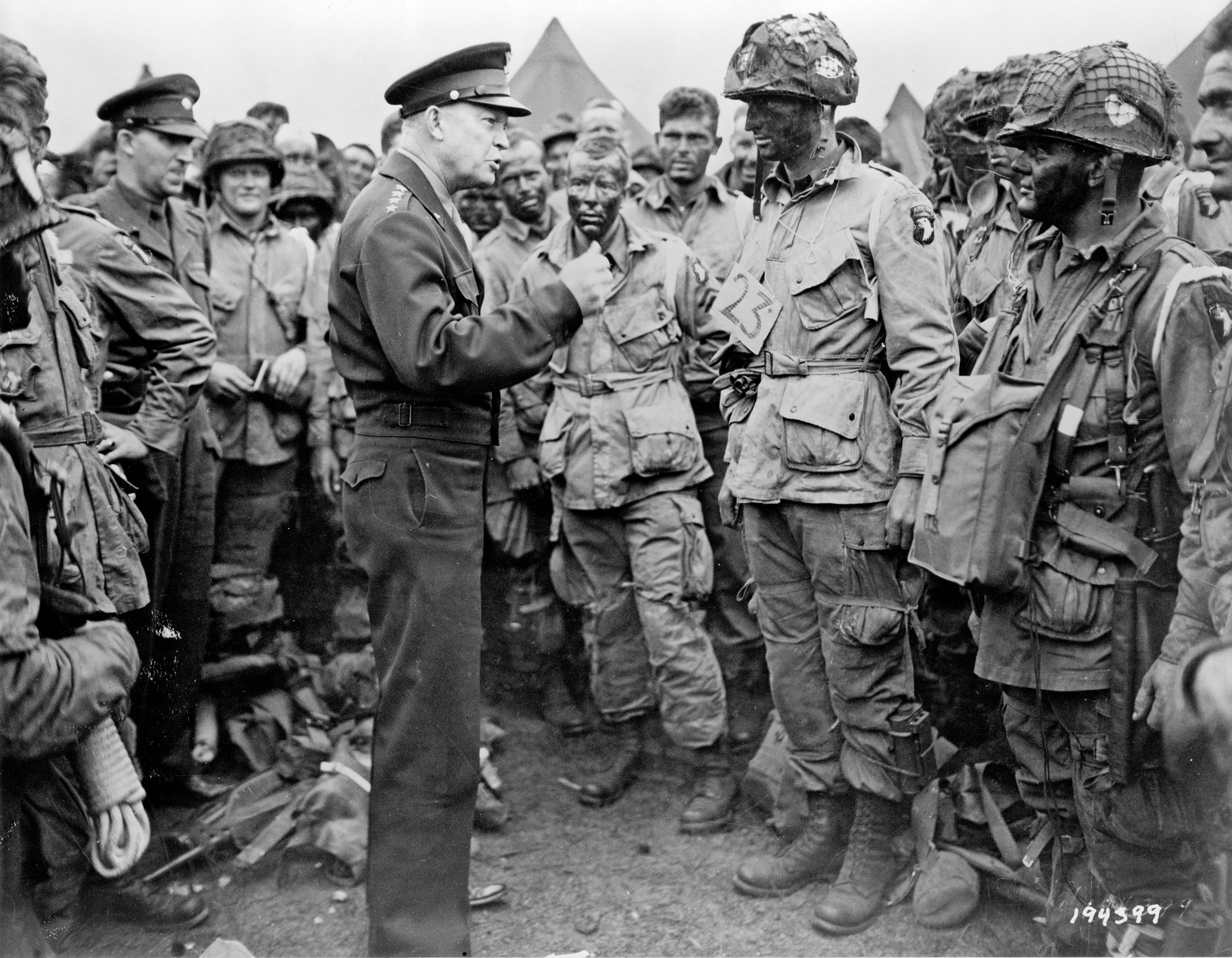
Order of the Day, June 6, 1944
“You are about to embark upon the Great Crusade, toward which we have striven these many months. The eyes of the world are upon you.”
General Dwight D. Eisenhower, to the soldiers, sailors and airmen of the Allied Expeditionary Force
The landings
The five beaches
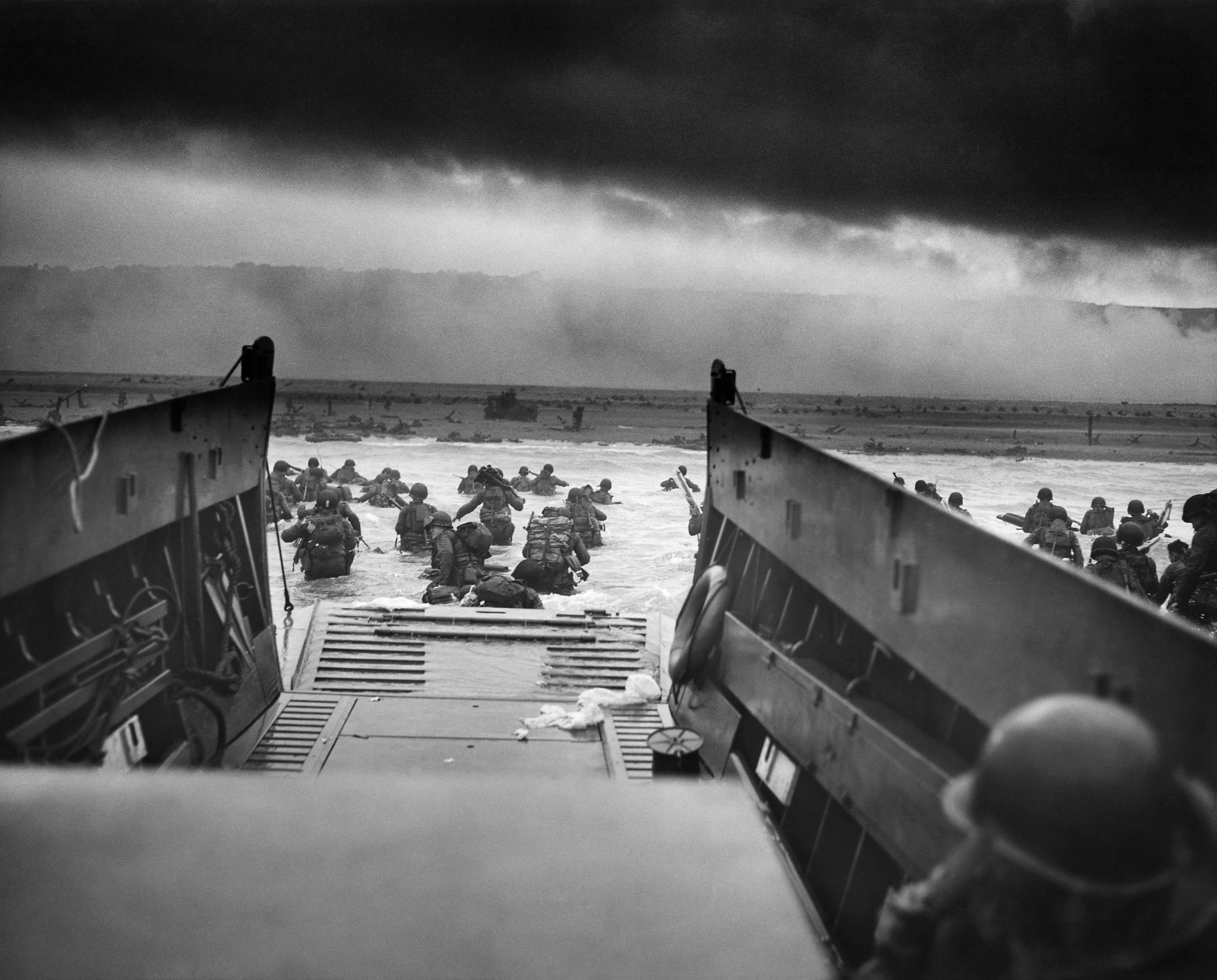
The assault stretched across 50 miles of coast. Americans landed on the two western beaches at 6:30 a.m.; the British and Canadians landed an hour later, when the rising tide reached the eastern beaches.
American sector · 6:30 a.m.
Utah
US 4th Infantry Division
Strong currents carried the first wave about a mile south of its target, onto a stretch with fewer defenses. Brig. Gen. Theodore Roosevelt Jr., the only general in the first wave, decided to stay: “We’ll start the war from right here.” Some 21,000 men were ashore by nightfall.
American sector · 6:30 a.m.
Omaha
US 1st and 29th Infantry Divisions, with Army Rangers
The bloodiest beach. Pre-dawn bombing missed its targets, most amphibious tanks sank in heavy seas, and German troops held the bluffs above. For hours men were pinned at the waterline until small groups, often led by lieutenants and sergeants, fought their way up the draws.
British sector · 7:25 a.m.
Gold
British 50th (Northumbrian) Division
British troops cleared the beach defenses and pushed inland toward Bayeux, which they freed the next day. Off the village of Arromanches, engineers soon built a huge artificial “Mulberry” harbor to land supplies.
Canadian sector · 7:45 a.m.
Juno
3rd Canadian Infantry Division
Rough seas delayed the landing, so the first waves arrived with the tide already covering many mines and obstacles. Despite heavy losses in the first hour, the Canadians pushed farther inland on D-Day than any other Allied force.
British sector · 7:25 a.m.
Sword
British 3rd Infantry Division, with British and French commandos
The easternmost beach. Lord Lovat’s commandos, led ashore by piper Bill Millin, marched to join the paratroopers at Pegasus Bridge. That evening German tanks of the 21st Panzer Division reached the sea between Juno and Sword before pulling back.
Allied forces on D-Day
Three nations, five beaches
Americans landed on Utah and Omaha, the British on Gold and Sword, and the Canadians on Juno. Free French, Polish, Norwegian, Dutch and other Allied sailors and airmen fought alongside them.
Behind and above the beaches
Paratroopers and Rangers
After midnight, June 6
The airborne assault
More than 13,000 American paratroopers of the 82nd and 101st Airborne Divisions jumped behind Utah Beach in the dark, many scattered for miles by cloud and anti-aircraft fire. Small groups still seized causeways and crossroads, and the 82nd took Sainte-Mère-Église, one of the first towns in France to be liberated. To the east, British glider troops captured Pegasus Bridge at 12:16 a.m., the first action of D-Day.
7:10 a.m.
Pointe du Hoc
About 225 men of the 2nd Ranger Battalion, led by Lt. Col. James Earl Rudder, climbed 100-foot cliffs on ropes and ladders under fire. At the top they found the big guns had been moved. A patrol led by Sgt. Leonard Lomell tracked them to an orchard inland and destroyed them. Cut off for two days, only about 90 Rangers could still fight when relief arrived on June 8.
Hour by hour
Timeline of June 6, 1944
People
Who led D-Day
Dwight D. Eisenhower
Supreme Allied Commander
Commanded the whole invasion and made the final call to go on June 6. He had a note ready taking full blame if it failed.
Bernard Montgomery
Allied ground forces commander
The British general who commanded all Allied land forces in Normandy and shaped the final invasion plan.
Omar Bradley
Commander, US First Army
Led the American landings on Utah and Omaha and later the breakout from Normandy.
Erwin Rommel
German Army Group B
Germany’s best-known general, in charge of the coastal defenses. He was home in Germany on D-Day and raced back to France that day.
Theodore Roosevelt Jr.
Assistant commander, US 4th Infantry Division
The oldest man in the first wave at 56 and the son of President Theodore Roosevelt. He won the Medal of Honor for his leadership on Utah Beach.
James Earl Rudder
Commander, 2nd Ranger Battalion
Led the Rangers up the cliffs at Pointe du Hoc and was wounded twice. He later became president of Texas A&M.
What came next
From the beaches to Paris
D-Day was only the first day of the Battle of Normandy. By the end of June more than 850,000 men and 148,000 vehicles had landed, but the Germans fought hard for every hedgerow. The breakout came in late July, and on August 25 Paris was free.
Remembering D-Day
The Normandy American Cemetery
On the bluff above Omaha Beach at Colleville-sur-Mer, 9,389 American servicemen and women lie buried, and the Walls of the Missing list 1,557 more. Canadian, British and German war cemeteries lie nearby, and every June 6 veterans’ families and visitors gather on the beaches to remember.
Go deeper
Sources and further reading
- The Longest Day, by Cornelius Ryan (1959)
- D-Day: June 6, 1944, by Stephen E. Ambrose (1994)
- D-Day: The Battle for Normandy, by Antony Beevor (2009)
- The Guns at Last Light, by Rick Atkinson (2013)
Meanwhile in the East
On June 22, 1944, two weeks after D-Day, the Soviet Union launched Operation Bagration and destroyed Germany’s Army Group Centre. Germany now faced huge Allied offensives in the west and the east at the same time.