
Home › World History › World War II › George C. Marshall
Army Chief of Staff, 1939–1945 · Commanders
George C. Marshall
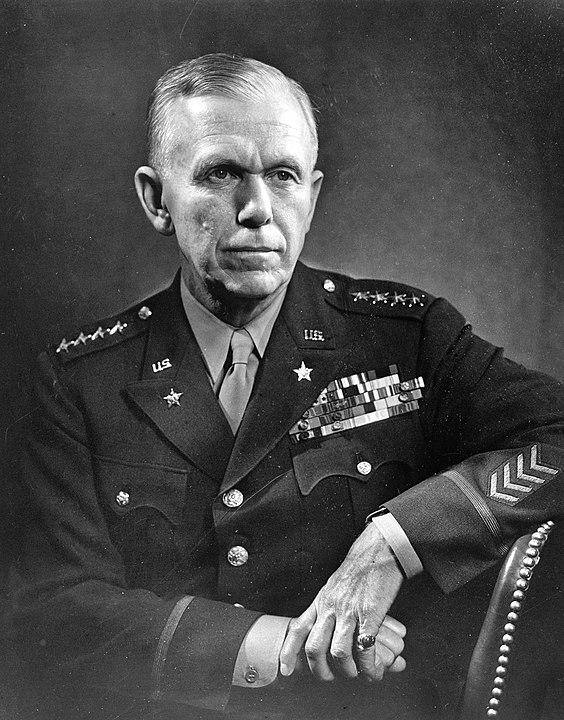
He never led troops in battle during World War II, yet Winston Churchill called him “the organizer of victory.” As Army Chief of Staff, George Marshall built an army of 189,000 men into one of more than eight million, chose the generals who led it, and shaped the strategy that won the war. Afterward, his plan to rebuild Europe earned him the Nobel Peace Prize.
Quick facts
Marshall at a glance
| Born | December 31, 1880, in Uniontown, Pennsylvania | |
| Died | October 16, 1959, in Washington, D.C.; buried at Arlington National Cemetery | |
| Education | Virginia Military Institute, class of 1901 | |
| Highest rank | General of the Army (five stars), December 16, 1944 | |
| World War II role | Chief of Staff of the US Army, September 1, 1939, to November 18, 1945, and Roosevelt's chief military adviser | |
| After the war | Special envoy to China (1945–47), Secretary of State (1947–49), president of the American Red Cross (1949–50), Secretary of Defense (1950–51) | |
| Family | Married Lily Coles (1902; she died in 1927) and Katherine Tupper Brown (1930). No children of his own; three stepchildren | |
| Honors | Nobel Peace Prize (1953), Time Man of the Year (1943 and 1947), Congressional Gold Medal |
The big picture in 30 seconds
Why he matters
- He turned a small, poorly armed peacetime army into the force that fought from North Africa to Normandy to the Pacific.
- He spotted and promoted the generals who won the war, including Eisenhower, Bradley and Patton.
- He pushed hard for the cross-Channel invasion of France that became D-Day.
- His Marshall Plan rebuilt Western Europe after the war; he is the only career soldier to win the Nobel Peace Prize.
8.3 million
soldiers in the Army by 1945, up from 189,000 in 1939
6 years
as Army Chief of Staff
5
stars: General of the Army, 1944
$13 billion
in Marshall Plan aid to rebuild Europe
Biography
The making of a soldier
George Catlett Marshall grew up in a small Pennsylvania coal and coke town. He was an indifferent student, but at the Virginia Military Institute he found his calling, graduating as first captain of the cadet corps in 1901. He was commissioned a second lieutenant in 1902 and served in the Philippines and at posts across the United States.
World War I: "the Wizard"
In France in 1917 and 1918, Marshall became one of the Army’s best planners. In the fall of 1918 he organized the movement of some 600,000 men and their guns and supplies from the St. Mihiel battlefield to the Meuse-Argonne in a matter of days, earning the nickname “the Wizard.” He then spent five years as aide to General John J. Pershing.
The teacher
From 1927 to 1932, as assistant commandant of the Infantry School at Fort Benning, Georgia, Marshall rewrote how the Army trained its officers, stressing simple orders and quick thinking. Some 200 future generals of World War II passed through the school during his time there, and Marshall kept a note of the best of them.
Chief of Staff
President Roosevelt chose Marshall over more senior generals to lead the Army. He was sworn in on September 1, 1939, the day Germany invaded Poland.
Career
From VMI to the Nobel Prize
Marshall’s career covered half a century of service as a soldier and statesman.
Building the Army
From 189,000 to 8.3 million
When Marshall took over, the US Army ranked about 19th in the world, behind Portugal’s. Under his leadership it grew more than fortyfold.
1941
Germany first
Marshall backed the decision to defeat Germany before Japan, while sending enough to the Pacific to stop the Japanese advance. It guided American strategy for the rest of the war.
1940–44
Choosing the commanders
Marshall pushed aside many older officers and promoted younger men he had watched for years. He lifted Dwight Eisenhower from colonel to Supreme Allied Commander in less than three years.
1942–44
The fight for D-Day
Marshall argued from the start for a direct invasion of France. He lost the argument in 1942 and 1943 to the British, who preferred North Africa, Sicily and Italy, but he kept the plan alive until it became D-Day in 1944.
Dec. 1943
The command he gave up
Everyone expected Marshall to command the D-Day invasion, and he wanted the job. Roosevelt told him he could not sleep easily with Marshall out of Washington, so the command went to Eisenhower. Marshall never complained.
The Marshall Plan
"Against hunger, poverty, desperation and chaos"
Our policy is directed not against any country or doctrine but against hunger, poverty, desperation and chaos.
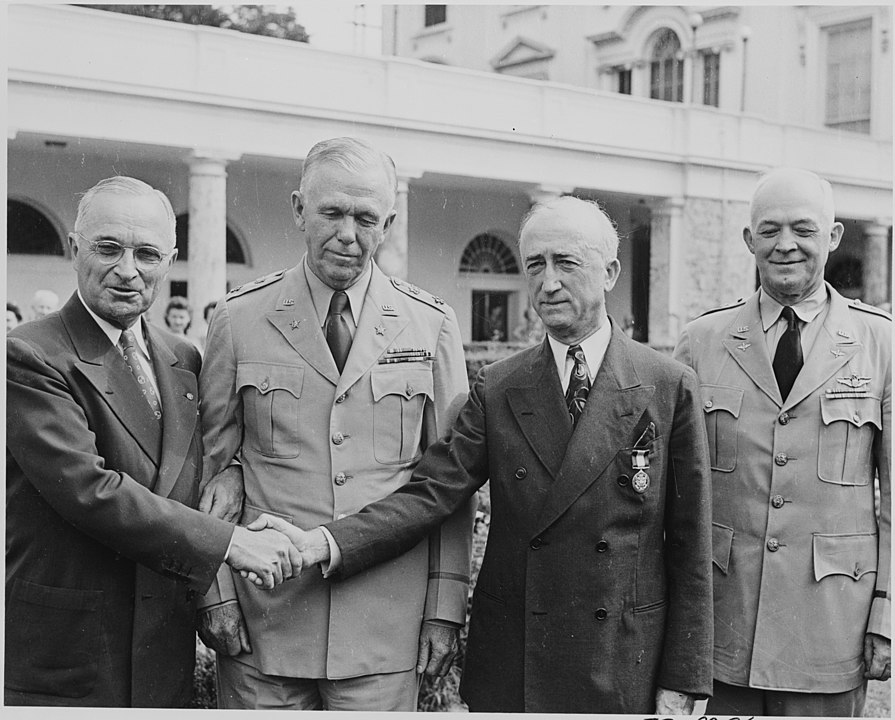
Marshall, speaking at Harvard University on June 5, 1947, as Secretary of State. His offer of American aid became the European Recovery Program, better known as the Marshall Plan. Between 1948 and 1952 it gave about $13 billion to 16 European countries to rebuild their factories, farms and cities.
His life
Timeline
His team
Marshall's generals
Dwight D. Eisenhower
Supreme Allied Commander, Europe
Marshall brought him to Washington in December 1941 and soon sent him to command in Europe.
Omar Bradley
Commander, US 12th Army Group
A Fort Benning instructor under Marshall who rose to command more American troops than any general before him.
Commander, US Third Army
Marshall valued Patton‘s fighting spirit and kept him in the war despite his outbursts.
Joseph Stilwell
Commander in China, Burma and India
Another Fort Benning colleague, sent to the hardest diplomatic and military job of the war.
Mark W. Clark
Commander, US Fifth Army
Marshall’s protégé, who led American forces in the long Italian campaign.
Matthew Ridgway
Commander, 82nd Airborne Division
Marshall’s choice to build one of the Army’s first airborne divisions. He later commanded in Korea.
Legacy
After the war
Marshall’s second career as a statesman was as important as his first. He helped rebuild Europe, strengthen the Western alliance and rebuild the armed forces for the Korean War.
Visit
The George C. Marshall Museum
The George C. Marshall Foundation runs a museum and research library on the grounds of the Virginia Military Institute in Lexington, Virginia, with his papers, his Nobel Prize and exhibits on his life. Marshall is buried at Arlington National Cemetery.
Go deeper
Sources and further reading


- George Marshall: Defender of the Republic, by David L. Roll (2019)
- General of the Army: George C. Marshall, Soldier and Statesman, by Ed Cray (1990)
- George C. Marshall, by Forrest C. Pogue (four volumes, 1963–87)
A family loss
Marshall’s stepson, Lt. Allen Tupper Brown, a tank officer, was killed in Italy in May 1944. Marshall, who was sending millions of other families’ sons to war, learned of it at his desk in the Pentagon.