
Home › World History › The Renaissance › Galileo and the Scientific Revolution
The Renaissance · Science · 1543–1687
The Scientific Revolution: Copernicus, Galileo, Newton and a New View of the Universe
The Scientific Revolution was a time, from about 1543 to 1687, when European thinkers replaced old ideas about nature with new ones based on observation, experiment and mathematics. Copernicus put the Sun at the center of the universe, Galileo proved it with his telescope and was put on trial for it, and Isaac Newton explained the laws of motion and gravity. The Scientific Revolution created modern science.

Galileo Galilei, painted by Justus Sustermans in 1636.
Quick facts
The Scientific Revolution at a glance
- When: About 1543 (Copernicus) to 1687 (Newton’s Principia)
- Where: Across Europe: Poland, Denmark, Italy, Germany, England, France and the Netherlands
- Biggest idea: The Earth and planets go around the Sun, not the Sun around the Earth
- New method: Test ideas by observation and experiment, and describe nature with mathematics
- New tools: The telescope, the microscope, the pendulum clock, the thermometer and the barometer
- Key scientists: Copernicus, Vesalius, Tycho Brahe, Kepler, Galileo, Harvey, Descartes, Boyle and Newton
- Famous clash: Galileo’s trial by the Roman Inquisition, 1633
- Result: Modern science, and the Enlightenment that followed
The big picture in 30 seconds
Why the Scientific Revolution matters
- It moved the Earth from the center of the universe.
- It created the scientific method we still use.
- Newton’s laws still send rockets into space.
- It changed how people decide what is true.
1543
Copernicus puts the Sun at the center
20×
power of Galileo’s best telescope
4
moons of Jupiter Galileo found in 1610
1687
Newton’s Principia
The old view
What did people believe before the Scientific Revolution?
For some 1,400 years Europeans followed the ancient Greek thinkers Aristotle and Ptolemy. They taught that the Earth sat still at the center of the universe, while the Sun, Moon, planets and stars circled it on crystal spheres. The heavens were perfect and unchanging. It matched what people saw every day, and it fit with the Church’s teaching.
Copernicus
Nicolaus Copernicus, a Polish church official and astronomer, found that the old system needed more and more complicated corrections to predict where the planets would be. He worked out that the math was simpler if the Sun stood at the center and the Earth spun on its axis and traveled around the Sun once a year.
Fearing ridicule, he waited decades to publish. His book On the Revolutions of the Heavenly Spheres came out in 1543; legend says he was handed a printed copy on the day he died.

Who first said it?
The Greek astronomer Aristarchus suggested a Sun-centered universe about 270 BC, but almost no one followed him.
The diagram
From an Earth-centered to a Sun-centered universe
In the old picture, everything in the sky circled the Earth. To explain why planets such as Mars sometimes seem to move backward, astronomers added small extra circles called epicycles.
Copernicus moved the Sun to the center. The backward motion is then easy to explain: it happens when the faster-moving Earth overtakes a slower outer planet, the way a fast car seems to make a slow one go backward.
The old view
Ptolemy, about AD 150: Earth at the center
The new view
Copernicus, 1543: the Sun at the center
The big discoveries
The Scientific Revolution, step by step
Each discovery built on the last, over nearly 150 years.
1543: Copernicus
On the Revolutions puts the Sun at the center. The same year, Vesalius publishes the first accurate book of human anatomy.
1572–1601: Tycho Brahe
The Danish astronomer sees a new star and makes the most accurate naked-eye measurements of the planets ever.
1609: Kepler
Using Tycho’s data, Johannes Kepler shows that the planets move in ellipses, not circles.
1610: Galileo’s telescope
Galileo sees mountains on the Moon, the moons of Jupiter and countless stars.
1628: Harvey
The English doctor William Harvey proves that the heart pumps blood around the body.
1687: Newton
Isaac Newton’s laws of motion and universal gravity explain both falling apples and orbiting planets.
1609–1633
Galileo: the telescope and the trial
Galileo Galilei was a professor of mathematics in Padua when he heard in 1609 that a Dutch spectacle maker had made a tube that made far-away things look close. He built his own, improved it to about 20 times magnification, and pointed it at the night sky.
What he saw amazed Europe. The Moon had mountains and craters, so the heavens were not perfect. Jupiter had four moons circling it, so not everything circled the Earth. Venus showed phases like the Moon, which only made sense if it went around the Sun. He published his findings in The Starry Messenger in 1610 and named Jupiter’s moons the “Medicean stars” after the Medici family.
The trial
In 1616 the Church declared the Sun-centered idea false and told Galileo not to defend it. In 1632 he published a book that made the supporters of the old view look foolish. The Roman Inquisition put him on trial in 1633. Under threat of torture, the 69-year-old scientist was forced to say he was wrong. He spent the rest of his life under house arrest near Florence, still writing, and died in 1642. In 1992 Pope John Paul II admitted the Church had erred.

“And yet it moves”
Legend says that after his trial Galileo muttered “Eppur si muove,” meaning the Earth still moves. There is no evidence he really said it.
Key people
The scientists who changed how we see the universe
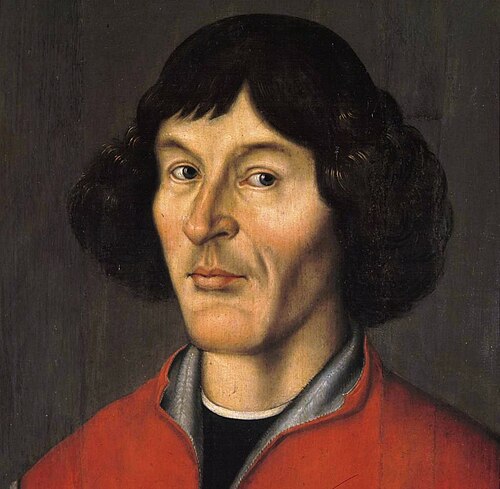
Nicolaus Copernicus
1473–1543
Polish astronomer
Put the Sun at the center of the universe.

Tycho Brahe
1546–1601
Danish astronomer
Made the most precise sky measurements before the telescope.

Johannes Kepler
1571–1630
German astronomer
Discovered the three laws of planetary motion.
Galileo Galilei
1564–1642
Italian scientist
Used the telescope to support Copernicus; founder of modern physics.

René Descartes
1596–1650
French philosopher
Argued that nature works like a machine that can be explained by mathematics.

Isaac Newton
1643–1727
English scientist
Explained gravity and the laws of motion.
Why it mattered
The birth of modern science
The Scientific Revolution did more than move the Earth. It created a new way to find out what is true: make careful observations, test ideas with experiments, describe nature with mathematics, and share results so others can check them. Scientific societies such as London’s Royal Society, founded in 1660, spread this method.
Its success inspired the Enlightenment of the 1700s, when thinkers asked whether reason could also improve government and society, ideas that shaped the American founders. Newton’s laws are still used to launch satellites and plan spaceflights today.
1543
Copernicus’s book
1610
Galileo’s Starry Messenger
1633
Galileo’s trial
1687
Newton’s Principia
Timeline
The Scientific Revolution, 1543–1687
- 1543 Copernicus publishes On the Revolutions; Vesalius publishes his anatomy.
- February 15, 1564 Galileo is born in Pisa.
- 1572 Tycho Brahe sees a new star, a supernova.
- 1600 William Gilbert publishes his study of magnetism.
- 1608 The telescope is invented in the Netherlands.
- 1609 Kepler publishes his first laws; Galileo builds his telescope.
- 1610 Galileo’s Starry Messenger reports the moons of Jupiter.
- 1616 The Church bans teaching that the Earth moves.
- 1620 Francis Bacon calls for science based on experiment.
- 1628 William Harvey explains the circulation of the blood.
- 1633 Galileo is tried and placed under house arrest.
- 1637 René Descartes publishes his Discourse on Method.
- 1642 Galileo dies; Isaac Newton is born.
- 1660 The Royal Society is founded in London.
- 1687 Newton publishes the Principia.
“Philosophy is written in this grand book, the universe, which stands continually open to our gaze. It is written in the language of mathematics.”
Galileo Galilei
From The Assayer, 1623
The bigger story
The Renaissance, about 1300–1600
Our Renaissance overview tells the whole story in one place: the rediscovery of ancient learning, Florence and the Medici, the great artists, the printing press, the Reformation and the new science.
Go deeper
Sources and further reading
- Galileo’s Daughter, by Dava Sobel (1999)
- The Scientific Revolution, by Steven Shapin (1996)
- The Invention of Science, by David Wootton (2015)
- More recommended books