
Home › World History › The Renaissance › Leonardo da Vinci
The Renaissance · Artist, scientist and inventor · 1452–1519
Leonardo da Vinci: Life, Paintings and Inventions of a Renaissance Genius
Leonardo da Vinci was an Italian painter, scientist and inventor, the most famous example of a Renaissance genius. He painted the Mona Lisa and The Last Supper, two of the best-known works of art ever made. Leonardo da Vinci also filled thousands of notebook pages with designs for flying machines, studies of the human body and observations of nature, centuries ahead of his time.

Leonardo da Vinci in old age, in a red chalk drawing from about 1515.
Quick facts
Leonardo da Vinci at a glance
- Lived: April 15, 1452 to May 2, 1519
- Born: Near the small town of Vinci, outside Florence, Italy
- Trained: In the Florence workshop of the artist Andrea del Verrocchio
- Most famous paintings: Mona Lisa, The Last Supper, Lady with an Ermine
- Paintings that survive: Fewer than 20 are accepted as his
- Notebooks: About 7,000 pages survive, mostly in mirror writing, right to left
- Inventions on paper: Flying machines, a parachute, an armored car, a diving suit and giant crossbows
- Died: At Amboise, France, as a guest of King Francis I
The big picture in 30 seconds
Why Leonardo matters
- He painted the most famous portrait in the world.
- He joined art and science as no one had before.
- His notebooks foresaw helicopters and tanks.
- He is the model of the “Renaissance man.”
67 years
of life, 1452–1519
About 7,000
notebook pages survive
Fewer than 20
surviving paintings
$450 million
paid for his Salvator Mundi in 2017
Early life
From Vinci to Florence
Leonardo was born on April 15, 1452, the son of a notary, Ser Piero, and a young local woman named Caterina. Because his parents were not married, he could not go to university or follow his father’s profession. He had little formal schooling and taught himself Latin later in life.
Around age 14 he was apprenticed to Andrea del Verrocchio, one of the leading artists of Florence. In the workshop he learned painting, sculpture, metalwork and engineering. A story says that when Verrocchio saw the angel young Leonardo painted in his Baptism of Christ, he was so amazed he gave up painting.
Off to Milan
In 1482 Leonardo moved to Milan to work for its ruler, Ludovico Sforza. In his letter asking for a job he listed ten kinds of war machines and bridges he could build, and only at the end mentioned that he could also paint and sculpt.

Mirror writing
Leonardo was left-handed and wrote most of his notes backward, from right to left. They are easy to read in a mirror.
The map
Leonardo’s life on the move
Leonardo spent his career following patrons. After his training in Florence, he worked 17 years in Milan, then moved between Venice, Florence, Milan again and Rome as wars and rulers changed.
In 1516, at about 64, he crossed the Alps to France at the invitation of King Francis I, who gave him a manor house near the royal castle of Amboise. He died there in 1519.
His life and work
Leonardo da Vinci, step by step
Leonardo started far more projects than he finished, but what he did finish changed art forever.
About 1466: apprentice in Florence
Trains with Verrocchio and becomes a master painter by age 20.
1482: Milan
Works for Ludovico Sforza on festivals, canals and a giant bronze horse that is never cast.
1495–1498: The Last Supper
Paints Jesus and the apostles on a monastery dining-room wall in Milan.
About 1503: the Mona Lisa
Back in Florence, begins the portrait of Lisa Gherardini, wife of a silk merchant. He keeps working on it for years.
1507–1513: science
Dissects some 30 human bodies and draws the heart, skull and a baby in the womb with amazing accuracy.
1516: France
King Francis I names him “first painter, engineer and architect to the King.”
About 1503–1519
The Mona Lisa
The Mona Lisa shows Lisa Gherardini, the wife of a Florentine merchant, Francesco del Giocondo; in Italian she is called La Gioconda. Leonardo began the portrait around 1503 but never handed it over. He kept it with him, adding thin layers of paint, and took it to France.
He used a technique called sfumato, Italian for “smoky,” blending colors so softly that there are no hard lines. That is why her smile seems to change as you look at it.
Stolen!
The painting became part of the French royal collection and hangs in the Louvre in Paris. In 1911 an Italian worker, Vincenzo Peruggia, walked out with it under his smock. It was missing for over two years, and the news made it the most famous painting in the world. It was found in Florence in 1913.

Crowds
About 9 million people a year visit the Louvre, and most come to see her. The painting is only 30 by 21 inches.
Key people
Leonardo’s patron, follower and rival

Lorenzo de’ Medici
1449–1492
Ruler of Florence
Said to have sent Leonardo to Milan in 1482 with a gift for its duke.
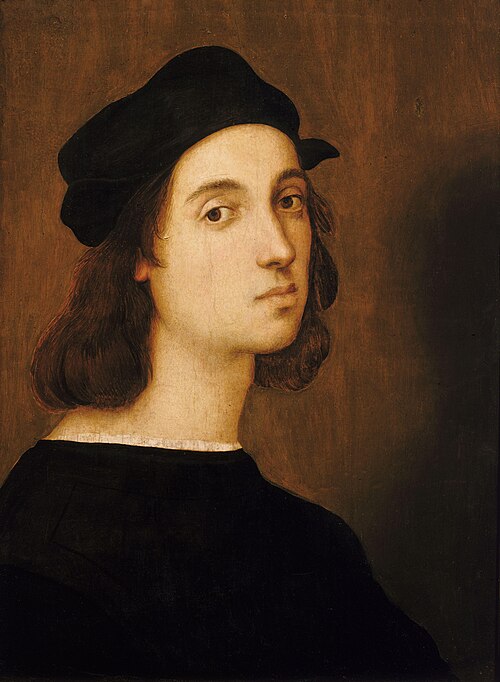
Raphael
1483–1520
Younger painter
Studied Leonardo’s work in Florence and borrowed his poses and soft shading.

Michelangelo
1475–1564
Rival artist
The two competed to paint battle scenes in Florence’s city hall in 1504.
Why it mattered
The original Renaissance man
Leonardo da Vinci finished few paintings, but they changed Western art. His use of light and shadow, his life-like faces and his carefully balanced scenes taught later painters, including Raphael, how to make pictures feel alive. The Last Supper has been copied, printed and parodied more than almost any other image.
His notebooks were scattered after his death and only became widely known in the 1800s. They showed a mind that studied everything: birds in flight, water currents, plants, rocks, the human heart. He designed a flying machine, a parachute and an armored vehicle 400 years before such things were built. Bill Gates paid $30.8 million for one notebook, the Codex Leicester, in 1994.
1498
The Last Supper is finished
About 1503
the Mona Lisa is begun
About 7,000
notebook pages survive
1519
Leonardo dies in France


Inventions
Leonardo the inventor and scientist
Leonardo believed that to paint nature well, you had to understand it. His notebooks mix shopping lists and jokes with some of the most remarkable drawings in history.
Flying machines
After studying birds and bats, he designed wings worked by a pilot, and a screw-shaped machine often called the first helicopter design.
Parachute
He sketched a pyramid-shaped linen parachute. In 2000 a daredevil built one and jumped with it safely.
War machines
An armored car moved by cranks, giant crossbows and rapid-firing guns for the wars of his patrons.
Anatomy
His drawings of the heart, muscles and skeleton were more accurate than any made before.
Timeline
The life of Leonardo da Vinci, 1452–1519
- April 15, 1452 Leonardo is born near Vinci.
- About 1466 He joins Verrocchio’s workshop in Florence.
- 1472 He becomes a member of the painters’ guild of Florence.
- 1482 He moves to Milan to work for Ludovico Sforza.
- About 1490 He draws the Vitruvian Man.
- 1495–1498 He paints The Last Supper.
- 1499 The French take Milan; Leonardo leaves.
- 1502 He works as a military engineer for Cesare Borgia.
- About 1503 He begins the Mona Lisa.
- 1506–1513 Back in Milan, he works on anatomy, water and flight.
- 1513–1516 He lives in Rome under Medici protection.
- 1516 He moves to Amboise, France, for King Francis I.
- May 2, 1519 Leonardo dies at Amboise.
- 1911 The Mona Lisa is stolen from the Louvre; it is found in 1913.
“Iron rusts from disuse; stagnant water loses its purity and in cold weather becomes frozen; even so does inaction sap the vigor of the mind.”
Leonardo da Vinci
From his notebooks (the Codex Atlanticus)
The bigger story
The Renaissance, about 1300–1600
Our Renaissance overview tells the whole story in one place: the rediscovery of ancient learning, Florence and the Medici, the great artists, the printing press, the Reformation and the new science.
Go deeper
Sources and further reading
- Leonardo da Vinci, by Walter Isaacson (2017)
- Leonardo da Vinci: Flights of the Mind, by Charles Nicholl (2004)
- The Notebooks of Leonardo da Vinci, edited by Irma Richter
- More recommended books