
Home › World History › The Renaissance › Michelangelo
The Renaissance · Sculptor, painter and architect · 1475–1564
Michelangelo: Life, the David and the Sistine Chapel Ceiling
Michelangelo Buonarroti was an Italian sculptor, painter, architect and poet, and one of the greatest artists who ever lived. Michelangelo carved the Pietà and the giant marble David, painted the ceiling of the Sistine Chapel in Rome, and designed the dome of St. Peter’s Basilica. He worked for nearly 75 years and was called “the divine one” in his own lifetime.

Michelangelo, painted by his friend Daniele da Volterra about 1545.
Quick facts
Michelangelo at a glance
- Lived: March 6, 1475 to February 18, 1564, nearly 89 years
- Born: Caprese, a village in Tuscany; raised in Florence
- Most famous sculptures: The Pietà (1499), David (1504), Moses (about 1515)
- Most famous paintings: The Sistine Chapel ceiling (1508–1512) and The Last Judgment (1536–1541)
- Architecture: The dome of St. Peter’s Basilica and the Laurentian Library in Florence
- Patrons: The Medici family and several popes, above all Julius II
- Also: A poet who wrote some 300 sonnets and other poems
- Buried: Santa Croce church, Florence
The big picture in 30 seconds
Why Michelangelo matters
- His David is the most famous statue in the world.
- The Sistine ceiling is a high point of Western art.
- He shaped the look of St. Peter’s in Rome.
- He was the first artist with a biography in his lifetime.
17 feet
height of the marble David
4 years
painting the Sistine ceiling
300+
figures on the Sistine ceiling
88
his age when he died, still working
Early life
A boy who wanted to carve stone
Michelangelo was born on March 6, 1475, in Caprese, where his father was briefly the local magistrate. He grew up in Florence and, as a baby, was cared for by the wife of a stonecutter. He later joked that he took in his love of the chisel and hammer with his nurse’s milk.
Against his father’s wishes, he became an apprentice to the painter Domenico Ghirlandaio at 13. Soon Lorenzo de’ Medici noticed his talent and invited him to live in the Medici palace, where he ate at the family table and met poets and philosophers. A jealous fellow student, Pietro Torrigiano, punched him and broke his nose, which is why it looks flattened in his portraits.
The Pietà
In Rome, at just 24, Michelangelo finished the Pietà, showing Mary holding the dead Jesus across her lap. When he heard visitors say another artist had made it, he climbed back at night and carved his name across Mary’s sash. It is the only work he ever signed.

Signed only once
The sash reads, in Latin, “Michelangelo Buonarroti of Florence made this.”
The map
Florence, Carrara and Rome
Michelangelo’s life moved between two cities: Florence, where he grew up and carved David, and Rome, where the popes kept him busy for decades.
He often went himself to the quarries at Carrara in the mountains of Tuscany to pick out his blocks of white marble, sometimes staying for months.
His life and work
Michelangelo, step by step
Michelangelo considered himself a sculptor first, but popes made him paint and build as well.
1490: the Medici palace
As a teenager he lives with Lorenzo de’ Medici and studies ancient statues in the Medici garden.
1499: the Pietà
Aged 24, he finishes the marble Pietà in Rome and becomes famous.
1504: David
He carves the giant David from a block other sculptors had given up on.
1508–1512: the Sistine ceiling
Pope Julius II makes him paint the ceiling of the Sistine Chapel.
1536–1541: The Last Judgment
He paints Christ judging the dead on the chapel’s altar wall.
1546: St. Peter’s
At 71 he becomes chief architect of St. Peter’s and designs its great dome.
1508–1512
Painting the Sistine Chapel ceiling
Pope Julius II wanted the ceiling of the Sistine Chapel, the pope’s private chapel in the Vatican, painted. Michelangelo protested that he was a sculptor, not a painter, but the pope insisted. He designed his own scaffolding and worked standing up, his head bent back and his arms raised, for four years, with paint dripping into his face.
The ceiling covers about 5,000 square feet and holds more than 300 figures. Nine scenes down the middle tell the story of Genesis, from the Creation to Noah. In the most famous, The Creation of Adam, God reaches out to give life to the first man; their fingers almost touch.
Unveiled
When the ceiling was revealed on October 31, 1512, all of Rome came to see it. The painter Giorgio Vasari wrote that it was a beacon to the whole art of painting.

Lying on his back?
A popular story says he painted lying down. In fact he stood, bending backward, and wrote a funny poem about his aching neck.
Key people
Michelangelo’s patron and rivals


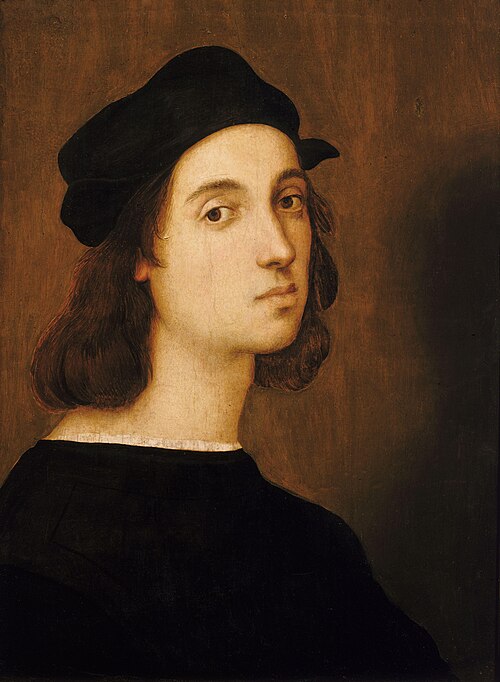
Raphael
1483–1520
Rival painter
Painted the pope’s rooms next door while Michelangelo worked on the ceiling.
Why it mattered
“The divine Michelangelo”
Michelangelo changed what people thought an artist could be. Before him, artists were seen as skilled craftsmen. He was treated as a genius, argued with popes, and became the first artist to have two biographies published while he was still alive, by Giorgio Vasari and his pupil Ascanio Condivi.
His powerful, muscular figures inspired generations of artists and led to the style called Mannerism. David became the symbol of Florence; the original now stands in the Accademia Gallery, with a copy in its first spot outside the city hall. Millions visit the Sistine Chapel every year, and St. Peter’s dome still rises over Rome.
1499
the Pietà
1504
David is unveiled
1512
the Sistine ceiling is unveiled
1546
chief architect of St. Peter’s

The giant
How Michelangelo carved David
For 40 years a huge block of marble had lain in the cathedral workshop of Florence. Two sculptors had started on it and given up, and people called it “the Giant.” In 1501, Michelangelo, then 26, took on the challenge.
Working for more than two years, he carved the young hero David just before his fight with Goliath, alert and ready. When the statue was finished in 1504, it took 40 men four days to move it to the main square. Florence saw it as a symbol of their small republic standing up to powerful enemies.
- Height: About 17 feet (5.17 meters)
- Weight: About 6 tons
- Material: One block of white marble from Carrara
- Today: Accademia Gallery, Florence, since 1873


Michelangelo the architect
In his last 18 years he worked, without pay, on St. Peter’s, the largest church in Christendom. He did not live to see the dome finished in 1590.
Timeline
The life of Michelangelo, 1475–1564
- March 6, 1475 Michelangelo is born in Caprese.
- 1488 He is apprenticed to the painter Ghirlandaio.
- 1490–1492 He lives in the household of Lorenzo de’ Medici.
- 1496 He goes to Rome for the first time.
- 1498–1499 He carves the Pietà.
- 1501–1504 He carves David in Florence.
- 1505 Pope Julius II orders his giant tomb.
- 1508–1512 He paints the Sistine Chapel ceiling.
- About 1515 He carves Moses for the tomb of Julius II.
- 1520s He builds the Medici Chapel and Laurentian Library in Florence.
- 1534 He leaves Florence for Rome for good.
- 1536–1541 He paints The Last Judgment.
- 1546 He becomes chief architect of St. Peter’s.
- February 18, 1564 Michelangelo dies in Rome; he is buried in Florence.
“My beard turns up to heaven; my nape falls in, fixed on my spine.”
Michelangelo
From his poem about painting the Sistine Chapel ceiling, about 1510, translated by John Addington Symonds
The bigger story
The Renaissance, about 1300–1600
Our Renaissance overview tells the whole story in one place: the rediscovery of ancient learning, Florence and the Medici, the great artists, the printing press, the Reformation and the new science.
Go deeper
Sources and further reading
- Michelangelo and the Pope’s Ceiling, by Ross King (2003)
- Michelangelo: A Life in Six Masterpieces, by Miles J. Unger (2014)
- The Lives of the Artists, by Giorgio Vasari (1550)
- More recommended books