
Home › World History › Ancient Greece
World History · about 800–146 BC
Ancient Greece: History, City-States, Culture and Legacy
Ancient Greece was a world of hundreds of independent city-states around the Aegean Sea that flourished from about 800 BC until the Roman conquest in 146 BC. Its people invented democracy, the Olympic Games, theater, history writing and much of philosophy, mathematics and science. Athens and Sparta beat back the mighty Persian Empire, and Alexander the Great carried Greek culture as far as India.
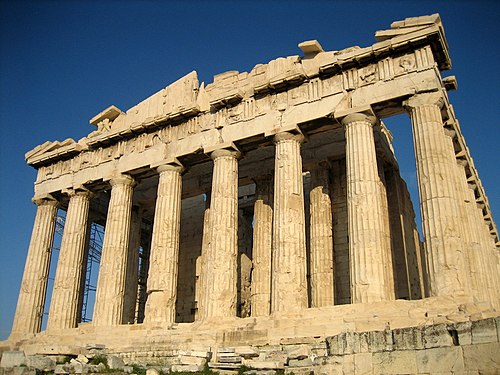
The Parthenon, temple of Athena, built on the Acropolis of Athens in 447–432 BC.
Quick facts
Ancient Greece at a glance
- Dates: About 800 BC to 146 BC: the Archaic (800–480), Classical (480–323) and Hellenistic (323–146) periods
- Where: Greece, the Aegean islands, western Turkey, and colonies from Spain to the Black Sea
- Government: More than 1,000 city-states (poleis), each with its own laws: monarchies, oligarchies, tyrannies and democracies
- Greatest cities: Athens, the sea power and first democracy, and Sparta, the military state
- Language: Greek, written with an alphabet adapted from the Phoenicians about 800 BC
- Religion: Many gods led by Zeus on Mount Olympus, honored with temples, sacrifices, oracles and festivals
- Famous firsts: The Olympic Games (776 BC), democracy (508 BC), theater, and history writing
- How it ended: Macedon conquered Greece in 338 BC; Rome conquered it in 146 BC
The big picture in 30 seconds
Why Ancient Greece matters
- It invented democracy and the idea of citizens.
- Its philosophers taught the world to reason and ask why.
- Its columns and temples shape buildings all over America.
- The Olympics, theater and the marathon all began there.
1,000+
Greek city-states
776 BC
the first Olympic Games
508 BC
democracy begins in Athens
2 million
square miles in Alexander’s empire
Who were the ancient Greeks?
From Troy to the city-states
Greek history began in the Bronze Age with the Minoans of Crete, builders of the palace of Knossos, and the Mycenaeans of the mainland, whose kings may have fought the Trojan War around 1200 BC. After their palaces collapsed, Greece entered a “dark age” in which even writing was forgotten.
The rise of the polis
From about 800 BC the Greeks revived. They borrowed the alphabet from the Phoenicians, Homer’s Iliad and Odyssey were written down, and the first Olympic Games were held in 776 BC. Mountains and sea split Greece into small valleys, so each grew into an independent city-state, or polis, with its own government, army and gods. Cities sent settlers to found colonies from Spain to the Black Sea.
One people, many cities
Greeks fought each other often, but they shared one language, the same gods, the oracle at Delphi and the Olympic Games, when a sacred truce let athletes travel safely. They called themselves Hellenes and their land Hellas.

Why “Greece”?
The Greeks never called themselves Greeks. The name comes from the Romans, who called them Graeci. To this day Greece’s official name is Hellas.
Athens and Sparta
Two very different cities
The two leading cities of Greece could hardly have been more different. They fought side by side against Persia, then against each other.
Athens: rule by the people
From 508 BC male citizens governed themselves directly in the Assembly. Athens grew rich from trade and silver mines and built the strongest navy in Greece.
Athens: art and ideas
The home of the Parthenon, of the great playwrights, and of Socrates, Plato and Aristotle’s schools. Read about the golden age of Athens.
Athens: empire at sea
After the Persian Wars, Athens led the Delian League, an alliance that became its empire.
Sparta: a nation of soldiers
Spartan boys left home at seven for 13 years of military training. Adult men lived in barracks until 30 and were the finest soldiers in Greece.
Sparta: two kings
Sparta had two kings at once, who led its armies, plus a council of elders and elected officials called ephors. Its women could own land and exercised outdoors.
Sparta: built on the helots
Spartans did no farming. The work was done by helots, enslaved Greeks who outnumbered their masters perhaps seven to one.
The map
The Greek world, from Spain to the Black Sea
The Greek homeland was a rugged peninsula and hundreds of islands, but Greeks lived wherever there was a coast. Plato said they sat around the Mediterranean “like frogs around a pond.” Cities such as Syracuse, Naples, Marseille and Byzantium, later Constantinople and Istanbul, began as Greek colonies.
Red dots mark the events that have their own pages: the battles of Marathon and Thermopylae against Persia, and Pella, capital of Macedon and birthplace of Alexander the Great.
The key events
The events that shaped Ancient Greece
Each event marked “Read the full story” has its own page.
The first Olympic Games, 776 BC
Athletes from all over Greece gather at Olympia to honor Zeus. The Games are held every four years for over a thousand years.
The Battle of Marathon, 490 BC
Athenian citizen-soldiers defeat a Persian invasion army and save their young democracy. Read the full story.
Thermopylae and Salamis, 480 BC
Leonidas and his 300 Spartans make their last stand; weeks later the Greek fleet wins at Salamis. Read the full story.
The Golden Age of Athens, about 480–430 BC
Under Pericles, Athens builds the Parthenon and leads the world in democracy, theater and ideas. Read the full story.
The Peloponnesian War, 431–404 BC
Athens and Sparta fight a 27-year war that ends with the fall of Athens. Read the full story.
Alexander the Great, 336–323 BC
The young king of Macedon conquers the Persian Empire and marches to India. Read the full story.
Key people
Famous ancient Greeks

Pericles
about 495–429 BC
Leader of Athens
Led Athens in its golden age and built the Parthenon.

Leonidas
died 480 BC
King of Sparta
Died with his 300 Spartans holding the pass at Thermopylae.

Socrates
469–399 BC
Philosopher
Taught by asking questions and was put to death by Athens for it.

Plato
about 428–348 BC
Philosopher
Student of Socrates. Wrote The Republic and founded the Academy in Athens.

Aristotle
384–322 BC
Philosopher and scientist
Student of Plato and teacher of Alexander. Wrote on everything from politics to biology.
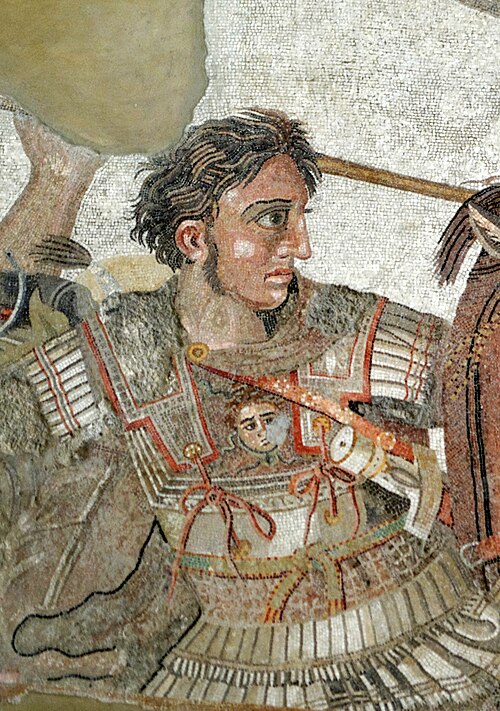
Alexander the Great
356–323 BC
King of Macedon
Conquered an empire from Greece to India before he was 33.
Gifts of the Greeks
What we owe to Ancient Greece
Democracy
The word means “rule by the people.” Athens let ordinary citizens make the laws and sit on juries.
Philosophy
Socrates, Plato and Aristotle asked what is true, what is just and how we should live, and taught the world to argue with reason.
Theater
Tragedy and comedy were born at the festivals of Athens. Theater, scene, drama and chorus are all Greek words.
Math and science
Pythagoras, Euclid and Archimedes laid the foundations of geometry; Hippocrates, the father of medicine, gave doctors their oath.
Architecture
Greek columns, Doric, Ionic and Corinthian, still stand on the U.S. Capitol, the Supreme Court and the Lincoln Memorial.
Sport
The Olympic Games were revived in Athens in 1896, complete with a new race honoring the Battle of Marathon.
Why it mattered
The legacy of Ancient Greece
Greece lost its freedom first to Macedon in 338 BC and then to Rome, which destroyed Corinth in 146 BC. But as the Roman poet Horace put it, captive Greece took its wild conqueror captive. Romans copied Greek statues, studied Greek books and spoke Greek. Through Rome, then through the Byzantine Empire and the scholars of the Islamic world, Greek learning reached Renaissance Europe.
The American founders read the Greek historians and philosophers. They admired Athenian freedom but feared its mob rule, and built a republic modeled more on Rome, with checks and balances. Even so, words like democracy, politics, history and Olympics, and the columns of countless American courthouses, are gifts of Ancient Greece.
776 BC
the first Olympics
508 BC
Athenian democracy
432 BC
the Parthenon finished
146 BC
Rome conquers Greece
Meanwhile in America
The Americas in the age of Ancient Greece
The Olmec, about 1200–400 BC
On the Gulf Coast of Mexico, the Olmec carved giant stone heads and built the first great ceremonial centers of the Americas.
The Adena mound builders, about 800 BC–AD 1
In the Ohio Valley, the Adena people raised earthen burial mounds and traded copper and shells over long distances.
The early Maya, about 600–100 BC
In Guatemala the Maya built their first cities, such as El Mirador, with pyramids as tall as 230 feet.
Greek ideas and the Founders
The Founding Fathers studied Greek democracy at the Constitutional Convention in 1787 and chose a republic instead. Read the full story.
Timeline
Ancient Greece, about 2000–146 BC
- About 2000–1450 BC The Minoans build palaces on Crete.
- About 1600–1100 BC The Mycenaean kingdoms of mainland Greece.
- About 1200 BC The traditional date of the Trojan War.
- About 1100–800 BC The Greek “dark age.”
- 776 BC The first Olympic Games.
- About 750–550 BC Greeks found colonies around the Mediterranean and Black Sea.
- About 700 BC Homer’s epics are written down.
- 508 BC Cleisthenes makes Athens a democracy.
- 499–494 BC The Ionian Revolt against Persia.
- 490 BC The Battle of Marathon.
- 480 BC Thermopylae and Salamis.
- 479 BC The Greeks win at Plataea; the Persian invasion ends.
- 447–432 BC The Parthenon is built.
- 431–404 BC The Peloponnesian War.
- 399 BC Socrates is executed.
- 387 BC Plato founds the Academy.
- 338 BC Philip II of Macedon conquers Greece at Chaeronea.
- 334–323 BC The conquests of Alexander the Great.
- 323 BC Alexander dies; the Hellenistic Age begins.
- 146 BC Rome destroys Corinth and takes control of Greece.
“The unexamined life is not worth living.”
Socrates
At his trial in Athens, 399 BC, as recorded by Plato in the Apology
The bigger story
All of World History
See how Ancient Greece fits into the bigger story, from Ancient Rome and Medieval Europe to the Age of Exploration, England and Britain, the French Revolution and Napoleon.
Go deeper
Sources and further reading
- The Histories, by Herodotus
- The Greeks: A Global History, by Roderick Beaton (2021)
- The Ancient Greeks: A Very Short Introduction, by Paul Cartledge (2011)
- More recommended books