
Home › People › US Presidents › Herbert Hoover
31st President · 1929–1933 · Republican
Herbert Hoover: The Great Humanitarian and the Great Depression
Herbert Hoover was an orphan from Iowa who became a world-famous mining engineer and saved millions from starvation during and after World War I. Elected in a landslide in 1928, he was president when the stock market crashed and the Great Depression began, and the crisis swept him from office four years later.
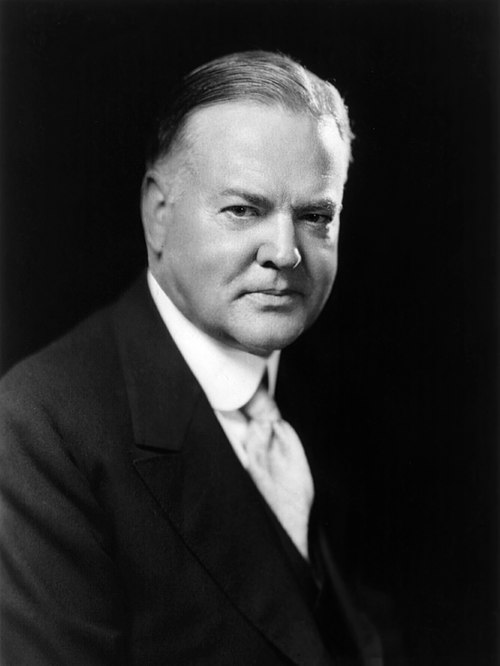
Herbert Hoover, official presidential portrait
Quick facts
Herbert Hoover at a glance
| Born | August 10, 1874, in West Branch, Iowa, the first president born west of the Mississippi | |
| Died | October 20, 1964, in New York City, aged 90 | |
| President | 31st, from March 4, 1929, to March 4, 1933 (one term) | |
| Vice president | Charles Curtis of Kansas | |
| Party | Republican | |
| Education | Stanford University (geology), first graduating class, 1895 | |
| Profession | Mining engineer and businessman | |
| Before the White House | Head of Belgian relief and US Food Administrator in World War I; Secretary of Commerce (1921–1928) | |
| Wife | Lou Henry, married February 10, 1899 | |
| Children | Two sons: Herbert Jr. and Allan | |
| Elections | Won in 1928 over Al Smith; lost in 1932 to Franklin D. Roosevelt | |
| Buried | Herbert Hoover National Historic Site, West Branch, Iowa |
The big picture in 30 seconds
Why he matters
- Organized food relief that fed millions of people in Belgium, northern France and later Russia, earning the name “the Great Humanitarian.”
- Was president when the stock market crashed in 1929 and the Great Depression began.
- Went further than any president before him to fight a depression, creating the Reconstruction Finance Corporation.
- Signed the Smoot-Hawley Tariff, which most economists believe made the world slump worse.
- Was blamed for “Hoovervilles” and for the Army's rout of the Bonus Army veterans in 1932.
- In a long retirement, fed postwar Europe again for President Truman and led two commissions to reorganize the government.
9 million
Belgians and French fed by his relief commission during World War I
24.9%
unemployment in 1933, the worst in American history
444
electoral votes in 1928, then only 59 in 1932
31 years
of life after the White House, one of the longest retirements
Early years
An orphan who struck it rich
Herbert Clark Hoover was born on August 10, 1874, in a two-room cottage in West Branch, Iowa, to a Quaker blacksmith and his wife. His father died when he was six and his mother when he was nine. He was sent to live with an uncle in Oregon, where he worked in the family’s land office and studied math at night.
In 1891 he entered the brand-new Stanford University in California as a member of its first class, studying geology and running the student government’s finances. He graduated in 1895 and went to work pushing ore carts in a Nevada gold mine for $2 a day.
Engineer to the world
Within a few years he was managing gold mines in the Australian outback, and in 1899 he married Lou Henry, a Stanford geology student from California. The couple sailed for China the next day. In 1900 they were trapped in the siege of Tianjin during the Boxer Rebellion. Based in London, Hoover rescued failing mines on several continents and was a millionaire by the age of 40.

The Great Humanitarian
Feeding a continent
When World War I broke out in 1914, Hoover was in London. He first helped 120,000 stranded Americans get home, then organized the Commission for Relief in Belgium, which shipped food through the British blockade and German lines to more than nine million people in occupied Belgium and northern France.
“Food will win the war”
When the United States entered the war in 1917, President Wilson made Hoover the US Food Administrator. Instead of rationing, he asked Americans to observe “wheatless Mondays” and “meatless Tuesdays,” and “to Hooverize” came to mean to save food. After the war his American Relief Administration fed millions more in Central Europe and, in 1921–1923, in famine-struck Soviet Russia.
Secretary of Commerce
Under Harding and Coolidge, Hoover turned the Commerce Department into one of the busiest in government. He promoted standard sizes for everything from bricks to bolts, helped regulate the new radio and airline industries, and led relief after the great Mississippi flood of 1927.
Election of 1928
A landslide
Electoral votes: 531 electors; 266 needed to win. Popular vote: Hoover 21.4 million (58.2%), Smith 15.0 million (40.8%)
Election of 1932
Swept out by the Depression
Electoral votes: 531 electors; 266 needed to win. Popular vote: Roosevelt 22.8 million (57.4%), Hoover 15.8 million (39.6%)
The presidency, 1929–1933
The crash and the Great Depression
Hoover took office on March 4, 1929, promising to end poverty. Seven months later, on “Black Thursday” (October 24) and “Black Tuesday” (October 29), the stock market crashed. Banks failed by the thousands, factories closed and by 1932 about one worker in four had no job. Hoover worked 18-hour days, but he believed relief should come mainly from charities and local governments, not from Washington.
November 1929
Asking business to hold the line
Hoover called business leaders to the White House and asked them not to cut wages, and asked states to speed up public works. It helped for a while, but as the slump deepened, wages and jobs fell anyway.
June 17, 1930
The Smoot-Hawley Tariff
Over a petition from more than 1,000 economists, Hoover signed a tariff that raised taxes on thousands of imports. Other countries struck back with tariffs of their own, and world trade shrank.
January 1932
Reconstruction Finance Corporation
The RFC lent billions to banks, railroads and later states. Critics said it helped big business more than ordinary people, but it set a pattern for federal action that Franklin Roosevelt would greatly expand.
1930–1933
Public works
Federal building rose to record levels, including the giant Boulder Dam on the Colorado River, begun in 1931 and now called Hoover Dam. He also signed the law making “The Star-Spangled Banner” the national anthem in 1931.
June 1931
The Hoover Moratorium
As banks collapsed in Europe, Hoover proposed a one-year pause in payments of war debts and German reparations, a step praised abroad but too little to stop the global banking crisis.
1930–1932
“Hoovervilles”
Homeless families built shantytowns of scrap wood and tin on the edges of cities, nicknamed Hoovervilles. Newspapers used as blankets were “Hoover blankets,” and empty pockets turned out were “Hoover flags.”
The slide
Unemployment during Hoover's term
No president before or since has watched the economy fall so far. Unemployment rose almost eightfold in four years.
Estimates by economist Stanley Lebergott (Census Bureau, Historical Statistics of the United States). Hoover left office in March 1933, when the Depression hit bottom.
1932
The Bonus Army and defeat
In the summer of 1932, about 20,000 World War I veterans and their families camped in Washington, demanding early payment of a bonus promised for 1945. After the Senate voted the payment down, most stayed. On July 28, police shot two veterans, and Hoover ordered the Army to clear the area near the Capitol. General Douglas MacArthur went further than ordered, using tanks, cavalry and tear gas to drive the veterans out and burn their camp at Anacostia Flats.
Pictures of soldiers attacking veterans shocked the country. In November, voters chose Franklin D. Roosevelt by a landslide. During the four months before Roosevelt took office, the banking system collapsed, and the two men could not agree on a joint plan.

“We in America today are nearer to the final triumph over poverty than ever before in the history of any land.”
Herbert Hoover, accepting the Republican nomination
August 11, 1928, a year before the crash
A long second act
Elder statesman
Hoover left office bitter and became a sharp critic of the New Deal. But he lived another 31 years and slowly won back respect. After World War II, President Truman asked him to tour 38 countries to fight famine, and his school lunch programs fed millions of German and Austrian children. He then led the two “Hoover Commissions,” which recommended hundreds of ways to run the government better, many of them adopted.
He wrote many books, including The Ordeal of Woodrow Wilson (1958). He died in New York City on October 20, 1964, aged 90, and was buried near the cottage where he was born.
How he is remembered
Hoover is usually ranked below average as president, because his policies failed to stop the Depression and his public image seemed cold. Many historians now note that he did more than any earlier president to fight an economic crisis, and that his humanitarian work may have saved more lives than that of anyone of his time.
His life at a glance
Life timeline
People
Who's who in Hoover's story


Visit
Hoover's birthplace
The Herbert Hoover National Historic Site in West Branch, Iowa, includes the two-room cottage where he was born, his father’s blacksmith shop, a Quaker meetinghouse and the graves of Herbert and Lou Hoover. Next door is the Herbert Hoover Presidential Library and Museum.