
Home › World History › World War II › Pearl Harbor
December 7, 1941 · Oahu, Hawaii
Pearl Harbor: A Date Which Will Live in Infamy
Just before 8 a.m. on a quiet Sunday morning, more than 350 Japanese aircraft struck the US Pacific Fleet at its base in Hawaii. In under two hours, 2,403 Americans were killed and the battleships of the fleet lay sunk or burning. The next day, the United States went to war.
Quick facts
Pearl Harbor at a glance
| Date | Sunday, December 7, 1941, 7:48 to about 9:45 a.m. (Hawaii time) | |
| Location | Pearl Harbor and nearby airfields, Oahu, Territory of Hawaii | |
| Japanese commanders | Adm. Isoroku Yamamoto (planner), Vice Adm. Chuichi Nagumo (strike force), Cmdr. Mitsuo Fuchida (air attack) | |
| American commanders | Adm. Husband E. Kimmel (Pacific Fleet), Lt. Gen. Walter Short (Army, Hawaii) | |
| Japanese strength | 6 aircraft carriers, 353 aircraft in two waves, 5 midget submarines | |
| US strength | 8 battleships and about 90 other ships in harbor; some 390 aircraft on Oahu | |
| American losses | 2,403 killed (including 68 civilians), 1,178 wounded; 19 ships sunk or damaged; 188 aircraft destroyed | |
| Japanese losses | 64 killed, 1 captured; 29 aircraft and 5 midget submarines lost | |
| Result | Japanese tactical victory, but America's aircraft carriers, fuel tanks and repair yards survived, and the United States entered the war |
The big picture in 30 seconds
Why it matters
- Japan hoped to knock out the US Pacific Fleet so it could seize oil and resources in Southeast Asia without interference.
- Four battleships were sunk and more than 2,400 Americans killed, almost half of them aboard the USS Arizona.
- The fleet's aircraft carriers were at sea and escaped, and the fuel tanks and shipyards were left untouched.
- The attack united a divided country. Congress declared war on Japan the next day, and Germany declared war on the US four days later.
- Six months later, at Midway, the US Navy sank four of the six carriers that had attacked Pearl Harbor.
2,403
Americans killed, including 68 civilians
19
US ships sunk or damaged, including all eight battleships
353
Japanese aircraft in two attack waves
Under 2 hours
from the first bomb to the last attacker leaving
Background
The road to Pearl Harbor
Japan had been at war in China since 1937. When Japanese troops moved into southern French Indochina in July 1941, the United States froze Japanese assets and cut off its oil. Japan imported most of its oil from America and had perhaps two years of reserves. Its leaders decided to seize the oil fields of the Dutch East Indies by force.
The one fleet that could stop them was the US Pacific Fleet, which President Roosevelt had moved forward to Pearl Harbor in 1940. Admiral Isoroku Yamamoto, who had studied in America and feared its industrial power, argued that Japan’s only chance was to destroy that fleet in a single blow at the start of the war.
A secret voyage
On November 26, 1941, six Japanese carriers slipped out of Hitokappu Bay in the Kuril Islands and steamed east across the empty North Pacific under strict radio silence. On December 2 they received the coded signal to attack: “Climb Mount Niitaka.” By dawn on December 7 they were about 230 miles north of Oahu.
Warnings missed
American code breakers were reading Japan’s diplomatic messages and knew war was close, but no message named Pearl Harbor. Commanders in Hawaii expected sabotage, not an air raid, so planes were parked wingtip to wingtip to guard them from saboteurs. That morning, a destroyer sank a midget submarine at the harbor entrance and a radar station spotted the incoming planes. Neither warning got through in time.
The attack
How the attack unfolded
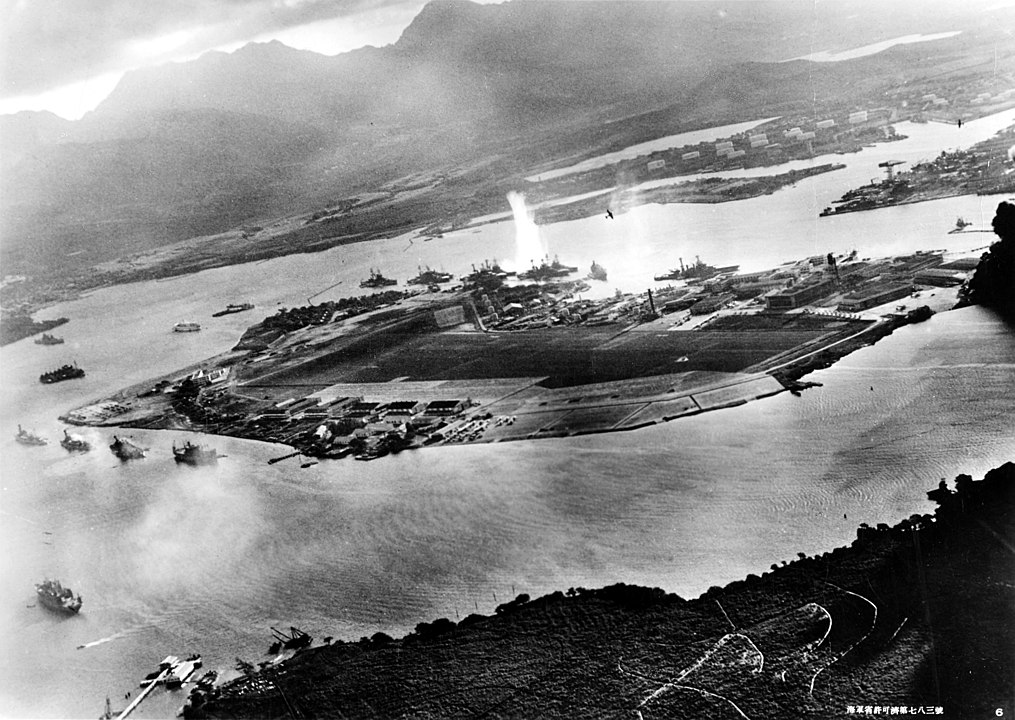
The first wave flew down the center of the island and along the east coast, hitting the airfields first so American fighters could not get off the ground, then the ships in the harbor.
7:48 a.m. · 183 aircraft
The first wave
Torpedo bombers skimmed across the harbor and launched special shallow-running torpedoes at the battleships moored along Ford Island. High-level bombers followed, and dive bombers and fighters struck Hickam, Wheeler, Kaneohe and the other airfields. Within minutes Oklahoma had capsized and Arizona had exploded.
8:54 a.m. · 167 aircraft
The second wave
Smoke now hid much of the harbor, and American anti-aircraft fire was heavier. The second wave went after ships that had not yet been hit and the airfields again. The battleship Nevada, trying to escape to the open sea, was bombed and deliberately run aground so she would not sink and block the channel.
Battleship Row
What happened to each battleship
Seven battleships were moored in pairs along the southeast side of Ford Island. Ships on the outside took most of the torpedoes.
Minute by minute
Timeline of the morning
All times are Hawaii time, Sunday, December 7, 1941.
Courage under fire
Heroes of the day
Fifteen Americans received the Medal of Honor for their actions at Pearl Harbor, most of them after their deaths.
USS West Virginia
Doris "Dorie" Miller
A mess attendant, Miller was collecting laundry when the attack began. He carried his mortally wounded captain to shelter, then took over an anti-aircraft machine gun he had never been trained to fire. He became the first Black American to receive the Navy Cross. He was killed in 1943 when his ship, the escort carrier Liscome Bay, was sunk.
USS Nevada
The ship that tried to escape
With her captain ashore, Nevada’s junior officers got the battleship underway under fire, the only battleship to move that morning. Her crew watched the Arizona burning as they passed. Hit again and again, Nevada was run aground at Hospital Point to keep her from sinking in the channel and trapping the rest of the fleet.
December 8, 1941
"A date which will live in infamy"
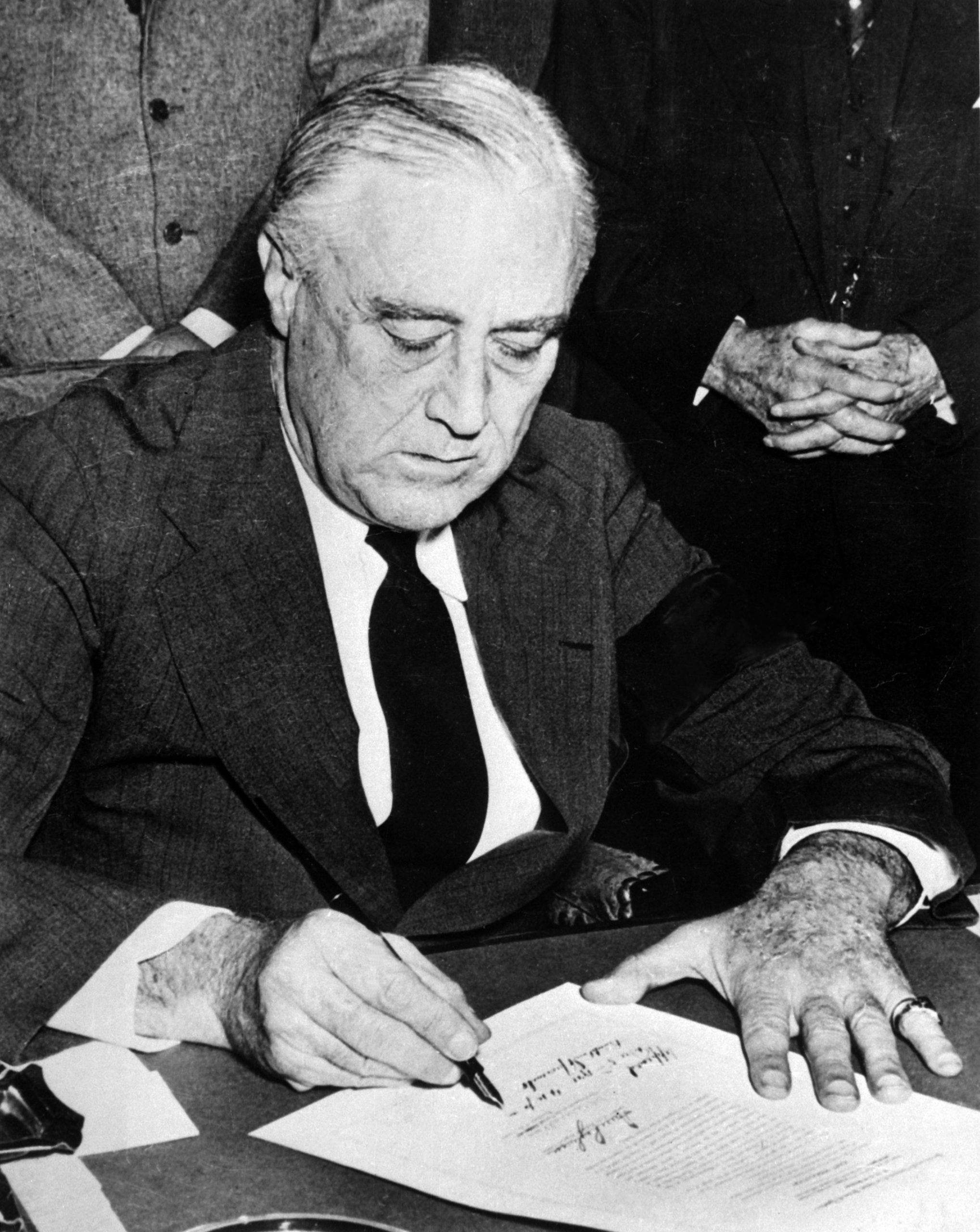
“Yesterday, December 7th, 1941, a date which will live in infamy, the United States of America was suddenly and deliberately attacked by naval and air forces of the Empire of Japan.”
President Franklin D. Roosevelt spoke to a joint session of Congress at 12:30 p.m. Within an hour Congress declared war on Japan, 82 to 0 in the Senate and 388 to 1 in the House. The lone vote against was Representative Jeannette Rankin of Montana, who had also voted against entering World War I. On December 11, Germany and Italy declared war on the United States.
What came next
From Pearl Harbor to Midway
Japan won a string of victories across the Pacific in the months after Pearl Harbor. But the ships it had missed, above all the aircraft carriers, struck back within half a year. Six of the eight battleships hit at Pearl Harbor were raised or repaired and returned to service, and five of them fought at the Battle of Surigao Strait in 1944.
People
Who was involved
Isoroku Yamamoto
Commander, Japanese Combined Fleet
Planned the attack, though he doubted Japan could win a long war against America. He was killed in 1943 when US fighters shot down his plane.
Chuichi Nagumo
Commander, Japanese carrier strike force
Led the six carriers to Hawaii. His decision not to launch a third strike spared Pearl Harbor’s fuel tanks and repair yards.
Mitsuo Fuchida
Leader of the air attack
Led the first wave and sent the famous “Tora! Tora! Tora!” signal. After the war he became a Christian and preached in the United States.
Husband E. Kimmel
Commander, US Pacific Fleet
Watched the attack from his headquarters. He was removed from command ten days later and blamed for the disaster for the rest of his life.
Walter Short
Commander, US Army in Hawaii
Had ordered aircraft bunched together to guard against sabotage, which made them easy targets. He was relieved alongside Kimmel.
Franklin D. Roosevelt
President of the United States
Turned the shock of the attack into national resolve with his “infamy” speech and led the country into the war.
Remembering Pearl Harbor
The USS Arizona Memorial
Dedicated in 1962, the white memorial spans the sunken hull of the Arizona, where more than 900 of her crew remain entombed. Oil still seeps to the surface from her tanks. The memorial is part of the Pearl Harbor National Memorial, which also includes the USS Oklahoma and USS Utah memorials, and the battleship Missouri, where Japan surrendered in 1945, now rests nearby.
Go deeper
Sources and further reading


- Day of Infamy, by Walter Lord (1957)
- At Dawn We Slept, by Gordon W. Prange (1981)
- Countdown to Pearl Harbor, by Steve Twomey (2016)
Meanwhile across the Pacific
Pearl Harbor was only one part of a vast, coordinated offensive. Within hours Japan also struck Malaya, Hong Kong, Guam, Wake Island and the Philippines, where American planes at Clark Field were caught on the ground nine hours after the news from Hawaii.