
1800

Thomas Jefferson
November 1800
Washington, D.C. becomes the capital
Congress meets for the first time in the unfinished Capitol, and President John Adams moves into the White House. Months later, Thomas Jefferson wins the bitter election of 1800.
Thomas Jefferson →1803

The Louisiana Purchase (green) on a modern map
The Louisiana Purchase
Jefferson buys the vast Louisiana Territory from Napoleon's France for $15 million, about four cents an acre. The purchase doubles the size of the United States.
1804–06

Lewis and Clark on the lower Columbia, by Charles Marion Russell
The Lewis and Clark Expedition
Meriwether Lewis and William Clark lead the Corps of Discovery up the Missouri River, across the Rockies and down the Columbia to the Pacific. Sacagawea, a Shoshone woman, travels with them as an interpreter.
1812
June 18, 1812
The War of 1812 begins
Angry over British attacks on American ships and support for Native resistance in the West, Congress declares war on Britain.
1814
August – September 1814
Washington burns; the Star-Spangled Banner
British troops burn the Capitol and the White House in August. Weeks later, watching Fort McHenry survive a night of bombardment at Baltimore, Francis Scott Key writes the poem that becomes the national anthem.
1815

The Battle of New Orleans, by Jean Hyacinthe de Laclotte
January 8, 1815
The Battle of New Orleans
General Andrew Jackson's army crushes a British assault outside New Orleans. The peace treaty had already been signed, but the victory makes Jackson a national hero.
1820

Henry Clay
The Missouri Compromise
Missouri enters as a slave state and Maine as a free state, and slavery is barred from the rest of the Louisiana Territory north of 36°30'. Henry Clay helps broker the deal.
Henry Clay →1823
The Monroe Doctrine
President James Monroe warns European powers not to start new colonies in the Americas.
1825

The Erie Canal at Lockport, New York, about 1855
October 26, 1825
The Erie Canal opens
The 363-mile canal links the Hudson River to Lake Erie, cutting shipping costs and making New York City the nation's busiest port.
1830

Andrew Jackson
The Indian Removal Act
President Andrew Jackson signs a law to move Native nations of the Southeast to lands west of the Mississippi.
Andrew Jackson →1836

The Fall of the Alamo, by Robert Jenkins Onderdonk
The Alamo and Texas independence
Mexican troops under Santa Anna storm the Alamo in San Antonio on March 6, killing all of its defenders, including Davy Crockett and Jim Bowie. Sam Houston's army wins Texas independence at San Jacinto on April 21.
1838–39
The Trail of Tears
The US Army forces about 16,000 Cherokee from their homes in Georgia and nearby states to Indian Territory (Oklahoma). Thousands, perhaps 4,000 or more, die along the way.
1844

Samuel Morse
May 24, 1844
Morse sends the first long-distance telegraph
Samuel Morse taps out "What hath God wrought" from Washington to Baltimore. News can now travel at the speed of electricity.
Samuel Morse →1846–48
The Mexican-American War
After the annexation of Texas, war with Mexico ends with the Treaty of Guadalupe Hidalgo. Mexico gives up California and most of the Southwest.
1848

Sutter's Mill, about 1850
Gold is discovered in California
James Marshall finds gold at Sutter's Mill on January 24. By 1849 some 300,000 people are rushing to California, which becomes a state in 1850.
1848
July 19 – 20, 1848
The Seneca Falls Convention
Elizabeth Cady Stanton and Lucretia Mott lead the first women's rights convention, which demands, among other rights, the right to vote.
1850

Henry Clay in the Senate, 1850
California enters as a free state, but a tough new Fugitive Slave Act forces Northerners to help return people who escape slavery.
1857
The Dred Scott decision
The Supreme Court rules that Black Americans cannot be citizens and that Congress cannot ban slavery in the territories, inflaming the North.
1859
John Brown's raid on Harpers Ferry
The abolitionist John Brown seizes the federal armory in Virginia, hoping to start a slave uprising. He is captured and hanged.
1860

Abraham Lincoln
Lincoln is elected; the South secedes
Abraham Lincoln wins the presidency on November 6 without a single Southern electoral vote. South Carolina leaves the Union on December 20, and six more states follow.
Abraham Lincoln →1861

Bombardment of Fort Sumter
April 12, 1861
Fort Sumter
Confederate guns open fire on the federal fort in Charleston Harbor. The fort surrenders the next day and the war begins.
The Civil War →1862
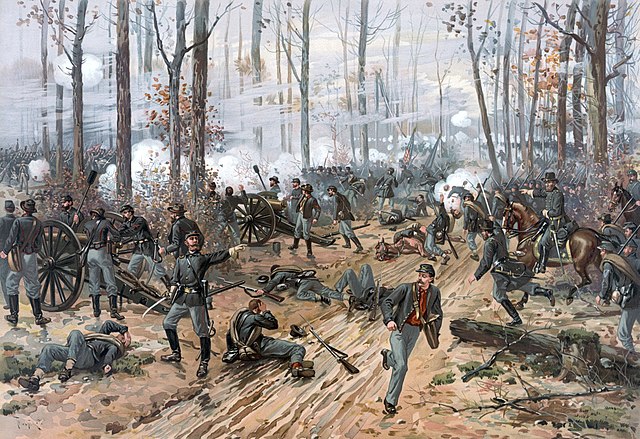
The Battle of Shiloh
Shiloh and Antietam
The two-day Battle of Shiloh in April shocks the nation with its losses. At Antietam on September 17, about 23,000 men are killed, wounded or missing in the bloodiest single day in American history.
1863
January 1, 1863
The Emancipation Proclamation
Lincoln declares enslaved people in the rebelling states "forever free" and opens the Union army to Black soldiers.
1863

The Battle of Gettysburg, by Thure de Thulstrup
Gettysburg and Vicksburg
Lee's invasion of the North is turned back at Gettysburg on July 1 to 3, and Vicksburg surrenders to Grant on July 4. In November, Lincoln's Gettysburg Address calls for "a new birth of freedom."
1864
Sherman's March to the Sea
General William T. Sherman captures Atlanta in September and marches to Savannah, destroying railroads and supplies along the way.
William T. Sherman →1865
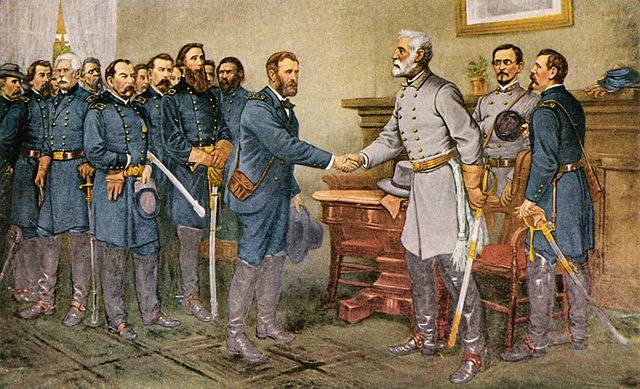
Lee surrenders at Appomattox Court House
April 9, 1865
Surrender at Appomattox
Robert E. Lee surrenders the Army of Northern Virginia to Ulysses S. Grant, effectively ending the war.
1865
April 14 – 15, 1865
Lincoln is assassinated
John Wilkes Booth shoots Lincoln at Ford's Theatre on April 14. He dies the next morning. In December the 13th Amendment abolishes slavery throughout the United States.
1868

Andrew Johnson
The 14th Amendment
The amendment makes everyone born in the United States a citizen and promises all people equal protection of the laws. The same year, President Andrew Johnson is impeached and escapes removal by one vote.
Andrew Johnson →1869

The meeting of the rails, by Andrew J. Russell
May 10, 1869
The transcontinental railroad is finished
The Union Pacific and Central Pacific meet at Promontory Summit, Utah, where a golden spike completes the line. A trip across the country now takes about a week instead of months.
1876

Bell opens the New York to Chicago telephone line, 1892
Bell's telephone; Little Bighorn
Alexander Graham Bell patents the telephone in March. In June, Lakota and Cheyenne warriors led by Sitting Bull and Crazy Horse destroy George Custer's command at the Little Bighorn.
Alexander Graham Bell →1877
Reconstruction ends
To settle the disputed election of 1876, federal troops are withdrawn from the South. Southern states soon strip Black citizens of their voting rights under Jim Crow laws.
1879

Edison's carbon-filament lamp
Edison's light bulb
Thomas Edison demonstrates a long-lasting electric light at Menlo Park, New Jersey. In 1882 his Pearl Street station begins lighting lower Manhattan.
Thomas Edison →1886

Unveiling the Statue of Liberty, by Edward Moran
October 28, 1886
The Statue of Liberty is dedicated
France's gift to the United States is unveiled in New York Harbor and becomes a symbol of welcome to immigrants.
1890
December 29, 1890
Wounded Knee
US soldiers kill more than 250 Lakota men, women and children at Wounded Knee Creek, South Dakota. The massacre marks the end of the Indian Wars on the Plains.
1892

Immigrants at Ellis Island, 1902
January 1, 1892
Ellis Island opens
The new federal immigration station in New York Harbor will process about 12 million immigrants before it closes in 1954.
1896
Plessy v. Ferguson
The Supreme Court upholds racial segregation under the rule of "separate but equal."
1898

Roosevelt and the Rough Riders, 1898
After the battleship Maine explodes in Havana harbor, the US goes to war with Spain. Theodore Roosevelt's Rough Riders charge up Kettle Hill and San Juan Heights, and the US gains Puerto Rico, Guam and the Philippines.
Theodore Roosevelt →


