
Home › People › US Presidents › Theodore Roosevelt
26th President · 1901–1909 · Republican
Theodore Roosevelt: The 26th President and Conservationist
Theodore Roosevelt overcame childhood asthma to become a rancher, author, police commissioner and the colonel of the Rough Riders. At 42 he became the youngest president. He broke up monopolies, protected about 230 million acres of public land, started the Panama Canal and won the Nobel Peace Prize. In 1912 he ran again as the Bull Moose candidate and survived an assassin’s bullet.
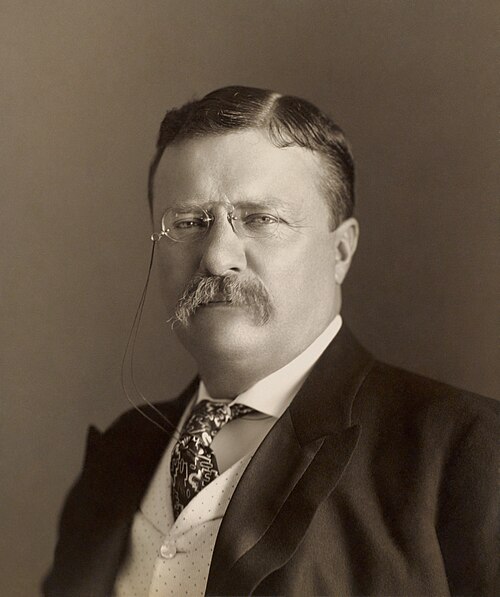
Theodore Roosevelt, photographed by Pach Brothers about 1904
Quick facts
Theodore Roosevelt at a glance
| Born | October 27, 1858, in New York City | |
| Died | January 6, 1919, at Sagamore Hill, Oyster Bay, New York, aged 60 | |
| President | 26th, from September 14, 1901, to March 4, 1909 | |
| Vice president | Charles W. Fairbanks (1905–1909) | |
| Party | Republican; Progressive (Bull Moose) in 1912 | |
| Education | Harvard College, 1880 | |
| Professions | Author, historian, rancher, soldier and public official | |
| Military | Colonel of the 1st US Volunteer Cavalry, the Rough Riders | |
| Wives | Alice Hathaway Lee (married 1880, died 1884); Edith Kermit Carow (married 1886) | |
| Children | Six: Alice, Theodore Jr., Kermit, Ethel, Archibald and Quentin | |
| Elections | Won in 1904; lost as a third-party candidate in 1912 | |
| Buried | Youngs Memorial Cemetery, Oyster Bay, New York |
The big picture in 30 seconds
Why he matters
- The youngest person ever to become president, at 42.
- Used the Sherman Antitrust Act to break up big monopolies.
- Protected about 230 million acres as national forests, parks, monuments and bird reserves.
- Started building the Panama Canal.
- The first American to win the Nobel Peace Prize, for ending the Russo-Japanese War.
- Signed the Pure Food and Drug Act and the Meat Inspection Act.
42
his age when he became president, the youngest ever
230M
acres of public land he protected
1906
the year he won the Nobel Peace Prize
35+
books he wrote, on history, nature, hunting and his own life
Early years
The strenuous life
Theodore Roosevelt was born on October 27, 1858, into a wealthy family in New York City. He was a sickly, asthmatic boy, and his father urged him to build up his body. He lifted weights, boxed and hiked, and he collected birds and animals. He graduated from Harvard in 1880 and published a history of the naval War of 1812 at 23.
Elected to the New York Assembly in 1881, he fought corruption. On February 14, 1884, his mother and his wife, Alice, died in the same house on the same day, two days after Alice gave birth to their daughter. In grief he went west to his cattle ranches in the Dakota Territory.
Reformer and Rough Rider
Back east, Roosevelt married Edith Carow, served six years on the Civil Service Commission and ran the New York City police. As assistant secretary of the Navy he readied the fleet for war with Spain. In 1898 he resigned to lead the Rough Riders, a volunteer cavalry regiment of cowboys and college athletes, and led a charge up Kettle Hill at San Juan. He came home a hero and was elected governor of New York.

Election of 1904
Elected in his own right
Electoral votes: 476 electors; 239 needed to win. Popular vote: Roosevelt 56.4%, Parker 37.6%
Election of 1912
The Bull Moose campaign
Electoral votes: 531 electors; 266 needed to win. Popular vote: Wilson 41.8%, Roosevelt 27.4%, Taft 23.2%, Debs 6.0%
The presidency, 1901–1909
A Square Deal
Roosevelt believed the president should act boldly for the public good, as a “steward of the people.” He promised a “Square Deal” for business owners, workers and consumers alike.
1902
The trustbuster
His Justice Department sued the Northern Securities railroad trust, and the Supreme Court broke it up in 1904. Dozens of other antitrust suits followed.
October 1902
The coal strike
When striking coal miners threatened the nation’s winter heat, Roosevelt brought owners and union to the table, the first time a president had settled a strike as a neutral referee.
October 16, 1901
Dinner with Booker T. Washington
Roosevelt invited the Black educator to dinner at the White House, the first such invitation. Southern newspapers erupted in anger.
June 30, 1906
Pure food and safe meat
After Upton Sinclair’s novel The Jungle exposed filthy meatpacking plants, Roosevelt signed the Meat Inspection Act and the Pure Food and Drug Act.
1907–1909
The Great White Fleet
Sixteen battleships painted white sailed around the world to show off American naval power.
1905
Peace at Portsmouth
Roosevelt brought Russia and Japan to a peace conference in Portsmouth, New Hampshire, ending their war and earning the Nobel Peace Prize.
Conservation
Protecting America's wild places
Roosevelt loved the outdoors more than any president before him. With his chief forester, Gifford Pinchot, he turned the federal government into a protector of forests, wildlife and scenery. In 1903 he camped in Yosemite with the naturalist John Muir, who urged him to save more wilderness.
He set aside the first federal bird reservation at Pelican Island, Florida, in 1903. The Antiquities Act of 1906 let him protect places like Devils Tower and the Grand Canyon as national monuments. In all, he protected about 230 million acres.

Conservation by the numbers
What Roosevelt protected
Each of these places is still protected today, from Alaska’s Tongass forest to the Grand Canyon.
Figures from the National Park Service. Many national forests were created by expanding or combining earlier forest reserves.
The Panama Canal
“I took the Isthmus”
Roosevelt wanted a canal across Central America so the Navy could move quickly between the oceans. When Colombia rejected a treaty, he backed a revolt in Panama in November 1903 and quickly signed a treaty with the new nation for a canal zone. Construction began in 1904; the canal opened in 1914.
In 1906 Roosevelt visited the works, the first sitting president to travel abroad. In the Roosevelt Corollary to the Monroe Doctrine, he claimed the right to step in to keep order in Latin America, a policy he summed up as “speak softly and carry a big stick.”

Later life
Bull Moose and the River of Doubt
After choosing William Howard Taft as his successor, Roosevelt went on an African safari. He returned angry that Taft had sided with conservatives and challenged him for the 1912 Republican nomination. When he lost, he formed the Progressive Party. On October 14, 1912, a man shot him in Milwaukee. The bullet was slowed by his folded speech and glasses case, and Roosevelt gave his speech anyway: “It takes more than that to kill a Bull Moose.”
In 1914 he explored an uncharted Amazon river in Brazil and nearly died. During World War I he urged the country to prepare for war; his youngest son, Quentin, a pilot, was killed in France in 1918. Roosevelt died in his sleep at Sagamore Hill on January 6, 1919.
“Speak softly and carry a big stick; you will go far.”
Theodore Roosevelt
Letter of January 26, 1900, quoting what he called a West African proverb
His life at a glance
Life timeline
People
Who's who in Roosevelt's story


Visit
Sagamore Hill
Sagamore Hill National Historic Site in Oyster Bay, New York, was Roosevelt’s home from 1885 until his death and his “Summer White House.” You can also visit his birthplace in Manhattan and Theodore Roosevelt National Park in North Dakota, where he ranched.