
1718
The French found New Orleans
Jean-Baptiste Le Moyne de Bienville founds La Nouvelle-Orleans near the mouth of the Mississippi. It becomes the capital of French Louisiana in 1722.
1732
Georgia, the thirteenth colony
King George II grants a charter to James Oglethorpe and other trustees. Savannah is founded in 1733 as a buffer against Spanish Florida.
1732

George Washington
February 22, 1732
George Washington is born
The future commander and first president is born on his family's plantation in Westmoreland County, Virginia.
George Washington →1735
The Zenger trial
A New York jury finds printer John Peter Zenger not guilty of libel for criticizing the royal governor, because what he printed was true. The case becomes a landmark for freedom of the press.
1739
The Stono Rebellion
About 20 enslaved people near the Stono River in South Carolina rise up and march south toward freedom in Spanish Florida, gathering others along the way. Militia crush the revolt, and the colony passes harsher slave laws.
1740s
The Great Awakening
Preachers such as George Whitefield and Jonathan Edwards draw huge crowds in every colony. The revival encourages colonists to question established authority.
1752

Benjamin Franklin
Benjamin Franklin's kite experiment
Franklin reports flying a kite in a thunderstorm to show that lightning is electricity. His lightning rod soon protects buildings across the colonies and Europe.
The Founders →1754
The French and Indian War begins
A young Virginia officer, George Washington, clashes with French troops in the Ohio Valley. The fighting grows into a world war between Britain and France. The same year, Franklin's Albany Plan proposes uniting the colonies.
1763
The Treaty of Paris and the Proclamation Line
France gives up Canada and its lands east of the Mississippi to Britain. King George III then forbids colonists to settle west of the Appalachian Mountains, angering land-hungry settlers.
1765
The Stamp Act
Parliament taxes newspapers, legal papers and playing cards. Colonists protest "no taxation without representation," and nine colonies send delegates to the Stamp Act Congress. Parliament repeals the tax in 1766.
1770
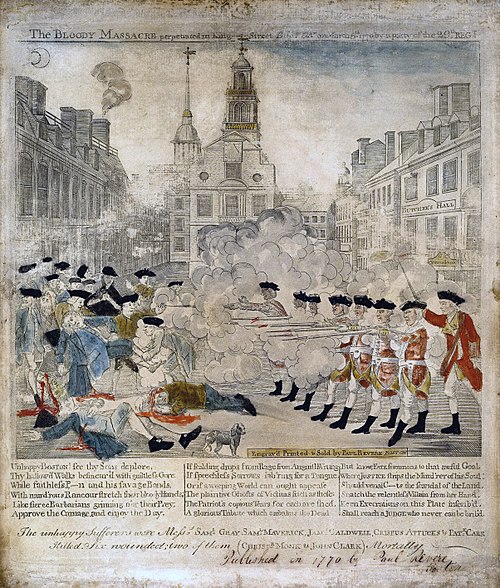
Paul Revere's engraving of the Boston Massacre
March 5, 1770
The Boston Massacre
British soldiers fire into a crowd of taunting Bostonians, killing five men, including Crispus Attucks. Paul Revere's engraving of the scene spreads anger across the colonies.
1773
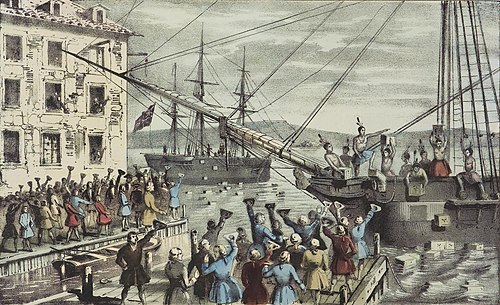
The Destruction of Tea at Boston Harbor, Currier lithograph
December 16, 1773
The Boston Tea Party
Colonists disguised as Mohawk warriors dump 342 chests of East India Company tea into Boston Harbor to protest the Tea Act. Parliament responds with the Coercive Acts, which colonists call the Intolerable Acts.
1774
The First Continental Congress
Delegates from 12 colonies meet in Philadelphia, agree to boycott British goods and plan to meet again.
1775

The Battle of Lexington, engraving by Amos Doolittle, 1775
April 19, 1775
Lexington and Concord
British troops march to seize colonial weapons. Militia meet them at Lexington and at Concord's North Bridge, firing "the shot heard round the world." The Revolutionary War has begun.
1775
Bunker Hill and a new commander
In June, colonists inflict heavy losses on the British at the Battle of Bunker Hill. Congress names George Washington commander of the new Continental Army.
1776
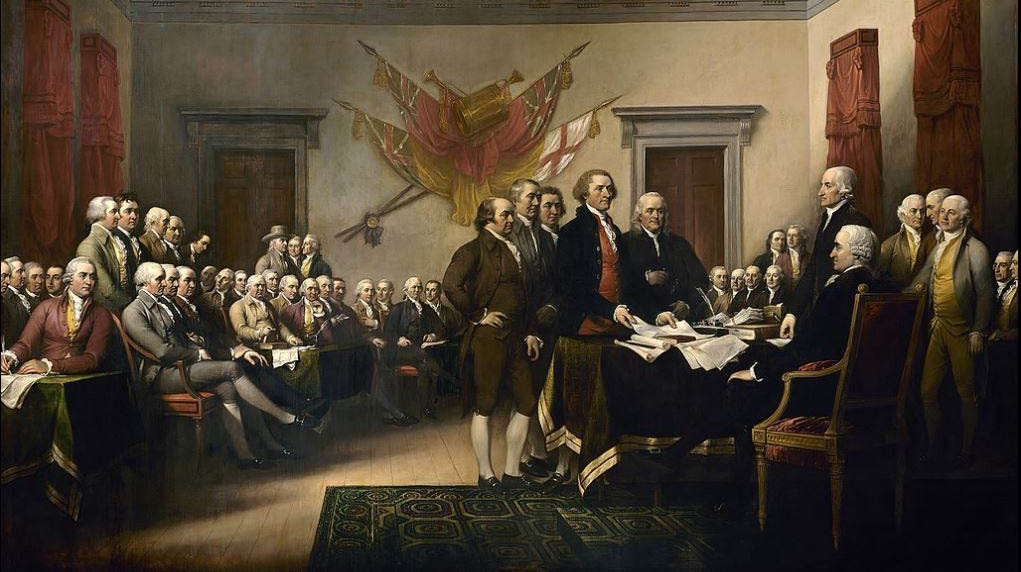
The Declaration of Independence, by John Trumbull
July 4, 1776
The Declaration of Independence
Congress adopts Thomas Jefferson's declaration that "all men are created equal" and that the colonies are free and independent states.
Revolution and Founding →1776

Washington Crossing the Delaware, by Emanuel Leutze, 1851
December 25 – 26, 1776
Washington crosses the Delaware
On Christmas night, Washington leads his army across the icy Delaware River and surprises Hessian troops at Trenton, New Jersey, a badly needed victory.
1777
Victory at Saratoga
American forces force British General John Burgoyne to surrender his army in New York. The win convinces France to sign an alliance with the United States in 1778.
1777–78

Washington and Lafayette at Valley Forge
Winter at Valley Forge
Washington's army camps in Pennsylvania through a hard winter. About 2,000 soldiers die of disease, but Baron von Steuben drills the survivors into a disciplined fighting force.
1781

Surrender of Lord Cornwallis, by John Trumbull
October 19, 1781
Victory at Yorktown
Trapped by Washington's army and a French fleet, British General Lord Cornwallis surrenders more than 7,000 troops in Virginia. It is the last major battle of the war.
1783

The American peace commissioners, by Benjamin West
September 3, 1783
The Treaty of Paris
Britain recognizes the independence of the United States, with borders reaching west to the Mississippi River.
1786
Shays' Rebellion
Debt-ridden Massachusetts farmers led by Daniel Shays close courts and march on the Springfield armory. The revolt convinces many leaders that the national government is too weak.
1787

Scene at the Signing of the Constitution, by Howard Chandler Christy
September 17, 1787
The Constitution is written
Delegates meet in Philadelphia from May to September and write a new plan of government with a president, a two-house Congress and a Supreme Court. 39 delegates sign it on September 17.
1787
The Northwest Ordinance
Congress sets up a plan for turning the lands north of the Ohio River into new states and bans slavery there.
1788

The Federalist, first edition, 1788
June 21, 1788
The Constitution is ratified
New Hampshire becomes the ninth state to ratify, putting the Constitution into effect. The Federalist essays by Hamilton, Madison and Jay helped win the argument.
1789
George Washington
April 30, 1789
George Washington becomes president
Washington takes the oath of office at Federal Hall in New York City, then the capital.
George Washington →1791
December 15, 1791
The Bill of Rights
The first ten amendments to the Constitution, protecting freedom of speech, religion and the press, the right to a jury trial and more, are ratified.
1793
Eli Whitney's cotton gin
Whitney's machine pulls the seeds out of cotton fifty times faster than by hand. Cotton growing explodes across the South, and so does the demand for enslaved labor.
1794
The Whiskey Rebellion
Pennsylvania farmers revolt against a federal tax on whiskey. Washington leads nearly 13,000 militia to restore order, showing the new government can enforce its laws.
1796

John Adams
John Adams elected president
In the first contested presidential election, Adams defeats Thomas Jefferson, who becomes vice president.
John Adams →1799
December 14, 1799
Death of George Washington
Washington dies at Mount Vernon. Henry Lee eulogizes him as "first in war, first in peace, and first in the hearts of his countrymen."


