
Home › People › US Presidents › Woodrow Wilson
28th President · 1913–1921 · Democrat
Woodrow Wilson: The World War I President
Woodrow Wilson was a Virginia-born professor who became president of Princeton, governor of New Jersey and then president of the United States. He remade the nation’s banking and tax laws, led America through World War I, and dreamed of a League of Nations to keep the peace, a dream his own country turned down.
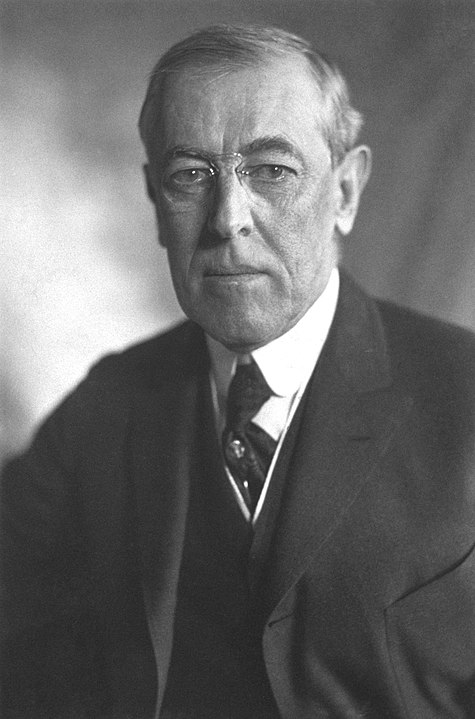
Woodrow Wilson, about 1913
Quick facts
Woodrow Wilson at a glance
| Born | December 28, 1856, in Staunton, Virginia, as Thomas Woodrow Wilson | |
| Died | February 3, 1924, in Washington, D.C., aged 67 | |
| President | 28th, from March 4, 1913, to March 4, 1921 (two terms) | |
| Vice president | Thomas R. Marshall of Indiana | |
| Party | Democratic | |
| Education | College of New Jersey (Princeton), 1879; law at the University of Virginia; Ph.D., Johns Hopkins University, 1886 | |
| Before the White House | Professor, president of Princeton University (1902–1910), governor of New Jersey (1911–1913) | |
| Wives | Ellen Louise Axson, married 1885 (died 1914); Edith Bolling Galt, married 1915 | |
| Children | Three daughters: Margaret, Jessie and Eleanor | |
| Elections | Won in 1912 over Theodore Roosevelt and William Howard Taft; won again in 1916 over Charles Evans Hughes | |
| Honors | Nobel Peace Prize for 1919, for his work founding the League of Nations | |
| Buried | Washington National Cathedral, the only president buried in the nation's capital |
The big picture in 30 seconds
Why he matters
- Signed the Federal Reserve Act of 1913, which still shapes America's money and banking today.
- Brought in the modern federal income tax and new laws against monopolies, child labor and long railroad workdays.
- Led the United States into World War I in 1917, sending about two million soldiers to France.
- Set out the Fourteen Points, his plan for a fair peace and a League of Nations.
- Was the first sitting president to travel to Europe, and helped write the Treaty of Versailles.
- His record on race was a step backward: his government segregated many federal offices.
28th
President of the United States, and the only one to earn a Ph.D.
2 million
American soldiers sent to France in the American Expeditionary Forces
14 Points
his January 1918 plan for peace and a League of Nations
Nobel Prize
the Peace Prize for 1919, the second president to win it
Early years
A minister's son from the South
Thomas Woodrow Wilson was born on December 28, 1856, in the manse of the First Presbyterian Church in Staunton, Virginia, where his father, the Reverend Joseph Ruggles Wilson, was pastor. His mother, Janet “Jessie” Woodrow, was born in England. The family soon moved to Augusta, Georgia, and young “Tommy” grew up during the Civil War and Reconstruction. Among his earliest memories was hearing that Abraham Lincoln had been elected and that there would be war.
He was slow to learn to read, but he grew into a serious student and a gifted speaker. After a year at Davidson College he went to the College of New Jersey (later Princeton), graduating in 1879. He studied law at the University of Virginia and opened a law office in Atlanta in 1882, but he disliked the work and soon left it.
Scholar and teacher
Wilson went back to school at Johns Hopkins University, where his book Congressional Government (1885) made his name. He earned a Ph.D. in history and political science in 1886, which still makes him the only president with a doctorate. He taught at Bryn Mawr College and Wesleyan University before Princeton hired him in 1890.
In 1885 he married Ellen Louise Axson, a talented painter and a minister’s daughter from Georgia. They had three daughters, Margaret, Jessie and Eleanor.

Princeton and New Jersey
From campus to statehouse
Wilson was a popular lecturer at Princeton, and in 1902 the trustees made him president of the university, the first who was not a minister. He raised standards, hired dozens of young teachers called preceptors to work closely with students, and tried to replace the exclusive eating clubs with residential colleges. His fights with trustees and alumni over those plans made him famous as a reformer.
Governor of New Jersey
New Jersey’s Democratic bosses picked Wilson for governor in 1910, expecting an easy man to control. Once elected, he turned on them. In one year he pushed through direct primary elections, a law against corrupt practices, workers’ compensation and controls on utilities. Progressives across the country took notice.
The election of 1912
At the Democratic convention in Baltimore, Wilson won the nomination on the 46th ballot. Republicans then split: former president Theodore Roosevelt ran on the new Progressive (“Bull Moose”) ticket against President William Howard Taft. With the Republican vote divided, Wilson won 40 of the 48 states, though only about 42 percent of the popular vote.
Election of 1912
A four-way race
Electoral votes: 531 electors; 266 needed to win. Popular vote: Wilson 6.3 million, Roosevelt 4.1 million, Taft 3.5 million
Election of 1916
“He kept us out of war”
Electoral votes: 531 electors; 266 needed to win. Popular vote: Wilson 9.1 million (49.2%), Hughes 8.5 million (46.1%)
The first term, 1913–1917
The New Freedom at home
Wilson took the oath on March 4, 1913. A month later he did something no president had done since John Adams: he went to the Capitol and spoke to Congress in person. With Democrats in charge of both houses, he passed more major laws in his first two years than almost any president before him.
December 23, 1913
The Federal Reserve
After years of bank panics, the Federal Reserve Act created a central banking system of 12 regional banks overseen by a board in Washington. It could supply money in a crisis, and it remains the heart of the US financial system.
October 1913
Lower tariffs and an income tax
The Underwood Tariff cut taxes on imported goods. To replace the lost money, it used the brand-new 16th Amendment to start a permanent federal income tax, at first paid only by the richest Americans.
1914
Fighting monopolies
The Federal Trade Commission was set up to stop unfair business practices, and the Clayton Antitrust Act strengthened the laws against monopolies and protected labor unions’ right to strike.
1916
Workers and farmers
The Adamson Act gave railroad workers an eight-hour day, the Keating-Owen Act tried to ban goods made by child labor, and the Federal Farm Loan Act offered farmers cheaper credit. He also named Louis Brandeis the first Jewish Supreme Court justice.
1913 onward
A step backward on race
Wilson’s cabinet allowed the segregation of Black workers in the Post Office, the Treasury and other federal offices, and many Black civil servants were demoted or fired. Black leaders who had supported him felt betrayed. It is the darkest part of his record.
1914–1917
Trouble with Mexico
Revolution in Mexico drew Wilson in. US forces occupied the port of Veracruz in 1914, and after Pancho Villa raided Columbus, New Mexico, in 1916, General John J. Pershing led 10,000 troops into Mexico in a long, failed chase.
Neutrality, 1914–1917
“Neutral in fact as well as in name”
When war broke out in Europe in August 1914, Wilson asked Americans to stay neutral “in thought as well as in action.” The same month, his wife Ellen died of kidney disease in the White House. He told friends he hoped the war would not touch America.
But German submarines kept pulling the country in. On May 7, 1915, a U-boat sank the British liner Lusitania, killing 1,198 people, 128 of them Americans. Wilson sent notes of protest so strong that his secretary of state, William Jennings Bryan, resigned rather than sign them. Germany promised in 1916 to stop sinking passenger ships without warning.
A second marriage
In March 1915 Wilson met Edith Bolling Galt, a Washington widow descended from Pocahontas. They married on December 18, 1915. Edith became his constant companion and, after his stroke in 1919, the gatekeeper of his presidency.
The road to war
Wilson won reelection in 1916 on the slogan “He kept us out of war.” Within weeks of his second inauguration, Germany resumed unrestricted submarine warfare, and British codebreakers revealed the Zimmermann Telegram, in which Germany offered Mexico an alliance and the return of Texas, New Mexico and Arizona. After U-boats sank more American ships, Wilson decided there was no choice left.

World War I, 1917–1918
“Safe for democracy”
On the evening of April 2, 1917, Wilson asked a joint session of Congress to declare war on Germany. The Senate voted 82 to 6 and the House 373 to 50, and on April 6 the United States entered World War I. Wilson then led the country through a total war that changed American life at home as much as it changed Europe.

Over there
Raising an army of millions
The Selective Service Act of May 1917 registered 24 million men, and about 2.8 million were drafted. Under General John J. Pershing, some two million Americans reached France. They helped stop Germany’s last great offensives in 1918 and fought the Meuse-Argonne campaign, the largest battle in US Army history. About 116,000 Americans died in the war, more of them from disease, including the 1918 influenza pandemic, than in combat.
January 8, 1918
The Fourteen Points
Wilson told Congress what America was fighting for: open diplomacy, freedom of the seas, free trade, fewer weapons, the right of peoples to choose their own governments, and a “general association of nations” to keep the peace.
1917–1918
Free speech in wartime
The Espionage Act of 1917 and the Sedition Act of 1918 made it a crime to speak against the war or the draft. Thousands were prosecuted, including Socialist leader Eugene Debs, who got ten years in prison. Wilson refused to pardon him.
1917–1920
Votes for women
Suffragists picketed the White House as “Silent Sentinels.” Wilson at first said it was a matter for the states, then in 1918 urged the Senate to pass the 19th Amendment as a war measure. It was ratified in August 1920.
November 11, 1918
The Armistice
Germany, out of men and supplies and facing revolution at home, asked for peace based on the Fourteen Points. The guns fell silent at 11 a.m. on November 11, 1918.
“The world must be made safe for democracy. Its peace must be planted upon the tested foundations of political liberty.”
Woodrow Wilson, address to Congress
April 2, 1917, asking for a declaration of war against Germany
The peacemaker, 1918–1919
Six months in Paris
In December 1918 Wilson sailed for France aboard the liner George Washington, the first sitting president to visit Europe. Huge crowds in Paris, London and Rome cheered him as a hero. At the peace conference he spent months bargaining with the leaders of Britain, France and Italy, and he made the Covenant of the League of Nations the first part of the treaty.
Sails from New York (Hoboken) on the George Washington, lands at Brest and goes by train to Paris.
Visits London, staying with King George V at Buckingham Palace.
Tours Italy and meets the king and the Pope in Rome. The peace conference opens January 18.
Sails home to Boston to sign laws and defend the League before Congress adjourns.
Returns to France for the final, hardest months of bargaining.
Signs the Treaty of Versailles in the Hall of Mirrors, then sails home to New York.
The Treaty of Versailles
A compromise peace
The “Big Four” (Wilson, David Lloyd George of Britain, Georges Clemenceau of France and Vittorio Orlando of Italy) made the big decisions. Wilson wanted a fair peace without revenge, but Britain and France wanted Germany punished. The treaty, signed on June 28, 1919, made Germany accept blame for the war, give up land and colonies, and pay huge reparations.
Wilson gave ground on many of his Fourteen Points, but he won his great prize: the League of Nations, a world body where countries would settle disputes instead of going to war. He believed the League could later fix the treaty’s mistakes.

The fight for the League
Defeat at home, and a stroke
Under the Constitution, the Senate had to approve the treaty by a two-thirds vote. Republican leader Henry Cabot Lodge, chairman of the Foreign Relations Committee, demanded changes, mainly to Article X, which he feared could force the US into foreign wars without a vote of Congress. Wilson refused to accept them.
In September 1919 he took his case to the people with a train tour of the West, covering about 8,000 miles and giving some 40 speeches in three weeks. On September 25, after a speech in Pueblo, Colorado, he collapsed with exhaustion. A week later, back in Washington, he suffered a severe stroke that paralyzed his left side.
“Mrs. Wilson's stewardship”
For months Wilson was hidden from the public. Edith and his doctor, Cary Grayson, decided who and what reached him, a period she later called her “stewardship.” Critics called it a petticoat government. The 25th Amendment, which now covers a disabled president, did not exist until 1967.
The treaty fails
Wilson told Democrats to vote against the treaty with Lodge’s changes. It failed in November 1919 and again on March 19, 1920, when it fell seven votes short of two-thirds. The United States never joined the League of Nations, and in 1921 it made a separate peace with Germany.
Final years
The house on S Street
Wilson’s last months in office brought two new amendments into force: Prohibition (the 18th), whose enforcement law he vetoed only to be overruled by Congress, and women’s suffrage (the 19th). Too ill to run again, he watched Republican Warren G. Harding win the 1920 election in a landslide.
On March 4, 1921, the Wilsons moved to a brick house on S Street in Washington. He kept an office and a law partnership in name, and on Armistice Day 1923 he spoke to a crowd from his front steps. He died at home on February 3, 1924, and was buried in the Washington National Cathedral.
How he is remembered
Historians usually rank Wilson among the more important presidents for the Federal Reserve, his reforms and his vision of a world organization, an idea that returned as the United Nations in 1945. His views and policies on race, including the segregation of federal offices, have led to sharp criticism; in 2020 Princeton removed his name from its school of public and international affairs.
His life at a glance
Life timeline
People
Who's who in Wilson's story


Visit
Wilson's birthplace and last home
In Staunton, Virginia, the Woodrow Wilson Presidential Library at his birthplace manse shows his life and times, including his 1919 Pierce-Arrow limousine. In Washington, D.C., the President Woodrow Wilson House on S Street, where he spent his last years, is kept as he and Edith left it. His tomb is in the Washington National Cathedral.