
Home › World History › Ancient Rome › The Roman Empire
Ancient Rome · 27 BC–AD 476
The Roman Empire: Augustus, the Pax Romana and Rome at Its Height
The Roman Empire began in 27 BC, when Octavian took the name Augustus and became Rome’s first emperor. For about 200 years, a time called the Pax Romana or Roman Peace, the empire was stable and rich. At its largest, in AD 117, it ruled perhaps 60 million people from Britain to Egypt and Iraq, linked by roads, laws, trade and the Latin and Greek languages.
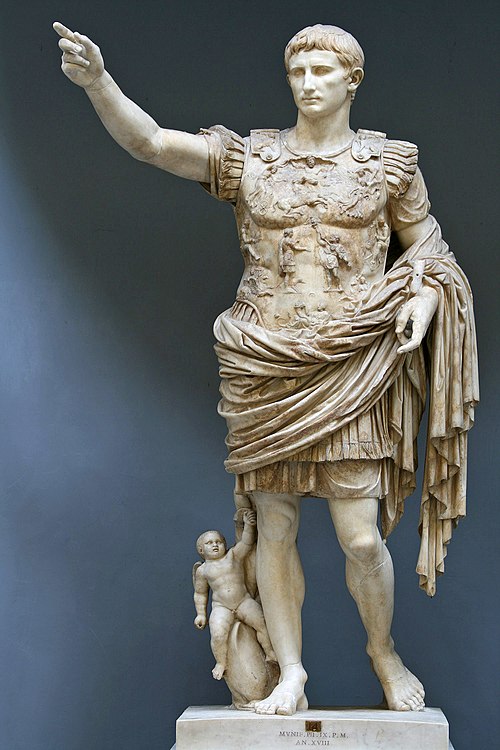
Augustus of Prima Porta, a statue of Rome’s first emperor.
Quick facts
The Roman Empire at a glance
- Dates: 27 BC to AD 476 in the West; the Eastern Empire lasted until 1453
- First emperor: Augustus (Octavian), who ruled from 27 BC to AD 14
- Pax Romana: About 27 BC to AD 180, two centuries of peace and prosperity
- Largest size: AD 117 under Trajan: about 5 million square kilometers (2 million square miles)
- Population: Perhaps 50 to 70 million people, about a quarter of the world’s population
- Roads: About 80,000 kilometers (50,000 miles) of paved highways
- Languages: Latin in the west, Greek in the east
- End in the West: AD 476, when the last western emperor, Romulus Augustulus, was overthrown
The big picture in 30 seconds
Why the Roman Empire matters
- Its roads, laws and cities shaped Europe.
- Latin became Spanish, French and Italian.
- Christianity spread through the empire.
- Its buildings still stand on three continents.
About 50,000
seats in the Colosseum
About 60 million
people at its height
80,000 km
of paved Roman roads
About 200 years
of the Pax Romana
A new kind of ruler
How Augustus turned the Republic into an empire
After Julius Caesar was murdered in 44 BC, his adopted son Octavian fought a long civil war. In 31 BC he defeated Mark Antony and Cleopatra at the sea battle of Actium. Rome now had one master, but Octavian had seen what happened to Caesar when he acted like a king.
So in 27 BC Octavian announced that he was restoring the Roman Republic. The grateful Senate gave him the name Augustus, meaning “revered one.” He kept the Senate, the consuls and the elections, but he controlled the army, the money and the most important provinces. He called himself princeps, “first citizen,” but in reality he was Rome’s first emperor.
“A city of marble”
Augustus ruled for 41 years. He built temples, aqueducts and a fire brigade, set up a standing army of professional soldiers, and boasted that he had found Rome a city of brick and left it a city of marble. The month of August is named after him.

What was the Pax Romana?
The “Roman Peace,” about 200 years from Augustus to Marcus Aurelius when the empire had few major wars inside its borders and trade flourished.
The map
From Britain to the Persian Gulf
The Mediterranean was the heart of the empire; Romans called it Mare Nostrum, “our sea.” Emperor Claudius added Britain in AD 43, and Trajan conquered Dacia (modern Romania) and, briefly, Mesopotamia.
Trajan’s successor Hadrian decided the empire was big enough. He gave up Mesopotamia and built walls to guard the frontiers, including Hadrian’s Wall across northern Britain, begun in AD 122.
The emperors
Famous emperors of Rome
Some emperors were wise and able; others were cruel or mad. These are among the best known.
Augustus, 27 BC–AD 14
The first emperor. He ended the civil wars, began the Pax Romana and rebuilt Rome.
Nero, AD 54–68
Ruled during the Great Fire of Rome in AD 64, blamed the Christians, and was remembered as a cruel tyrant.
Vespasian and Titus, AD 69–81
Ended a year of civil war and built the Colosseum. Under Titus, Vesuvius buried Pompeii.
Trajan, AD 98–117
A soldier-emperor who expanded the empire to its greatest size. His column in Rome shows his wars in Dacia.
Hadrian, AD 117–138
Traveled the whole empire, built Hadrian’s Wall and rebuilt the Pantheon in Rome.
Marcus Aurelius, AD 161–180
A philosopher-emperor who wrote the Meditations. His death is often taken as the end of the Pax Romana.
Life in the empire
Bread, circuses and the Colosseum
The city of Rome had about a million people, more than any city in Europe would have again until London around 1800. Most lived in crowded apartment blocks called insulae. The government handed out free grain to poor citizens, and emperors kept the crowds happy with spectacular shows. The poet Juvenal complained that the people wanted only “bread and circuses.”
The Colosseum, opened in AD 80, held about 50,000 spectators who watched gladiators fight each other and wild animals. At the Circus Maximus, up to 150,000 people cheered on chariot racing teams.
Roads, aqueducts and baths
Roman engineers built straight, paved roads across the empire, and aqueducts that carried fresh water for miles to cities, fountains and huge public baths. Roman concrete was so strong that the dome of the Pantheon, finished around AD 125, is still the world’s largest unreinforced concrete dome.

“All roads lead to Rome”
Every Roman road was measured from a golden milestone in the Forum. Some Roman roads are still used today.
Key people
Emperors of the Pax Romana
Augustus
63 BC–AD 14
First Roman emperor
Julius Caesar’s heir. He ruled for 41 years and turned the Republic into an empire.

Trajan
AD 53–117
Emperor, 98–117
Born in Spain, he was the first emperor from outside Italy and led the empire to its greatest size.

Marcus Aurelius
AD 121–180
Emperor, 161–180
The last of the “Five Good Emperors,” remembered for his wisdom and his book of thoughts.
Why it mattered
Rome’s lasting legacy
The Roman Empire left its mark everywhere. Latin grew into Italian, French, Spanish, Portuguese and Romanian, and gave English thousands of words. Roman law became the basis of the legal systems of much of Europe and Latin America. Many European cities, including London, Paris and Vienna, began as Roman towns.
Christianity, born in the Roman province of Judaea, spread along Roman roads and sea lanes. Emperor Constantine became a Christian in the 300s, and by the end of that century it was the official religion of the empire. The Western Empire fell in AD 476, but the Eastern, or Byzantine, Empire lasted another thousand years.
27 BC
Augustus becomes emperor
AD 80
the Colosseum opens
AD 117
the empire at its largest
AD 313
Christianity is legalized
Timeline
The Roman Empire, 31 BC–AD 476
- 31 BC Octavian defeats Antony and Cleopatra at Actium.
- 27 BC Octavian becomes Augustus, the first emperor.
- AD 9 Three legions are destroyed in the Teutoburg Forest in Germany.
- About AD 30 Jesus is crucified in Jerusalem under Pontius Pilate.
- AD 43 Emperor Claudius invades Britain.
- AD 64 The Great Fire of Rome under Nero.
- AD 79 Mount Vesuvius buries Pompeii.
- AD 80 The Colosseum opens with 100 days of games.
- AD 117 The empire reaches its largest size under Trajan.
- AD 122 Work begins on Hadrian’s Wall.
- AD 180 Marcus Aurelius dies; the Pax Romana ends.
- AD 212 Almost all free people in the empire become Roman citizens.
- AD 235–284 The Crisis of the Third Century: 26 emperors in 50 years.
- AD 313 Constantine legalizes Christianity.
- AD 330 Constantinople becomes the new capital.
- AD 395 The empire is split into East and West for good.
- AD 476 The last western emperor is overthrown.
“I found Rome a city of bricks and left it a city of marble.”
Augustus
As reported by the historian Suetonius
The bigger story
Ancient Rome, 753 BC–AD 476
Our Ancient Rome overview tells the whole story in one place: the kings, the Republic and its wars, Julius Caesar, the emperors, daily life, and the fall of the West.
Go deeper
Sources and further reading
- SPQR: A History of Ancient Rome, by Mary Beard (2015)
- Pax: War and Peace in Rome’s Golden Age, by Tom Holland (2023)
- Augustus: First Emperor of Rome, by Adrian Goldsworthy (2014)
- More recommended books