
Home › World History › Ancient Rome › Julius Caesar
Ancient Rome · The end of the Republic · 100–44 BC
Julius Caesar: Rise to Power, Crossing the Rubicon and Assassination
Julius Caesar was a Roman general and politician who conquered Gaul, won a civil war, and made himself dictator of Rome. In 49 BC he crossed the Rubicon River with his army, defying the Senate. Five years later, on the Ides of March, 44 BC, a group of senators stabbed him to death. His murder did not save the Roman Republic; instead it led to his heir Augustus becoming the first emperor.

Bust of Julius Caesar in the Vatican Museums.
Quick facts
Julius Caesar at a glance
- Lived: July 12 or 13, 100 BC to March 15, 44 BC
- Born: Rome, into an old but not wealthy patrician family
- Offices: Priest, general, consul (59 BC), and finally dictator for life (44 BC)
- Greatest conquest: Gaul, roughly modern France and Belgium, 58–50 BC
- Famous moment: Crossing the Rubicon River into Italy with his army, January 49 BC
- Lasting gift: The Julian calendar of 365 days with a leap year, basis of the calendar we use today
- Death: Stabbed 23 times by senators in Rome on the Ides of March, 44 BC
- Result: Civil war, then the rise of his adopted son Octavian as Augustus, the first emperor
The big picture in 30 seconds
Why Julius Caesar matters
- He ended 500 years of the Roman Republic.
- His calendar is still the base of ours.
- His name became a title: Kaiser and Tsar.
- His murder is one of history’s most famous.
8 years
conquering Gaul, 58–50 BC
About 1 million
Gauls killed or enslaved, by ancient counts
49 BC
Caesar crosses the Rubicon
23
stab wounds on the Ides of March
Rise to power
From young noble to conqueror of Gaul
Gaius Julius Caesar was born in 100 BC into a patrician family that claimed descent from the goddess Venus. As a young man he was captured by pirates, who asked for a ransom of 20 talents of silver. Caesar laughed and told them to ask for 50. After he was freed, he raised a fleet, caught the pirates and had them executed, just as he had promised.
Caesar was a gifted speaker and spent huge sums on public games to win the people’s love. In 60 BC he made a secret alliance, the First Triumvirate, with the general Pompey and Crassus, the richest man in Rome. With their help he was elected consul in 59 BC.
The conquest of Gaul
Caesar then took command in Gaul. In eight years of war he conquered the whole region, bridged the Rhine and twice landed in Britain. At Alesia in 52 BC he trapped the Gallic leader Vercingetorix behind two rings of walls and forced him to surrender. Caesar’s own book about the war made him a hero in Rome.

“I came, I saw, I conquered”
After a lightning victory at Zela in 47 BC, Caesar sent Rome a three-word report: Veni, vidi, vici.
The map
From Gaul to Egypt
Caesar fought across the whole Roman world. After conquering Gaul and crossing to Britain, he marched on Rome in 49 BC and chased Pompey to Greece, where he beat him at Pharsalus in 48 BC.
Pompey fled to Egypt and was murdered there. Caesar followed, sided with the young queen Cleopatra in her fight for the throne, then won further battles in Asia Minor, Africa and Spain before returning to Rome as its master.
His rise and fall
Julius Caesar, step by step
In just sixteen years Caesar went from consul to dictator to murder victim.
60 BC: the First Triumvirate
Caesar, Pompey and Crassus agree to work together to control Roman politics, and Caesar becomes consul.
58–50 BC: the Gallic Wars
Caesar conquers Gaul, gaining fame, riches and an army of veterans loyal to him rather than to the Senate.
January 49 BC: the Rubicon
Ordered to give up his army, Caesar instead crosses the Rubicon, the border of Italy, saying “the die is cast.”
48 BC: Pharsalus
Caesar defeats Pompey in Greece. Pompey flees to Egypt, where he is killed. Caesar meets Cleopatra.
44 BC: dictator for life
Caesar rules alone, reforms the calendar and fills the Senate with his supporters. Many fear he wants to be king.
March 15, 44 BC: the Ides of March
About 60 senators led by Brutus and Cassius stab Caesar to death at a meeting of the Senate.
March 15, 44 BC
The Ides of March
On the morning of March 15, called the Ides in the Roman calendar, Caesar went to a Senate meeting in a hall next to the Theater of Pompey. A fortune-teller had warned him to beware the Ides of March, and his wife Calpurnia had begged him to stay home.
As Caesar sat down, a senator tugged at his toga as a signal. The conspirators drew daggers hidden under their robes and struck him again and again. Among them was Marcus Brutus, a man Caesar had pardoned and trusted. Caesar fell at the foot of a statue of his old rival Pompey.
What came next
The killers called themselves liberators, but the people of Rome mourned Caesar. His friend Mark Antony and his 18-year-old adopted son Octavian hunted down the conspirators, who were defeated at Philippi in 42 BC. Then Octavian and Antony turned on each other.

“Et tu, Brute?”
Shakespeare wrote these words, “You too, Brutus?”, for Caesar in 1599. Ancient writers said he may have spoken a similar line in Greek, or said nothing at all.
Key people
Friends and enemies of Caesar

Pompey the Great
106–48 BC
Roman general
Caesar’s partner and son-in-law, then his rival. He led the Senate’s side in the civil war.

Cleopatra VII
69–30 BC
Queen of Egypt
The last ruler of Ptolemaic Egypt. Caesar helped her win her throne, and she bore him a son.
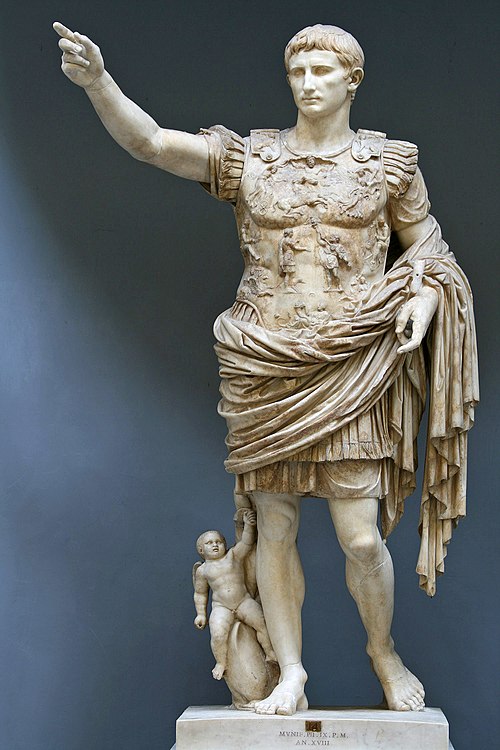
Octavian (Augustus)
63 BC–AD 14
Caesar’s heir
Caesar’s great-nephew and adopted son. He avenged Caesar and became Rome’s first emperor.
Why it mattered
The man who ended the Republic
Caesar’s killers wanted to save the Roman Republic, but his death destroyed it. After years of civil war, Octavian defeated Mark Antony and Cleopatra at Actium in 31 BC and in 27 BC became Augustus, the first ruler of the Roman Empire. Every emperor after him took the name Caesar as a title, and it lived on for 2,000 years as the German Kaiser and Russian Tsar.
Caesar also gave the world the Julian calendar, which started on January 1, 45 BC, with 365 days and a leap year every four years. The month of July is named after him. His own books on the Gallic and civil wars are still read by students of Latin.
58 BC
the Gallic Wars begin
49 BC
Caesar crosses the Rubicon
45 BC
the Julian calendar begins
44 BC
the Ides of March
Timeline
The life of Julius Caesar, 100–44 BC
- 100 BC Gaius Julius Caesar is born in Rome.
- 75 BC Caesar is captured by pirates and later has them executed.
- 63 BC Caesar is elected chief priest of Rome.
- 60 BC The First Triumvirate with Pompey and Crassus.
- 59 BC Caesar serves as consul.
- 58 BC The Gallic Wars begin.
- 55–54 BC Caesar leads two expeditions to Britain.
- 52 BC Vercingetorix surrenders at Alesia.
- January 10, 49 BC Caesar crosses the Rubicon; civil war begins.
- August 9, 48 BC Caesar defeats Pompey at Pharsalus.
- 47 BC Victory at Zela: “I came, I saw, I conquered.”
- January 1, 45 BC The Julian calendar takes effect.
- February 44 BC Caesar is named dictator for life.
- March 15, 44 BC Caesar is assassinated in the Senate.
“The die is cast.”
Julius Caesar
On crossing the Rubicon, January 49 BC, as reported by the historian Suetonius
The bigger story
Ancient Rome, 753 BC–AD 476
Our Ancient Rome overview tells the whole story in one place: the kings, the Republic and its wars, Julius Caesar, the emperors, daily life, and the fall of the West.
Go deeper
Sources and further reading
- Caesar: Life of a Colossus, by Adrian Goldsworthy (2006)
- The Death of Caesar, by Barry Strauss (2015)
- The Gallic War, by Julius Caesar (about 50 BC)
- More recommended books