
Home › World History › World War II › Stalingrad
World War II · Stalingrad, Soviet Union (today Volgograd, Russia) · August 23, 1942 – February 2, 1943
The Battle of Stalingrad
The Battle of Stalingrad was the turning point of World War II in Europe and one of the bloodiest battles in history. In the summer of 1942 the German Sixth Army fought its way into the city on the Volga River that carried Stalin’s name. For months the two sides fought street by street and room by room in the ruins. Then, in November, the Red Army surrounded the Germans. On February 2, 1943, the last of them surrendered, and Germany never fully recovered.

Smoke rises over Stalingrad during a German air attack, 1942. German army photo (Bundesarchiv).
Quick facts
Stalingrad at a glance
| When | August 23, 1942, to February 2, 1943, about five months | |
| Where | Stalingrad on the Volga River in southern Russia, today the city of Volgograd | |
| Sides | Soviet Union vs. Nazi Germany with Romania, Italy and Hungary | |
| Soviet leaders | Joseph Stalin; Gen. Georgy Zhukov; Gen. Vasily Chuikov, 62nd Army in the city | |
| German leaders | Adolf Hitler; Gen. (later Field Marshal) Friedrich Paulus, Sixth Army; Field Marshal Erich von Manstein | |
| Troops | More than 1 million soldiers on each side over the whole campaign | |
| Casualties | About 1.1 million Soviet casualties; about 800,000 German and allied; tens of thousands of civilians | |
| Result | Soviet victory; the German Sixth Army was destroyed and 91,000 men taken prisoner |
The big picture in 30 seconds
Why Stalingrad matters
- It was the turning point in Europe: after Stalingrad, Germany was mostly on the defensive in the East.
- A whole German army, about 270,000 men, was surrounded and destroyed for the first time.
- It ended Hitler’s hopes of seizing the oil fields of the Caucasus.
- It gave the Allies, including America, new hope just weeks after the Allied landings in North Africa.
5 months
of fighting in the city and on the steppe
About 2 million
total casualties
91,000
Germans surrendered
About 5,000
of those prisoners ever came home
Summer 1942
Hitler reaches for oil
After failing to take Moscow in 1941, Hitler launched a new offensive in the south in June 1942. His main goal was the oil fields of the Caucasus, which Germany badly needed. The city of Stalingrad, a center of industry and shipping on the Volga River, was meant to guard the flank of the drive.
But the city carried the name of the Soviet dictator, and both Hitler and Stalin came to see it as a matter of pride. Stalin had already issued Order No. 227, which said “Not one step back!” Soldiers who retreated without orders could be shot.
August 23, 1942
German tanks reached the Volga north of the city. The same day, hundreds of German bombers set Stalingrad on fire, killing thousands of civilians. Soon the German Sixth Army under Friedrich Paulus was fighting its way into the streets.

Where it happened
The trap on the Volga
The Germans pushed the Soviets back to a narrow strip along the Volga, but they never took the whole city. Their long flanks along the Don River were held by weaker Romanian armies. On November 19, 1942, the Soviets attacked those flanks from north and south. Four days later the pincers met at Kalach, and the Sixth Army was trapped.
Red arrows: Operation Uranus, the Soviet pincers that closed on November 23, 1942. Shaded: the pocket where the German Sixth Army was trapped. Simplified map.
How the battle unfolded
From the steppe to the surrender
The battle had two halves: the German assault on the city, then the Soviet counterstroke that turned the attackers into the besieged.
A massive German air raid sets Stalingrad ablaze. German tanks reach the Volga north of the city.
Chuikov’s 62nd Army clings to the west bank of the Volga. Fresh troops cross the river at night under fire. The hill called Mamayev Kurgan changes hands again and again.
Soviet armies smash the Romanian lines north and south of the city and meet at Kalach. About 270,000 Axis soldiers are surrounded.
Göring promises to supply the pocket by air. The Luftwaffe delivers only a fraction of what is needed. The trapped men starve and freeze.
Manstein’s relief attack, Operation Winter Storm, gets within about 30 miles of the pocket. Hitler forbids Paulus to break out.
Hitler promotes Paulus to field marshal, expecting him to die fighting. Instead Paulus surrenders. The last Germans in the city give up on February 2.
January 31, 1943
A field marshal surrenders
By late January the pocket had been cut in two. The Germans in Stalingrad were living on horse meat and a few ounces of bread a day, and the temperature fell to 20 and 30 degrees below zero. Tens of thousands of wounded lay in cellars without medicine.
On January 30 Hitler promoted Paulus to field marshal. No German field marshal had ever surrendered, and Hitler expected Paulus to fight to the death or kill himself. The next morning, Soviet soldiers entered the basement of the department store where Paulus had his headquarters, and he gave himself up.
About 91,000 Germans went into captivity. Most died of disease, cold and hunger in Soviet prison camps. Only about 5,000 returned to Germany, the last in 1955.

Commanders and fighters
The commanders at Stalingrad

Held the ruined city with a shrinking army. In 1945 he accepted the surrender of Berlin.
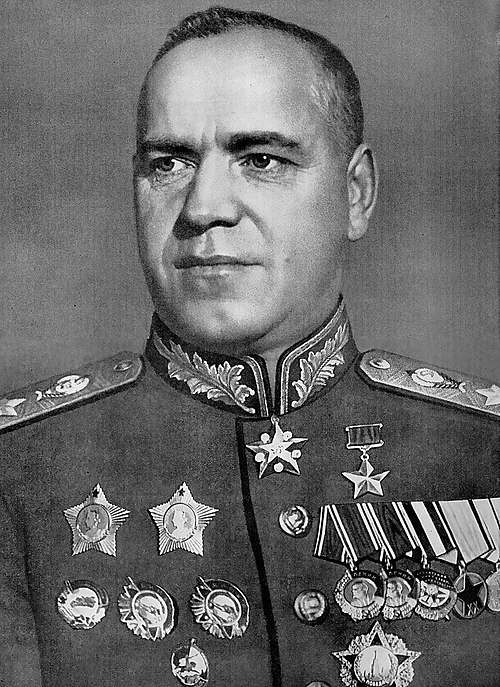
Helped plan Operation Uranus, the counterattack that trapped the Sixth Army.

Obeyed Hitler’s order not to break out, then surrendered the remains of his army.

Insisted the city bearing his name must be held at any cost.
Why it mattered
The turning point in Europe
Stalingrad was the first time an entire German army was destroyed, and the news shocked Germany, where three days of mourning were declared. From then on the Red Army held the initiative on the Eastern Front, winning again at Kursk in July 1943 and driving west toward Berlin. Together with the Allied victories in North Africa, at Operation Torch and El Alamein, Stalingrad marked the moment the war turned against Hitler. Britain’s King George VI had a ceremonial sword made for the “steel-hearted citizens of Stalingrad,” which Churchill presented to Stalin at the Tehran Conference in November 1943, with President Roosevelt looking on.
“Not one step back!”
Joseph Stalin
Order No. 227, July 28, 1942
The bigger story
World War II
Our World War II hub covers the whole war by theater, with every battle, commander and weapon page in one place. For the home front and America’s part in the war, see America in World War II.
Go deeper
Books and sources
- Stalingrad: The Fateful Siege 1942–1943, by Antony Beevor (1998)
- Enemy at the Gates: The Battle for Stalingrad, by William Craig (1973)
- Life and Fate, a novel by Vasily Grossman, who reported from Stalingrad (1959)
- More recommended books