
Home › World History › World War II › Okinawa
World War II · Okinawa, Ryukyu Islands, Japan · April 1 – June 22, 1945
The Battle of Okinawa
The Battle of Okinawa was the last great battle of World War II and the bloodiest of the Pacific war. On Easter Sunday, April 1, 1945, more than 180,000 American soldiers and Marines began landing on Okinawa, an island just 350 miles from mainland Japan. For 82 days they fought through a maze of caves and ridges, while kamikaze pilots crashed into the ships offshore. When it ended in June, more than 12,000 Americans, about 110,000 Japanese soldiers and as many as 150,000 Okinawan civilians were dead.

Marines come ashore on Okinawa, April 1945. U.S. Marine Corps photo.
Quick facts
Okinawa at a glance
| When | April 1 to June 22, 1945, 82 days | |
| Where | Okinawa, the largest of the Ryukyu Islands, about 350 miles south of mainland Japan | |
| Sides | United States, with a British carrier force, vs. Empire of Japan | |
| American leaders | Adm. Raymond Spruance, Fifth Fleet; Lt. Gen. Simon Bolivar Buckner Jr., Tenth Army | |
| Japanese leaders | Lt. Gen. Mitsuru Ushijima, 32nd Army; Lt. Gen. Isamu Chō; Col. Hiromichi Yahara | |
| Troops | About 183,000 Americans in the assault; about 100,000 Japanese soldiers and Okinawan conscripts | |
| Casualties | About 12,500 Americans killed or missing; about 110,000 Japanese soldiers killed; 100,000 to 150,000 civilians dead | |
| Result | American victory; Okinawa became the base for the planned invasion of Japan |
The big picture in 30 seconds
Why Okinawa matters
- It was the largest amphibious assault of the Pacific war and its bloodiest battle.
- Kamikaze planes sank 36 American ships and killed nearly 5,000 sailors, the Navy’s worst losses of the war.
- The terrible losses shaped President Truman’s view of what an invasion of Japan would cost.
- For Okinawans it was a catastrophe: up to a third of the island’s people died.
82 days
of fighting
183,000
American troops in the assault
About 1,900
kamikaze attacks
12,500
Americans killed or missing
The doorstep of Japan
Operation Iceberg
After Iwo Jima, the Americans needed one more stepping-stone before an invasion of Japan itself: a large island with room for airfields, harbors and an invasion army. Okinawa, 60 miles long, was the answer. The operation was called Iceberg.
The Japanese commander, Gen. Mitsuru Ushijima, did not plan to fight on the beaches. He pulled his army into the rugged south of the island and dug it into a web of caves, tunnels and tombs along a chain of ridges centered on the old castle at Shuri. His aim was to bleed the Americans and keep their fleet tied down offshore, where kamikazes could attack it.
April 1, 1945
Easter Sunday was also April Fools’ Day. After the biggest bombardment of the Pacific war, four divisions landed on the Hagushi beaches almost without a shot fired. By nightfall 60,000 Americans were ashore and two airfields were captured. Many Marines wondered where the enemy was. They soon found out.

Where it happened
Ridges, caves and the Shuri Line
The Marines swept north and cleared the upper part of the island in a few weeks. The Army divisions turning south ran into the Japanese main defenses within days. Ridge after ridge, Kakazu, the Maeda Escarpment, Sugar Loaf Hill, had to be taken in close fighting with flamethrowers and explosives. Shuri Castle did not fall until May 29.
Blue arrows: the landings on the Hagushi beaches on April 1, the Marine drive north and the Army drive south toward the Shuri Line. The last Japanese stand was at the southern tip of the island. Simplified map.
How the battle unfolded
Eighty-two days
The battle on land and the battle at sea went on side by side for almost three months.
Army and Marine divisions land on the west coast. The Japanese hold their fire. Kadena and Yontan airfields are taken the first day.
The first of ten mass kamikaze attacks hits the fleet. The battleship Yamato is sunk on its way to Okinawa.
The Army and then the Marines grind against the Japanese ridges. Heavy rains in late May turn the battlefield into a sea of mud.
Marines raise a flag over the ruined castle. Ushijima has already pulled his army back to the southern tip of the island.
General Buckner is killed by Japanese artillery while watching an attack, the highest-ranking American killed by enemy fire in the war.
Ushijima and his chief of staff take their own lives near Mabuni. Organized resistance ends. Thousands of civilians die in the final weeks.
April–June 1945
The kamikazes
While the soldiers fought ashore, the Navy faced the greatest air assault in its history. About 1,900 Japanese pilots flew kamikaze missions against the ships off Okinawa, deliberately crashing their bomb-laden planes into them. Small destroyers on radar picket duty, the first ships the attackers saw, were hit again and again.
On May 11 two kamikazes struck the carrier USS Bunker Hill, Admiral Marc Mitscher’s flagship, within 30 seconds of each other. Fires swept the ship and 393 men were killed, but the crew saved her.
By the end of the battle, 36 American ships had been sunk and 368 damaged. Nearly 5,000 sailors were killed, more than in any other battle in U.S. Navy history.

Commanders and fighters
The leaders at Okinawa
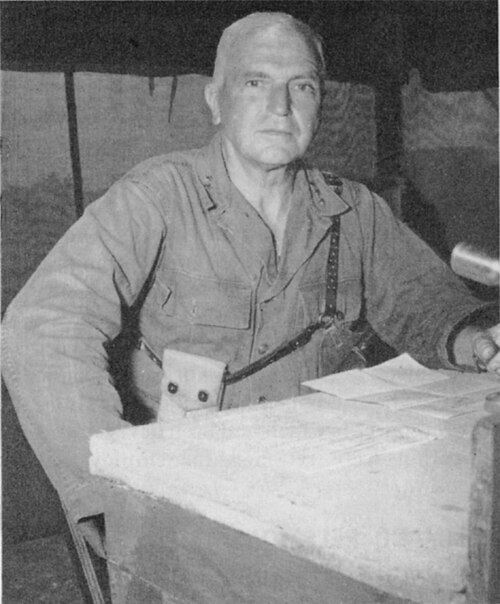
Led the American ground forces and was killed four days before the battle ended.

Built the cave defenses of southern Okinawa and fought to the end.

Commanded the whole operation from the sea. His flagship was hit by a kamikaze in May.

Saved about 75 wounded soldiers on the Maeda Escarpment without ever carrying a gun.
Why it mattered
A preview of the invasion of Japan
Okinawa gave the Americans the airfields and harbors they needed to invade Japan, planned for November 1945. It also showed what that invasion might cost. If Japanese soldiers, kamikazes and civilians fought this way on the home islands, American planners feared hundreds of thousands of American deaths. That fear was part of President Truman’s decision to use the atomic bomb on Hiroshima and Nagasaki six weeks after the battle ended. The famous war reporter Ernie Pyle was killed on nearby Ie Shima on April 18. Okinawa remained under American control until 1972, and large American bases are still there today.
“War is brutish, inglorious, and a terrible waste.”
Eugene B. Sledge
Marine veteran of Peleliu and Okinawa, With the Old Breed (1981)
The bigger story
World War II
Our World War II hub covers the whole war by theater, with every battle, commander and weapon page in one place. For the home front and America’s part in the war, see America in World War II.
Go deeper
Books and sources
- With the Old Breed: At Peleliu and Okinawa, by E. B. Sledge (1981)
- Tennozan: The Battle of Okinawa and the Atomic Bomb, by George Feifer (1992)
- Okinawa: The Last Battle, by Roy E. Appleman and others (U.S. Army, 1948)
- More recommended books