
Home › World History › World War II › Doolittle Raid
April 18, 1942 · Tokyo, Japan
The Doolittle Raid
Four months after Pearl Harbor, sixteen Army bombers took off from the deck of a Navy aircraft carrier, something no one had tried before, and struck Tokyo and five other Japanese cities. The damage was small, but the raid lifted American spirits and pushed Japan into the decision that led to its defeat at Midway.
Quick facts
The raid at a glance
| Date | April 18, 1942 | |
| Targets | Tokyo, Yokohama, Yokosuka, Nagoya, Kobe and Osaka, Japan | |
| Commanders | Lt. Col. James H. "Jimmy" Doolittle (raid leader); Vice Adm. William F. Halsey (Task Force 16); Capt. Marc Mitscher (USS Hornet) | |
| US strength | 16 B-25B Mitchell bombers and 80 airmen, carried by USS Hornet and escorted by USS Enterprise, cruisers and destroyers | |
| US losses | All 16 bombers lost (15 crash-landed or abandoned over China, 1 interned in the USSR); 3 airmen killed, 8 captured | |
| Japanese losses | About 50 people killed and some 400 injured; light damage to factories and military sites | |
| Result | Little physical damage, but a major boost to American morale and a shock to Japan's leaders |
The big picture in 30 seconds
Why it matters
- It was America's first strike on the Japanese home islands, at a time when the war news was almost all bad.
- Army bombers had never taken off from a carrier before. Doolittle's crews trained for weeks to lift off in a few hundred feet.
- Japan's leaders, embarrassed that Tokyo had been hit, approved Admiral Yamamoto's plan to attack Midway. That battle cost Japan four carriers.
- Japan took revenge on the Chinese who had helped the airmen, killing an estimated 250,000 civilians in eastern China.
16
B-25 bombers launched from USS Hornet
80
airmen, all volunteers
650
nautical miles from Japan at launch
0
bombers that survived the mission
Background
Hitting back at Japan
After Pearl Harbor, President Roosevelt wanted to strike Japan itself as soon as possible, to show Americans that the country could fight back. The problem was distance: no American airfield was close enough, and Navy carrier planes had too little range to attack Japan without bringing the carriers dangerously close.
An unusual idea
In January 1942, Navy Captain Francis Low suggested launching Army twin-engine bombers from a carrier. They could take off farther from Japan than Navy planes, bomb their targets, and fly on to friendly airfields in China. Lieutenant Colonel Jimmy Doolittle, a famous racing pilot and aeronautical engineer, was put in charge.
Training and preparation
Volunteer crews trained at Eglin Field in Florida, where a Navy instructor taught them to get a loaded B-25 into the air in about 500 feet. Their bombers were stripped down and fitted with extra fuel tanks. Broomsticks painted black were mounted in the tails to look like machine guns, and the secret Norden bombsight was replaced with a simple 20-cent sight so it could not fall into enemy hands.
Spotted early
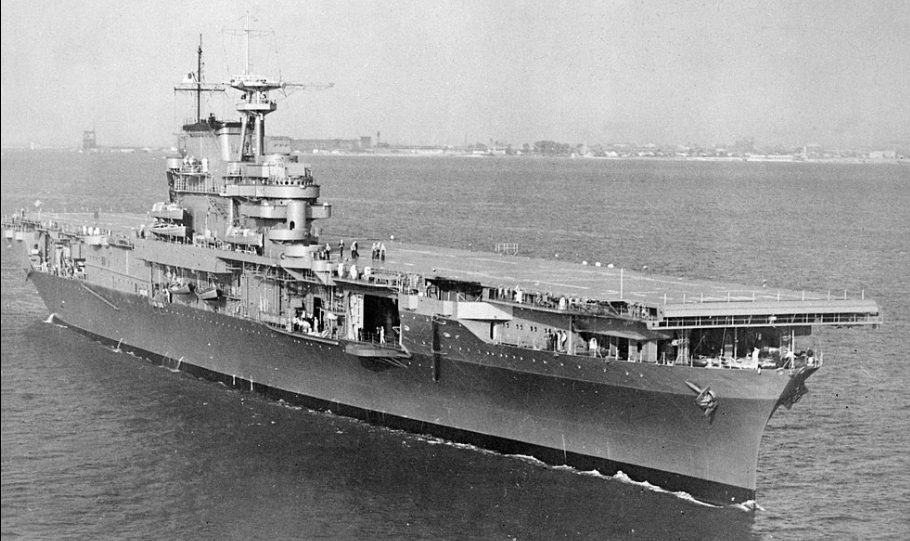
The plan called for launching about 400 miles from Japan. On the morning of April 18, a Japanese picket boat sighted the task force about 650 nautical miles out. Fearing the alarm had been raised, Halsey and Doolittle launched at once, ten hours early, knowing the bombers might not have enough fuel to reach China.
The mission
From California to Tokyo to China
Hornet sailed from California with the bombers lashed to her flight deck and met Admiral Halsey’s Enterprise in the North Pacific. After the attack, the bombers flew on toward eastern China in darkness and bad weather.
8:20 a.m.
Off the deck
Doolittle took off first, into a 40-mile-an-hour wind and heavy seas, with less than 500 feet of deck in front of him. All sixteen bombers made it into the air, one after another, in about an hour.
Around noon
Over Japan
Flying low to avoid detection, the bombers reached Japan around midday. Thirteen hit targets in the Tokyo area and three hit Nagoya, Kobe and Osaka. Japanese defenders were caught by surprise, and none of the bombers was shot down.
That night
Into China
Short of fuel, in darkness and rain, fifteen crews bailed out or crash-landed along the Chinese coast. One crew, almost out of fuel, flew to Vladivostok in the Soviet Union, where they were held for more than a year.
The weeks after
Escape and capture
Chinese villagers and guerrillas hid most of the airmen and guided them to safety, at enormous risk. Eight were captured by the Japanese. Three were executed after a show trial, one died in prison, and four survived the war as prisoners.
The raiders
What became of the 80 men
Each dot is one airman.
Step by step
Timeline of the raid
April 21, 1942
"Shangri-La"
Asked where the bombers had come from, President Roosevelt smiled and said they had flown from “our new secret base at Shangri-La.”
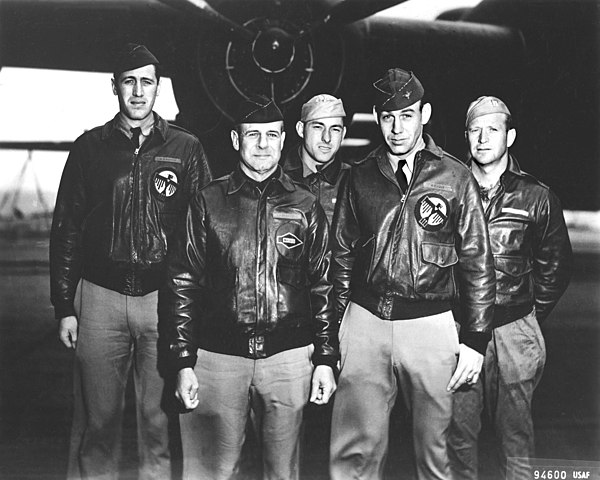
Shangri-La was the mythical hidden valley of the novel Lost Horizon. The joke kept the Hornet’s role secret, and the Navy later gave the name Shangri-La to a new aircraft carrier. In the photo, Doolittle stands at front left with members of his crew.
People
The men behind the raid
James H. "Jimmy" Doolittle
Raid leader
A record-setting pilot with a doctorate from MIT. He expected to be court-martialed for losing all his planes; instead he received the Medal of Honor and was promoted straight to brigadier general.
William F. "Bull" Halsey
Commander, Task Force 16
Took the carriers deep into Japanese waters and made the call, with Doolittle, to launch early.
Marc Mitscher
Captain, USS Hornet
Commanded the carrier that launched the raid. He later led the Navy’s fast carrier task force across the Pacific.
Francis Low
Navy planner
A submarine officer on Admiral Ernest King’s staff who came up with the idea of flying Army bombers off a carrier.
Richard E. Cole
Doolittle's copilot
Flew in the lead plane and bailed out over China. He was the last surviving raider when he died in 2019 at age 103.
Ted W. Lawson
Pilot of the "Ruptured Duck"
Badly injured in a crash landing off China, he lost a leg. His book Thirty Seconds Over Tokyo became a bestseller and a hit film.
What came next
The raid's long shadow
The raid did little damage, but its effects were enormous. Japan kept fighter squadrons at home to defend its cities and rushed into the Midway operation. In China, the Japanese army swept through the provinces where the raiders had landed, punishing anyone suspected of helping them.
Remembering the raid
The raiders' goblets
For decades the surviving raiders held a reunion every year. A set of 80 silver goblets, one engraved with each man’s name, was kept for them; at each reunion, the goblets of men who had died were turned upside down. The goblets are now on display at the National Museum of the US Air Force in Dayton, Ohio.
Go deeper
Sources and further reading
- Thirty Seconds Over Tokyo, by Ted W. Lawson (1943)
- Target Tokyo, by James M. Scott (2015)
- The Doolittle Raid, by Carroll V. Glines (1988)
- I Could Never Be So Lucky Again, by James H. Doolittle (1991)
Meanwhile in the Philippines
Nine days before the raid, on April 9, 1942, the American and Filipino defenders of Bataan surrendered. Tens of thousands of prisoners were being forced on the Bataan Death March as Doolittle’s bombers flew toward Tokyo.