
Home › World History › England and Britain › The English Civil War
England and Britain · The Stuarts · 1642–1651
The English Civil War (1642–1651): Causes, Battles and Results
The English Civil War was a series of wars from 1642 to 1651 between the supporters of King Charles I, called Royalists or Cavaliers, and the supporters of Parliament, called Parliamentarians or Roundheads. Parliament won. The king was put on trial and beheaded, and for eleven years England was a republic, led in the end by Oliver Cromwell.
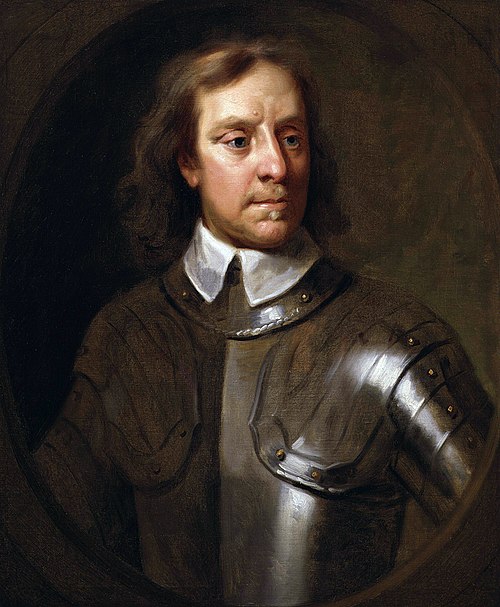
Oliver Cromwell, painted by Samuel Cooper around 1656. Cromwell is said to have asked to be painted “warts and all.”
Quick facts
The English Civil War at a glance
- Dates: August 22, 1642 (the king raises his standard at Nottingham) to September 3, 1651 (Battle of Worcester)
- Where: England and Wales, with linked wars in Scotland and Ireland
- Royalists: King Charles I and his nephew Prince Rupert; strongest in the north, the west and Wales
- Parliamentarians: Parliament, led in the field by Sir Thomas Fairfax and Oliver Cromwell; held London and the navy
- Key battles: Edgehill (1642), Marston Moor (1644), Naseby (1645), Preston (1648), Dunbar (1650), Worcester (1651)
- Deaths: Perhaps 200,000 in England and Wales from fighting and disease, and many more in Scotland and Ireland
- Turning point: King Charles I was tried and beheaded on January 30, 1649
- Result: England became a republic until 1660, when the monarchy was restored under Charles II
The big picture in 30 seconds
Why the English Civil War matters
- It decided that kings could not rule without Parliament.
- It is the only time England put its own king on trial and executed him.
- It made England a republic for eleven years.
- Its ideas about rights and liberty crossed the Atlantic to America.
9 years
of war, 1642–1651
3
civil wars in a row
About 200,000
dead in England and Wales
1649
King Charles I beheaded
The causes
King against Parliament
Charles I became king in 1625. He believed in the “divine right of kings”: that a king was chosen by God and answered only to God. Parliament, made up of the House of Lords and the House of Commons, believed the king had to rule by the law and could only raise taxes with its consent.
After quarrels over money and war, Charles ruled without Parliament for eleven years (1629–1640), raising money through old taxes like “ship money.” He and Archbishop William Laud also pushed Church services that many Puritans thought too close to Catholic worship.
The road to war
When Charles forced a new prayer book on Presbyterian Scotland, the Scots rebelled, and he had to call Parliament to pay for an army. The new “Long Parliament” of 1640 attacked his ministers and his powers. In January 1642 Charles marched into the House of Commons with soldiers to arrest five of its leaders, but “the birds had flown.” Both sides began raising armies, and on August 22, 1642 the king raised his royal standard at Nottingham.

Cavaliers and Roundheads
Both nicknames began as insults. “Cavalier” meant a swaggering horseman; “Roundhead” mocked the short-cropped hair of London apprentices who backed Parliament.
The map
Where the battles were fought
Most of the fighting took place in the Midlands and the north, between the king’s base at Oxford and Parliament’s base in London. There were hundreds of smaller fights and sieges of towns and castles all across England and Wales.
The war also spread to Scotland and Ireland. After the king’s death, Cromwell crushed resistance in Ireland, storming Drogheda in 1649, and then defeated the Scots at Dunbar in 1650 and at Worcester in 1651.
How the war unfolded
The English Civil War, step by step
Historians often speak of three civil wars: 1642–1646, 1648, and 1649–1651.
1642: war begins
The king raises his standard at Nottingham. The first big battle, at Edgehill in October, ends in a bloody draw, and Charles makes Oxford his capital.
1643–1644: the Scots join Parliament
Parliament allies with the Scots. At Marston Moor near York, in July 1644, their combined army wins the largest battle of the war and takes the north.
1645: the New Model Army and Naseby
Parliament forms a professional New Model Army under Fairfax, with Cromwell leading the cavalry. It destroys the king’s main army at Naseby in June.
1646–1648: the king a prisoner
Charles surrenders to the Scots, who hand him over to Parliament. He makes a secret deal with the Scots, but Cromwell beats their invasion at Preston in 1648.
1649: trial and execution
The army purges Parliament of moderates. The remaining “Rump” puts Charles on trial for treason, and he is beheaded in London on January 30.
1650–1651: Charles II
The Scots crown the dead king’s son as Charles II. Cromwell beats them at Dunbar and Worcester, and young Charles escapes, hiding in an oak tree, to France.
January 30, 1649
The execution of King Charles I
King Charles I refused to recognize the court that tried him, saying no court had the power to try a king. He was found guilty of treason against his own people, and 59 judges, Cromwell among them, signed his death warrant.
On a bitterly cold morning, Charles walked out of a window of the Banqueting House in Whitehall onto a scaffold draped in black. He wore two shirts so that he would not shiver and seem afraid. He told the crowd he died a “martyr of the people,” prayed, and laid his head on the block. When the executioner held up his head, witnesses remembered a deep groan from the crowd.
A world without a king
Parliament abolished the monarchy and the House of Lords, and declared England a “Commonwealth.” Europe was shocked: kings had been murdered before, but never tried and executed by their own people in the name of the law.

Lord Protector
In 1653 Cromwell dismissed Parliament and took the title Lord Protector. He ruled until his death in 1658 and refused the offer of the crown.
Key people
The leaders of the English Civil War

King Charles I
1600–1649
King of England, Scotland and Ireland
A shy, stubborn king who believed in his divine right to rule. He lost the war and was executed in 1649.
Oliver Cromwell
1599–1658
Parliament’s greatest general
A Puritan country gentleman who built the Ironside cavalry, won the war, and ruled as Lord Protector.

Prince Rupert of the Rhine
1619–1682
Royalist cavalry commander
The king’s dashing German nephew, famous for his charges and his pet dog Boye, killed at Marston Moor.

Sir Thomas Fairfax
1612–1671
Commander of the New Model Army
A brave Yorkshire general who won at Naseby, but refused to take part in the king’s trial.
Why it mattered
Kings and Parliament after the war
Cromwell’s republic did not outlive him. In 1660 Parliament invited Charles II home from exile, and the monarchy was restored. Cromwell’s body was dug up and hanged, and the judges who had signed the king’s death warrant were hunted down.
But the old kind of kingship never came back. No king could again rule for years without Parliament or raise taxes on his own. When Charles II’s brother, James II, tried to rule in his own way, Parliament removed him in the Glorious Revolution of 1688. The war also left a trail of new ideas: groups like the Levellers argued that ordinary men had rights and should have the vote, ideas that later inspired the American and French revolutions.
1649
the king is executed
1653
Cromwell becomes Lord Protector
1660
the monarchy is restored
1689
the Bill of Rights limits the Crown
Meanwhile in America
The English Civil War in the colonies
Puritan New England
Massachusetts and the other Puritan colonies sided with Parliament, and some colonists sailed home to fight for it.
Royalist Virginia
Virginia stayed loyal to the king and took in many Royalist exiles. Read about Virginia’s beginnings at Jamestown.
Rights and liberty
Arguments from the war about tyranny and the rights of free men were read again in the 1770s, before the American Revolution.
Timeline
The English Civil War, 1625–1660
- 1625 Charles I becomes king.
- 1629–1640 Charles rules without Parliament (the “Personal Rule”).
- 1639–1640 The Bishops’ Wars with Scotland.
- November 1640 The Long Parliament meets.
- January 4, 1642 Charles tries to arrest five members of the House of Commons.
- August 22, 1642 Charles raises his standard at Nottingham; war begins.
- October 23, 1642 The Battle of Edgehill.
- July 2, 1644 The Battle of Marston Moor.
- June 14, 1645 The Battle of Naseby.
- May 1646 Charles surrenders to the Scots.
- August 1648 Cromwell defeats the Scots at Preston.
- January 30, 1649 Charles I is beheaded; England becomes a republic.
- September 1649 Cromwell storms Drogheda in Ireland.
- September 3, 1650 The Battle of Dunbar.
- September 3, 1651 The Battle of Worcester; Charles II escapes to France.
- 1653 Cromwell becomes Lord Protector.
- September 3, 1658 Cromwell dies.
- May 29, 1660 Charles II returns to London; the monarchy is restored.
“I go from a corruptible to an incorruptible crown, where no disturbance can be.”
King Charles I
On the scaffold, January 30, 1649
The bigger story
England and Britain, 1485–1900
Our England and Britain overview tells the whole story in one place: the Tudors and the break with Rome, the Stuarts and the fight between king and Parliament, the union with Scotland, and the British Empire.
Go deeper
Sources and further reading
- The King’s War, 1641–1647, by C. V. Wedgwood (1958)
- The English Civil War: A People’s History, by Diane Purkiss (2006)
- Cromwell: Our Chief of Men, by Antonia Fraser (1973)
- More recommended books