
Home › World History › Age of Exploration › The Spanish Armada
Age of Exploration · England and Spain · 1588
The Spanish Armada (1588): How England Defeated the Invincible Armada
The Spanish Armada was a great fleet of about 130 ships that King Philip II of Spain sent against England in 1588. It was meant to carry a Spanish army across the Channel and overthrow Queen Elizabeth I. Instead, English ships, fireships and storms scattered it, and fewer than half of its ships came home.

Queen Elizabeth I in the Armada Portrait, painted to celebrate the victory of 1588.
Quick facts
The Spanish Armada at a glance
- Dates: May 28, 1588 (sailed from Lisbon) to September–October 1588 (survivors reach Spain)
- Where: The English Channel, the North Sea, and the coasts of Scotland and Ireland
- Rulers: King Philip II of Spain against Queen Elizabeth I of England
- Spanish fleet: About 130 ships and about 30,000 men, led by the Duke of Medina Sidonia
- English fleet: About 200 ships of all sizes, led by Lord Howard of Effingham with Francis Drake
- Turning point: English fireships off Calais, August 7–8, then the Battle of Gravelines on August 8
- Losses: Spain lost about 50 ships and perhaps 15,000 men, mostly to storms, shipwreck and disease; England lost no warships
- Result: The invasion failed and England stayed independent and Protestant
The big picture in 30 seconds
Why the Spanish Armada matters
- It saved England from a Spanish invasion.
- It became a symbol of English courage and sea power.
- It kept Protestant England and the Dutch revolt alive.
- It made Elizabeth I a national legend.
About 130
Spanish ships set out
About 30,000
Spanish soldiers and sailors
8
English fireships off Calais
About 67
Spanish ships made it home
The road to war
Why Philip II sent the Armada
Philip II ruled Spain, Portugal, much of Italy, the Netherlands and a vast empire in the Americas. He saw himself as the champion of the Catholic Church. Protestant England, under Queen Elizabeth I, stood in his way.
For years the two countries fought an undeclared war. English captains like Francis Drake raided Spanish treasure fleets and ports, and in 1585 Elizabeth sent an army to help the Dutch rebels fighting Spanish rule. Then in February 1587 Elizabeth executed her Catholic cousin, Mary, Queen of Scots. Philip decided that England must be conquered.
The “Enterprise of England”
Philip’s plan was for a great fleet to sail up the Channel to Flanders and protect barges carrying the Duke of Parma’s veteran army, about 30,000 men, across to Kent. Drake delayed it in 1587 with a daring raid on Cádiz. Then the Armada’s experienced admiral died, and Philip gave command to the Duke of Medina Sidonia, a nobleman who had never commanded at sea.

A note on dates
England still used the old Julian calendar in 1588, ten days behind Spain. English accounts date the Battle of Gravelines July 29; this page uses the modern calendar, August 8.
The route
Up the Channel and around the British Isles
The Armada left Lisbon in May, sheltered from storms at A Coruña, and was sighted off Cornwall on July 29. It sailed up the Channel in a great crescent, with the English harrying it at Plymouth, Portland and the Isle of Wight.
After the fireships and the battle off Gravelines, a south wind drove the Armada into the North Sea. With the English behind them, the Spanish sailed home the long way, around Scotland and past the west coast of Ireland, into the autumn storms.
How the campaign unfolded
The Armada campaign, step by step
Dates follow the modern calendar. The fighting in the Channel lasted ten days; the voyage home took two months.
May 28: the Armada sails
About 130 ships leave Lisbon. Storms force them into A Coruña for repairs, and they do not reach England until late July.
July 29: sighted off Cornwall
Beacons carry the news across England. According to legend, Drake insists on finishing his game of bowls on Plymouth Hoe before sailing out.
July 31 – August 4: the Channel fights
Faster English ships attack the Armada’s crescent off Plymouth, Portland and the Isle of Wight, but cannot break it. Drake captures the Spanish flagship Rosario.
August 7–8: fireships
The Armada anchors off Calais, but Parma’s army is not ready. At midnight the English send in eight burning ships, and the Spanish cut their anchor cables and scatter.
August 8: Gravelines
The English close in on the scattered Spanish ships off Gravelines. In a day of hard fighting several Spanish ships are sunk or driven aground.
August – October: the storms
The Armada sails north around Scotland and past Ireland. Storms wreck more than 20 ships on the Irish coast, and thousands of men drown or are killed ashore.
The night of August 7, 1588
The fireships off Calais
The Armada lay at anchor off Calais, packed together in the dark and waiting for news from Parma. Parma’s barges were not ready, and Dutch ships blocked the shallow coast. The English saw their chance.
Around midnight, eight old ships packed with tar, pitch and loaded guns were set on fire and sent drifting on the wind and tide into the Spanish fleet. The Spanish had heard of the terrible “hellburners” of Antwerp, fireships packed with explosives. In panic most captains cut their anchor cables and fled. No Spanish ship burned, but the Armada’s tight formation was broken, and it never came together again.
“God blew and they were scattered”
After Gravelines the wind swung round and pushed the Armada away from England. Elizabeth’s government struck a medal with the words Flavit Jehovah et Dissipati Sunt: God blew, and they were scattered.

Different ships, different tactics
Spanish ships were built to close in, grapple and board, with soldiers ready to fight hand to hand. England’s lower, faster galleons kept their distance and fought with guns.
Key people
The leaders of 1588
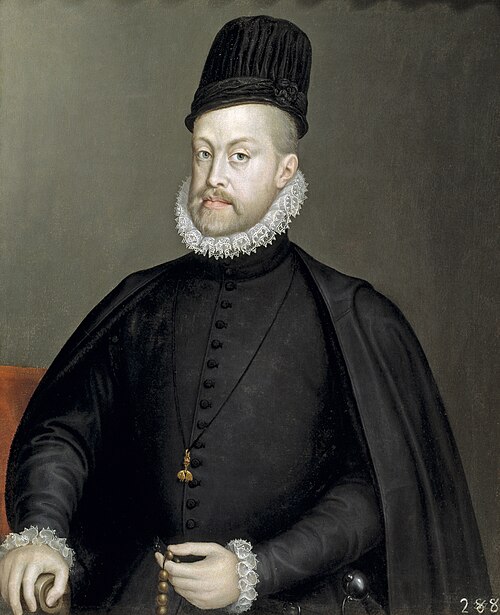
King Philip II
1527–1598
King of Spain
Ruled the largest empire in the world from his palace near Madrid and planned the Armada himself, down to small details.

Duke of Medina Sidonia
1550–1615
Commander of the Armada
A rich nobleman who begged not to be given the command. He kept his fleet together through the Channel and brought the survivors home.

Lord Howard of Effingham
1536–1624
Lord High Admiral of England
Commanded the English fleet from his flagship, the Ark Royal, and wisely listened to experienced captains like Drake.

Sir Francis Drake
about 1540–1596
Vice admiral
England’s most famous seaman, who had sailed around the world, was Howard’s second in command in the Revenge.
Why it mattered
England survives
England was saved from invasion, and the victory became a legend. Elizabeth’s speech to her troops at Tilbury and the “Protestant wind” that scattered the Armada were remembered for centuries. The Dutch rebels, too, survived to win their independence from Spain.
But the Armada did not end Spanish power. Philip rebuilt his navy and sent new armadas in 1596 and 1597, both broken up by storms, and an English counterattack on Spain in 1589 failed badly. The war dragged on until the Treaty of London in 1604. Over the next century, England’s growing navy and its first lasting colonies in North America made it a rival to Spain at sea.
1588
the Armada is defeated
1589
England’s own armada fails
1604
the Treaty of London ends the war
Meanwhile in North America
The Armada and the Lost Colony
The Lost Colony of Roanoke
In 1587 about 115 English settlers landed at Roanoke Island. Supply ships were held in England to face the Armada, and when help finally arrived in 1590 the colonists had vanished.
Jamestown, 1607
Peace with Spain in 1604 opened the way for England’s first lasting colony at Jamestown.
The Pilgrims, 1620
The Pilgrims of the Mayflower founded Plymouth Colony in Massachusetts.
Timeline
England and Spain at war, 1585–1604
- August 1585 Elizabeth sends an army to help the Dutch rebels.
- February 8, 1587 Mary, Queen of Scots, is executed.
- April 1587 Drake raids Cádiz, “singeing the King of Spain’s beard.”
- February 1588 The Armada’s admiral dies; Medina Sidonia takes command.
- May 28, 1588 The Armada sails from Lisbon.
- July 29, 1588 The Armada is sighted off Cornwall.
- July 31 – August 4, 1588 Fights off Plymouth, Portland and the Isle of Wight.
- August 6, 1588 The Armada anchors off Calais.
- August 7–8, 1588 English fireships scatter the Armada.
- August 8, 1588 The Battle of Gravelines.
- August 19, 1588 Elizabeth speaks to her army at Tilbury (August 9 in the English calendar).
- September 1588 Storms wreck Armada ships off Scotland and Ireland.
- 1596 and 1597 New Spanish armadas are broken up by storms.
- 1604 The Treaty of London ends the war.
“I know I have the body of a weak and feeble woman; but I have the heart and stomach of a king, and of a king of England too.”
Queen Elizabeth I
Speech to her troops at Tilbury, August 1588
The bigger story
The Age of Exploration, 1450–1600
Our Age of Exploration overview tells the whole story in one place: why Europeans went to sea, the great voyages, the race between Spain, Portugal and England, and how it changed the world.
Go deeper
Sources and further reading
- The Defeat of the Spanish Armada, by Garrett Mattingly (1959)
- The Spanish Armada, by Colin Martin and Geoffrey Parker (1988)
- The Confident Hope of a Miracle: The True History of the Spanish Armada, by Neil Hanson (2003)
- More recommended books