
Home › People › US Presidents › James Madison
4th President · 1809–1817 · Democratic-Republican
James Madison: Father of the Constitution and the War of 1812
James Madison was the smallest president, but few Americans did more to shape the country. He drafted the plan behind the Constitution, wrote the Bill of Rights and co-wrote the Federalist Papers. As the fourth president he led the nation through the War of 1812, when the British burned Washington, and left office with the country prouder and more united than before.

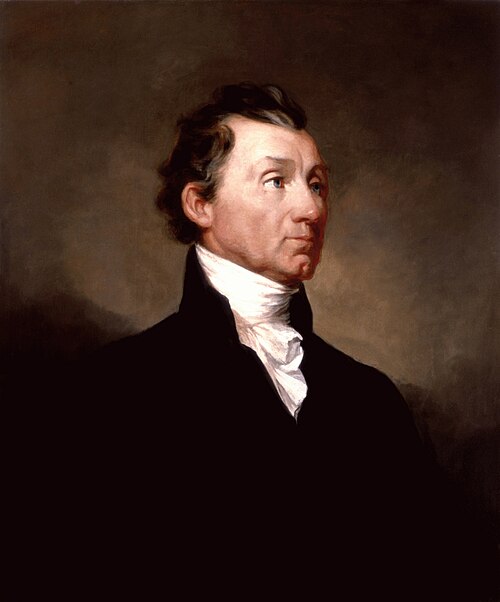
James Madison, painted by John Vanderlyn in 1816
Quick facts
James Madison at a glance
| Born | March 16, 1751, at Port Conway, King George County, Virginia | |
| Died | June 28, 1836, at Montpelier, Virginia, aged 85, the last of the founders to die | |
| President | 4th, from March 4, 1809, to March 4, 1817 (two terms) | |
| Vice presidents | George Clinton (died 1812), Elbridge Gerry (died 1814) | |
| Party | Democratic-Republican | |
| Education | College of New Jersey (now Princeton), 1771 | |
| Known as | “Father of the Constitution” | |
| Before the White House | Continental Congress, Virginia legislature, US House of Representatives, Secretary of State | |
| Wife | Dolley Payne Todd, married September 15, 1794 | |
| Children | None of his own; raised Dolley's son, John Payne Todd | |
| Elections | Won 1808 and 1812 | |
| Buried | Family cemetery at Montpelier, Orange County, Virginia |
The big picture in 30 seconds
Why he matters
- Wrote the Virginia Plan, the outline the Constitutional Convention used for the new government.
- Kept the best notes of the convention, our main record of what was said.
- Wrote 29 of the 85 Federalist Papers, which argued for ratifying the Constitution.
- Wrote the Bill of Rights and steered it through the first Congress.
- Led the country through the War of 1812, the first war declared under the Constitution.
- At 5 feet 4 inches and about 100 pounds, the shortest and lightest president.
10
amendments in the Bill of Rights, drafted by Madison in 1789
29
of the 85 Federalist Papers came from his pen
2 years, 8 months
of war with Britain, from June 1812 to February 1815
5 ft 4 in
the shortest president in American history
Early years
A sickly scholar from Virginia
James Madison Jr. was born on March 16, 1751, the eldest of twelve children of a wealthy tobacco planter, and grew up at Montpelier in Orange County, Virginia. He was small and often sick, and he loved books. At the College of New Jersey in Princeton he finished a three-year course in two years and stayed on to study Hebrew and philosophy.
Back in Virginia, he helped write the state’s 1776 constitution and its declaration of rights, and he fought for religious freedom. In 1780, at 29, he became the youngest member of the Continental Congress.
Father of the Constitution
Madison believed the Articles of Confederation were failing. He studied the history of every republic he could find, then helped call the Constitutional Convention of 1787. His Virginia Plan, with a strong national government in three branches, became the starting point for the Constitution. He sat at the front of the room and took notes every day.

Congressman and partner
The Bill of Rights and a new party
Elected to the first House of Representatives in 1789, Madison kept his promise to add a bill of rights. He drafted the amendments himself, and ten were ratified in 1791, protecting freedom of speech, religion and the press, and the right to a fair trial.
He soon broke with Hamilton over the national debt and the bank, and with Thomas Jefferson he founded the Democratic-Republican Party. In 1798 he secretly wrote the Virginia Resolutions against the Alien and Sedition Acts.
Dolley
In 1794 the shy 43-year-old married Dolley Payne Todd, a lively 26-year-old Quaker widow from Philadelphia. Dolley became the most famous hostess in Washington, and her parties helped her husband win friends in Congress. From 1801 to 1809 Madison served as Jefferson’s Secretary of State and handled the Louisiana Purchase.

Election of 1808
Jefferson's chosen successor
Electoral votes: 175 electors; 88 needed to win
Election of 1812
Re-elected in wartime
Electoral votes: 217 electors; 109 needed to win
The presidency, 1809–1817
“Mr. Madison's War”
Madison took office as Britain and Napoleon‘s France fought a world war at sea. Both seized American ships, and the British Royal Navy forced thousands of American sailors into its service. In the West, settlers blamed Britain for arming Native nations led by the Shawnee leader Tecumseh. Young “War Hawks” in Congress, led by Henry Clay, demanded war. The result was the War of 1812.
June 18, 1812
War is declared
Madison asked Congress for war, and it voted yes, the first declared war under the Constitution. The country had a tiny army, few warships and no national bank to pay for it.
1812–1813
Victories at sea and on Lake Erie
Invasions of Canada failed, but the frigate USS Constitution won famous duels, and Oliver Hazard Perry beat a British squadron on Lake Erie in September 1813.
August 24, 1814
Washington burns
British troops routed the militia at Bladensburg and set fire to the Capitol and the President’s House. Madison had to flee into Virginia. Dolley saved Gilbert Stuart’s portrait of Washington.
September 1814
Fort McHenry holds
Baltimore’s defenders turned back a British attack. Watching the bombardment, Francis Scott Key wrote the poem that became “The Star-Spangled Banner.”
December 24, 1814
The Treaty of Ghent
The peace treaty left borders as they were before the war. News crossed the Atlantic slowly, so Andrew Jackson‘s great victory at New Orleans came two weeks after it was signed.
1816
A stronger nation
After the war Madison signed the Second Bank of the United States into law, a protective tariff and plans for a larger navy, ideas he had once opposed.
Paying for the war
War sends the national debt soaring
Without a national bank, the government struggled to borrow. The national debt more than doubled during the war.
Debt on January 1 of each year, rounded, from the US Treasury's Historical Debt Outstanding. Years after war began shown in red.
The war at home
Hartford, New Orleans and the Era of Good Feelings
The war was unpopular in New England, whose trade it ruined. In December 1814 Federalist delegates met at the Hartford Convention to demand changes to the Constitution, and some talked of leaving the Union. When their messengers reached Washington, the news of New Orleans and of peace had arrived. The Federalists looked disloyal, and their party never recovered.
Americans chose to remember the war as a second war of independence. Madison left office in 1817 more popular than when he began, and the country entered a calm period that newspapers called the Era of Good Feelings.
Last of the founders
Madison retired to Montpelier, helped Jefferson run the University of Virginia and became its second rector. He spoke out against nullification and the idea of states leaving the Union. Though he called slavery evil, he enslaved more than 100 people and did not free them in his will. He died on June 28, 1836, the last signer of the Constitution.

“If men were angels, no government would be necessary.”
James Madison, Federalist No. 51
February 1788
His life at a glance
Life timeline
People
Who's who in Madison's story




Visit
James Madison's Montpelier
The Madison home in Orange County, Virginia, has been restored to its 1820s look. Visitors can tour the mansion, the reconstructed homes of the enslaved community in The Mere Distinction of Colour exhibit, and the Madison family cemetery where James and Dolley are buried.