
Home › People › US Presidents › George H. W. Bush
41st President · 1989–1993 · Republican
George H. W. Bush: The End of the Cold War and the Gulf War
George H. W. Bush was a World War II Navy pilot, Texas oilman, diplomat and spy chief who served eight years as Ronald Reagan’s vice president before winning the White House himself. He steered the country through the fall of the Berlin Wall and the breakup of the Soviet Union, and led a coalition that drove Iraq out of Kuwait. A weak economy and a broken tax pledge cost him a second term.

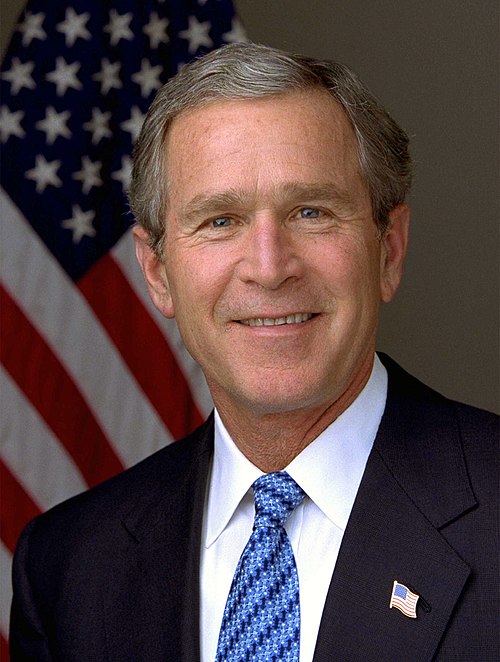
George H. W. Bush, official presidential portrait
Quick facts
George H. W. Bush at a glance
| Born | June 12, 1924, in Milton, Massachusetts | |
| Died | November 30, 2018, in Houston, Texas, aged 94 | |
| President | 41st, from January 20, 1989, to January 20, 1993 | |
| Vice president | J. Danforth “Dan” Quayle | |
| Party | Republican | |
| Education | Phillips Academy, Andover; Yale University, 1948 | |
| Military | US Navy torpedo bomber pilot in World War II; 58 combat missions; Distinguished Flying Cross | |
| Before the White House | US representative from Texas, ambassador to the UN, envoy to China, director of the CIA, vice president (1981–1989) | |
| Wife | Barbara Pierce, married January 6, 1945 | |
| Children | Six: George W., Robin (died aged 3), Jeb, Neil, Marvin and Dorothy | |
| Elections | Won in 1988 over Michael Dukakis; lost in 1992 to Bill Clinton | |
| Buried | George Bush Presidential Library, College Station, Texas |
The big picture in 30 seconds
Why he matters
- Guided the peaceful end of the Cold War, the reunification of Germany and the breakup of the Soviet Union.
- Built a coalition of 35 nations that freed Kuwait from Iraq in the 1991 Gulf War.
- Signed the Americans with Disabilities Act, a landmark civil rights law for people with disabilities.
- Signed the Clean Air Act Amendments of 1990, which cut acid rain.
- Broke his “Read my lips: no new taxes” pledge in a 1990 budget deal that helped reduce later deficits.
- The father of the 43rd president, George W. Bush. Only John Adams had also seen a son become president.
58
combat missions he flew as one of the Navy’s youngest pilots
100 hours
the length of the Gulf War ground campaign
89%
his approval rating after the Gulf War, a record at the time
43 million
Americans with disabilities protected by the ADA in 1990
Early years
A young pilot
George Herbert Walker Bush was born on June 12, 1924, in Milton, Massachusetts, and grew up in Greenwich, Connecticut. His father, Prescott Bush, was a Wall Street banker and later a US senator. His mother taught her children never to brag; Bush struggled with the word “I” all his life.
On his 18th birthday, six months after Pearl Harbor, he enlisted in the Navy. He became one of the youngest naval aviators of the war and flew torpedo bombers from the carrier USS San Jacinto.
Shot down
On September 2, 1944, his plane was hit by Japanese anti-aircraft fire over the island of Chichi Jima. Bush finished his bombing run, then bailed out over the ocean. His two crewmen died. He floated in a raft for hours until the submarine USS Finback rescued him. He later said he thought about those two men every day.
Yale and Texas
He married Barbara Pierce in January 1945, finished Yale in two and a half years and captained its baseball team. Instead of joining his father on Wall Street, the young couple drove to West Texas, where Bush went into the oil business. In 1953 their daughter Robin died of leukemia at age three.

Into politics
A long résumé
Bush won a seat in Congress from Houston in 1966 but lost two Senate races. Presidents Nixon and Ford gave him a string of important jobs: ambassador to the United Nations, chairman of the Republican Party during Watergate, chief American envoy to China and director of the CIA.
Vice president
Bush ran against Ronald Reagan for the 1980 Republican nomination, calling his tax plans “voodoo economics.” Reagan picked him as his running mate anyway, and Bush served eight loyal years. In 1988 he became the first sitting vice president elected president since Martin Van Buren in 1836. He promised a “kinder, gentler nation” and told voters, “Read my lips: no new taxes.”
Election of 1988
A third Republican term
Electoral votes: 538 electors; 270 needed to win. Popular vote: Bush 48.9 million (53.4%), Dukakis 41.8 million (45.6%)
Election of 1992
“It's the economy, stupid”
Electoral votes: 538 electors; 270 needed to win. Popular vote: Clinton 44.9 million (43.0%), Bush 39.1 million (37.4%), Perot 19.7 million (18.9%)
The end of the Cold War, 1989–1991
A new world order
In Bush’s first year, communist governments collapsed one after another across Eastern Europe. Bush was careful not to gloat, fearing a Soviet crackdown, and worked closely with Mikhail Gorbachev. Critics said he was too cautious; supporters credit him with helping the Cold War end without a shot fired between the superpowers.
November 9, 1989
The Berlin Wall falls
East Germany opened its borders, and Berliners climbed the wall and chipped away at it. Bush met Gorbachev at Malta three weeks later.
October 3, 1990
Germany reunited
Bush pushed hard for a united Germany inside NATO, overcoming doubts in Britain, France and the Soviet Union.
July 31, 1991
START I
Bush and Gorbachev signed the first treaty to cut, not just limit, long-range nuclear weapons.
December 25, 1991
The Soviet Union ends
Gorbachev resigned and the Soviet flag came down over the Kremlin. The USSR split into 15 independent countries.

Disarmament
Shrinking the nuclear stockpile
As the Cold War ended, Bush ordered thousands of American nuclear weapons retired, including all short-range nuclear weapons based on land in Europe and Asia. Gorbachev answered with similar cuts. In January 1993 Bush also signed START II with Russian President Boris Yeltsin.
Source: US Department of Energy and Department of Defense, stockpile figures released in 2010. Bush's years in office shown in red.
The Gulf War, 1990–1991
“This will not stand”
On August 2, 1990, Iraqi dictator Saddam Hussein invaded the small, oil-rich country of Kuwait. Bush declared that the invasion “will not stand.” He sent troops to protect Saudi Arabia in Operation Desert Shield, won United Nations approval for the use of force and built a coalition of 35 nations, including several Arab countries. Congress narrowly voted to authorize war.
Operation Desert Storm began on January 17, 1991, with weeks of bombing. The ground attack, led by General Norman Schwarzkopf, began February 24, and 100 hours later Kuwait was free. Fewer than 300 Americans died. Retreating Iraqi troops set more than 600 Kuwaiti oil wells on fire.
Bush decided not to march on Baghdad or remove Saddam, saying the UN had approved only freeing Kuwait. That choice is still debated.
Panama
Earlier, in December 1989, Bush had sent troops into Panama to remove its dictator, Manuel Noriega, who was wanted in the United States for drug trafficking.

At home
A kinder, gentler nation
Facing a Democratic Congress, Bush vetoed 44 bills and worked out compromises on others. A recession in 1990–91 hurt his popularity.
July 26, 1990
Americans with Disabilities Act
Banned discrimination against people with disabilities in jobs, transportation and public places, and required ramps, accessible buses and more.
November 15, 1990
Clean Air Act Amendments
Created a system of trading pollution permits that sharply cut the sulfur emissions that caused acid rain.
1990
“Read my lips”
To cut the deficit, Bush agreed to a budget deal with tax increases. Many Republicans felt betrayed, and conservative Pat Buchanan challenged him in 1992.
1989–1993
“A thousand points of light”
Bush praised volunteers as “points of light” and honored more than 1,000 of them with daily awards.
“This will not stand, this aggression against Kuwait.”
George H. W. Bush, remarks on the White House lawn
August 5, 1990
Final years
Parachutes and friendship
After losing in 1992, Bush left a handwritten note in the Oval Office for Bill Clinton: “Your success now is our country’s success. I am rooting hard for you.” He and Barbara retired to Houston and to their summer home in Kennebunkport, Maine. He celebrated his 75th, 80th, 85th and 90th birthdays by skydiving.
He watched his son George W. become president in 2001 and his son Jeb serve as governor of Florida. He and Clinton became close friends while raising money for victims of the 2004 Indian Ocean tsunami and Hurricane Katrina. Barbara died in April 2018 after 73 years of marriage, and Bush died that November at 94.
How he is remembered
Bush was often seen as a one-term president who lacked “the vision thing.” Historians now give him high marks for managing the end of the Cold War and the Gulf War, and for putting the country’s interest ahead of his own in the 1990 budget deal.
His life at a glance
Life timeline
People
Who's who in Bush's story


Visit
College Station and Kennebunkport
The George H.W. Bush Presidential Library and Museum at Texas A&M University in College Station includes a World War II torpedo bomber like the one he flew and a piece of the Berlin Wall. The Bush family compound at Walker’s Point in Kennebunkport, Maine, can be seen from the coastal road but is not open to visitors.