
Home › People › US Presidents › George W. Bush
43rd President · 2001–2009 · Republican
George W. Bush: September 11 and a Changed World
George W. Bush was a Texas oilman, baseball team owner and governor who won the presidency in 2000 after one of the closest elections in American history. Eight months later the September 11 attacks reshaped his presidency. He led the country into wars in Afghanistan and Iraq, created the Department of Homeland Security, cut taxes, expanded Medicare and launched a global fight against AIDS, and ended his second term in the 2008 financial crisis.
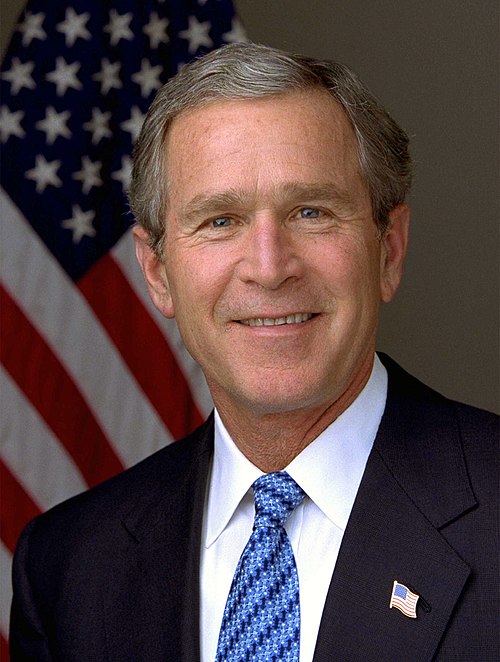
George W. Bush, official presidential portrait photograph
Quick facts
George W. Bush at a glance
| Born | July 6, 1946, in New Haven, Connecticut | |
| President | 43rd, from January 20, 2001, to January 20, 2009 | |
| Vice president | Richard B. “Dick” Cheney | |
| Party | Republican | |
| Education | Yale University, 1968; Harvard Business School (MBA), 1975, the only president with an MBA | |
| Military | F-102 fighter pilot in the Texas Air National Guard, 1968–1973 | |
| Before the White House | Oil businessman, managing partner of the Texas Rangers baseball team, governor of Texas (1995–2000) | |
| Wife | Laura Welch, married November 5, 1977 | |
| Children | Twin daughters, Barbara and Jenna | |
| Elections | Won in 2000 over Al Gore and in 2004 over John Kerry | |
| Family | Son of the 41st president, George H. W. Bush; brother of Florida governor Jeb Bush | |
| Library | George W. Bush Presidential Center, Southern Methodist University, Dallas |
The big picture in 30 seconds
Why he matters
- Led the nation after the September 11, 2001, terrorist attacks, the deadliest attack on American soil.
- Launched the war in Afghanistan in 2001 and the invasion of Iraq in 2003, both of which lasted for years.
- Created the Department of Homeland Security, the biggest government reorganization since 1947.
- Signed No Child Left Behind, large tax cuts and a Medicare prescription drug benefit.
- Started PEPFAR, a program to fight AIDS in Africa credited with saving more than 25 million lives.
- Faced the 2008 financial crisis in his final months, signing a $700 billion bank rescue.
537 votes
his margin in Florida, which decided the 2000 election
2,977
people killed in the September 11 attacks
90%
his approval rating after September 11, the highest Gallup has recorded
25 million
lives PEPFAR is credited with saving
Early years
From Midland to the governor's mansion
George Walker Bush was born on July 6, 1946, in New Haven, Connecticut, while his father was a student at Yale. When he was two, the family moved to the oil town of Midland, Texas, and later to Houston. His younger sister Robin died of leukemia when he was seven, and he tried to cheer up his grieving mother with jokes.
Like his father and grandfather, he went to Phillips Academy and Yale, where he was better known for his friendliness than his grades. He flew fighter jets in the Texas Air National Guard, then earned a business degree at Harvard.
Oil, Laura and baseball
Back in Midland he started an oil company, which struggled. In 1977 he married Laura Welch, a librarian who had grown up in Midland too, and their twin daughters were born in 1981. In 1986, at age 40, he gave up drinking and later said his Christian faith helped him change. In 1989 he and partners bought the Texas Rangers baseball team, which made him well known and wealthy.
Governor
In 1994 he beat popular Democratic Governor Ann Richards, and he won reelection in a landslide in 1998, with strong support from Hispanic voters. He called himself a “compassionate conservative” and worked with Democrats on school reform.

The 2000 election
Thirty-six days
On election night, November 7, 2000, the race came down to Florida, where Bush’s brother Jeb was governor. TV networks first called the state for Al Gore, then for Bush, then said it was too close to call. Bush led by just a few hundred votes out of almost six million. Recounts began, and Americans learned new words like “hanging chads” from punch-card ballots that had not been fully punched.
After weeks of court battles, the US Supreme Court ruled 5 to 4 in Bush v. Gore on December 12 to stop the recount. Bush won Florida by 537 votes and the presidency, though Gore had won about 540,000 more votes nationwide. Gore conceded the next day.
Election of 2000
One of the closest ever
Electoral votes: 538 electors; 270 needed to win. Popular vote: Gore 51.0 million (48.4%), Bush 50.5 million (47.9%)
Election of 2004
A wartime election
Electoral votes: 538 electors; 270 needed to win. Popular vote: Bush 62.0 million (50.7%), Kerry 59.0 million (48.3%)
September 11, 2001
The day everything changed
On the morning of September 11, 2001, 19 terrorists of the group al-Qaeda hijacked four airliners. They flew two into the towers of the World Trade Center in New York, which collapsed, and one into the Pentagon near Washington. Passengers on the fourth plane, United Flight 93, fought back, and it crashed in a field near Shanksville, Pennsylvania. In all, 2,977 people were killed.
Bush was reading to second-graders at a school in Florida when an aide whispered, “America is under attack.” Three days later he stood on the rubble at Ground Zero with a bullhorn. When a rescue worker shouted that he couldn’t hear him, Bush answered, “I can hear you!” His approval rating rose to 90 percent.
Homeland security
Congress passed the USA PATRIOT Act, giving the government new powers to track suspected terrorists, and in 2002 created the Department of Homeland Security. Critics argued that some measures, including the detention of prisoners at Guantanamo Bay and harsh interrogation methods such as waterboarding, violated civil liberties and human rights.

War on terror
Afghanistan and Iraq
Bush declared a global “war on terror.” The two wars that followed shaped his presidency and his reputation.
October 7, 2001
Afghanistan
The US and its allies attacked Afghanistan, whose Taliban rulers sheltered al-Qaeda leader Osama bin Laden. The Taliban fell within weeks, but bin Laden escaped, and the war went on for nearly 20 years.
March 20, 2003
Iraq
Saying Iraqi dictator Saddam Hussein had weapons of mass destruction and could give them to terrorists, Bush led an invasion. Baghdad fell in three weeks and Saddam was later captured, but no such weapons were found.
2003–2008
Insurgency and the surge
A violent insurgency and a civil war followed. In 2007 Bush sent about 30,000 more troops, a “surge” that reduced the violence. About 4,400 American troops died in Iraq, along with well over 100,000 Iraqis.
At home
Compassionate conservatism
Bush worked with both parties on several major laws in his first term, and pushed for more in his second.
2001 and 2003
Tax cuts
Bush signed two large tax cuts, lowering rates for every income bracket. Supporters said they helped the economy recover from the 2001 recession; critics said they mostly helped the wealthy and added to deficits.
January 8, 2002
No Child Left Behind
Written with Democratic Senator Ted Kennedy, this education law required yearly testing in reading and math and held schools responsible for results.
2003
Medicare drugs and PEPFAR
He added a prescription drug benefit to Medicare and launched the President’s Emergency Plan for AIDS Relief, which has paid for HIV treatment for millions of people in Africa and elsewhere.
August 29, 2005
Hurricane Katrina
The storm flooded New Orleans and killed more than 1,300 people. The slow federal response was widely criticized and badly hurt his popularity.
The economy
Unemployment, 2001–2009
Bush took office as the dot-com boom ended, and the economy dipped into recession in 2001, worsened by the shock of September 11. Jobs recovered by the middle of the decade. Then, in 2007 and 2008, a housing bubble burst and a financial crisis swept Wall Street. In October 2008 Bush signed the $700 billion Troubled Asset Relief Program to rescue the banks.
Source: US Bureau of Labor Statistics. Bush's years in office shown in red; 2009 shows the effect of the crisis after he left office.
“I can hear you! The rest of the world hears you! And the people who knocked these buildings down will hear all of us soon!”
George W. Bush, at Ground Zero in New York
September 14, 2001
After the White House
Painting and the Bush Center
Bush and Laura moved back to Texas, to Dallas and their ranch near Crawford. He stayed out of politics for years, saying his successor deserved his silence. He wrote a memoir, Decision Points, and took up painting, publishing books of portraits of veterans and of immigrants. The George W. Bush Presidential Center opened in Dallas in 2013 and runs programs for veterans and on global health.
How he is remembered
Bush left office with an approval rating of about 34 percent, after reaching a low of 25 percent in 2008. Supporters praise his leadership after September 11, the absence of another major attack on US soil during his presidency, PEPFAR and his education reform. Critics fault the Iraq War, which was based on intelligence that proved wrong, the treatment of terror suspects, the response to Hurricane Katrina and growing deficits. His reputation has improved somewhat since he left office.
His life at a glance
Life timeline
People
Who's who in Bush's story


Visit
Dallas, Texas
The George W. Bush Presidential Library and Museum at Southern Methodist University in Dallas includes a full-size replica of the Oval Office, the Decision Points Theater, where visitors weigh the choices he faced, and a Texas Rose Garden. The National September 11 Memorial and Museum in New York and the Flight 93 National Memorial in Pennsylvania honor the victims of the attacks.