
Home › People › US Presidents › Ronald Reagan
40th President · 1981–1989 · Republican
Ronald Reagan: The Great Communicator
Ronald Reagan was a small-town Illinois boy who became a radio announcer, a Hollywood actor and governor of California before winning the presidency at 69. He cut taxes, built up the military and survived an assassination attempt. Through four summits with Soviet leader Mikhail Gorbachev he helped wind down the Cold War, while the Iran-Contra scandal and soaring deficits drew sharp criticism.

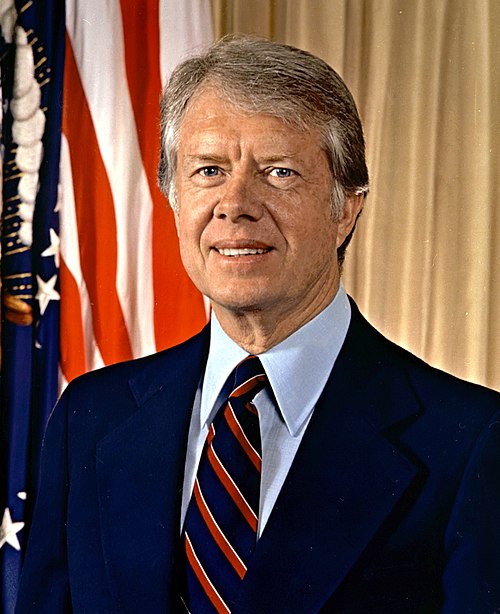
Ronald Reagan, official portrait photograph, 1981
Quick facts
Ronald Reagan at a glance
| Born | February 6, 1911, in Tampico, Illinois | |
| Died | June 5, 2004, in Los Angeles, California, aged 93 | |
| President | 40th, from January 20, 1981, to January 20, 1989 | |
| Vice president | George H. W. Bush | |
| Party | Republican (a Democrat until 1962) | |
| Education | Eureka College, Illinois, 1932 (economics and sociology) | |
| Military | US Army Air Forces in World War II, making training films in Hollywood | |
| Before the White House | Radio sports announcer, film actor, president of the Screen Actors Guild, governor of California (1967–1975) | |
| Wives | Jane Wyman (married 1940, divorced 1949); Nancy Davis, married March 4, 1952 | |
| Children | Maureen and Michael (with Jane Wyman); Patti and Ron (with Nancy) | |
| Elections | Won in 1980 over Jimmy Carter and in 1984 over Walter Mondale | |
| Buried | Ronald Reagan Presidential Library, Simi Valley, California |
The big picture in 30 seconds
Why he matters
- Led a conservative shift in American politics, arguing that government had grown too big.
- Cut income tax rates sharply in 1981 and simplified the tax code in 1986.
- Built up the military and called the Soviet Union an “evil empire,” then negotiated with Mikhail Gorbachev.
- Signed the INF Treaty of 1987, the first treaty to destroy an entire class of nuclear weapons.
- Appointed Sandra Day O'Connor, the first woman on the Supreme Court.
- Faced criticism for the Iran-Contra scandal and for deficits that nearly tripled the national debt.
69
his age when he took office, the oldest president up to that time
49 states
won in his 1984 landslide
4 summits
with Mikhail Gorbachev, from Geneva in 1985 to Moscow in 1988
2,692
nuclear missiles destroyed under the 1987 INF Treaty
Early years
Dutch from Dixon
Ronald Wilson Reagan was born on February 6, 1911, in an apartment above a bakery in Tampico, Illinois. His father said the chubby baby looked like “a fat little Dutchman,” and the nickname “Dutch” stuck. The family moved often before settling in Dixon, Illinois. His father struggled with alcohol; his mother was a devout churchgoer who loved acting in church plays.
As a teenager Reagan worked seven summers as a lifeguard on the Rock River and was credited with saving 77 people. He played football and acted at little Eureka College, where he led a student strike as a freshman.
Radio and Hollywood
Reagan became a sports announcer in Iowa, re-creating Chicago Cubs games from telegraph reports. In 1937 he passed a screen test at Warner Brothers and went on to make more than 50 films. His best-known roles were the football star George Gipp in Knute Rockne, All American (1940), which earned him the nickname “the Gipper,” and a young man who loses his legs in Kings Row (1942).
Into politics
From actor to governor
Reagan was president of the Screen Actors Guild for six terms, where he fought communist influence in Hollywood. In the 1950s he hosted the TV show General Electric Theater and toured GE factories giving speeches, which made him more and more conservative. He married actress Nancy Davis in 1952, and the two remained devoted for the rest of his life.
“A Time for Choosing”
A televised speech for Republican candidate Barry Goldwater in October 1964 made Reagan a political star. Two years later he was elected governor of California by nearly a million votes, and he was reelected in 1970. He challenged President Ford for the nomination in 1976 and lost narrowly, then won it in 1980.

Election of 1980
“Are you better off?”
Electoral votes: 538 electors; 270 needed to win. Popular vote: Reagan 43.9 million (50.7%), Carter 35.5 million (41.0%)
Election of 1984
“Morning in America”
Electoral votes: 538 electors; 270 needed to win. Popular vote: Reagan 54.5 million (58.8%), Mondale 37.6 million (40.6%)
March 30, 1981
“Honey, I forgot to duck”
Sixty-nine days into his presidency, Reagan was leaving a hotel in Washington when John Hinckley Jr. fired six shots. One bullet bounced off the limousine and lodged in Reagan’s chest, an inch from his heart. Press Secretary James Brady was shot in the head and permanently disabled, and a police officer and a Secret Service agent were also wounded.
Reagan walked into the hospital on his own before collapsing. He joked to Nancy, “Honey, I forgot to duck,” and told the surgeons he hoped they were all Republicans. His good humor made him enormously popular, and helped him push his economic program through Congress.

At home
Reaganomics
“Government is not the solution to our problem; government is the problem,” Reagan said in his first inaugural address. His economic plan, nicknamed Reaganomics, cut taxes and regulations and slowed the growth of domestic spending, while sharply raising military spending.
1981 and 1986
Tax cuts and tax reform
The 1981 tax law cut the top income tax rate from 70 to 50 percent. The bipartisan Tax Reform Act of 1986 lowered it to 28 percent and closed many loopholes.
August 1981
The air traffic controllers
When about 13,000 federal air traffic controllers went on an illegal strike, Reagan fired more than 11,000 who refused to return. The move weakened labor unions for years.
1982–1988
Recession, then boom
A deep recession pushed unemployment to 10.8 percent in late 1982. Then the economy boomed, and inflation fell. Critics noted that federal deficits soared and the national debt nearly tripled.
1981
Sandra Day O'Connor
Keeping a campaign promise, Reagan named the first woman to the Supreme Court. She was confirmed 99 to 0.
Inflation
Breaking inflation
Reagan backed Federal Reserve chairman Paul Volcker’s high interest rates even though they caused the 1981–82 recession. By 1983 inflation had fallen to its lowest level in years and stayed low.
Source: US Bureau of Labor Statistics, Consumer Price Index. Reagan's years in office shown in red.
The Cold War
From “evil empire” to friendship
In his first term Reagan built up the armed forces, called the Soviet Union an “evil empire” and proposed the Strategic Defense Initiative, a space-based shield against missiles that critics nicknamed “Star Wars.” He supported anti-communist rebels in Afghanistan, Nicaragua and Angola, and sent troops to invade the Caribbean island of Grenada in 1983.
Reagan and Gorbachev
In 1985 the younger, reform-minded Mikhail Gorbachev became the Soviet leader. The two men met in Geneva in 1985 and in Reykjavik, Iceland, in 1986, where they came close to agreeing to abolish all nuclear weapons. In December 1987 they signed the INF Treaty, which eliminated all American and Soviet intermediate-range nuclear missiles. In 1988 Reagan strolled through Red Square in Moscow and said he no longer considered the Soviet Union an evil empire.
“Tear down this wall!”
On June 12, 1987, at the Brandenburg Gate in West Berlin, Reagan challenged Gorbachev to open the Berlin Wall. The wall fell two years later, ten months after Reagan left office.

1986–1987
The Iran-Contra affair
In November 1986 Americans learned that White House officials had secretly sold missiles to Iran, hoping to free American hostages held in Lebanon, even though Reagan had promised never to bargain with terrorists. Part of the money was then sent to the Contra rebels in Nicaragua, which Congress had banned.
Reagan at first denied trading arms for hostages, then admitted in a TV address in March 1987 that it had happened. Investigators found no proof that he knew about the money going to the Contras, but criticized his loose management. Fourteen people were charged, and his approval rating fell sharply before recovering.
The Challenger
On January 28, 1986, the space shuttle Challenger exploded 73 seconds after launch, killing all seven astronauts, including teacher Christa McAuliffe. That night Reagan spoke to the nation and to the many schoolchildren who had watched the launch, saying the crew had “slipped the surly bonds of earth” to “touch the face of God.”
“General Secretary Gorbachev, if you seek peace, if you seek prosperity for the Soviet Union and Eastern Europe, if you seek liberalization: Come here to this gate! Mr. Gorbachev, open this gate! Mr. Gorbachev, tear down this wall!”
Ronald Reagan, speech at the Brandenburg Gate, West Berlin
June 12, 1987
Final years
“The sunset of my life”
Reagan left office with an approval rating of about 63 percent, one of the highest of any departing president. He retired to Los Angeles and to his ranch, Rancho del Cielo, in the mountains above Santa Barbara, where he loved to ride horses and cut brush.
In November 1994 he wrote a handwritten letter to the American people revealing that he had Alzheimer’s disease. “I now begin the journey that will lead me into the sunset of my life,” he wrote. Nancy cared for him for ten years. He died on June 5, 2004, at 93, and was buried at his library in Simi Valley.
How he is remembered
Admirers credit Reagan with restoring Americans’ confidence, beating inflation and helping to end the Cold War peacefully. Critics point to the deficits, rising inequality, cuts to programs for the poor, his slow response to the AIDS epidemic and the Iran-Contra scandal. Historians usually rank him in the top dozen presidents, and he remains a hero to conservatives.
His life at a glance
Life timeline
People
Who's who in Reagan's story


Visit
Simi Valley, Dixon and Tampico
The Ronald Reagan Presidential Library and Museum in Simi Valley, California, holds his grave and Nancy’s, a full-size replica of the Oval Office and the Air Force One that served seven presidents. In Illinois, visitors can see his birthplace in Tampico and his boyhood home in Dixon.