
Home › US History › Modern America › Apollo 11
Modern America · Kennedy Space Center to the Sea of Tranquility · July 1969
Apollo 11: The First Moon Landing
Apollo 11 was the NASA mission that landed the first humans on the Moon. On July 20, 1969, astronauts Neil Armstrong and Buzz Aldrin set the lunar module Eagle down on the Sea of Tranquility while Michael Collins circled overhead in Columbia. About 600 million people watched on television as Armstrong stepped onto the surface. The landing fulfilled President Kennedy’s 1961 goal and won the space race with the Soviet Union.

The Apollo 11 crew: Neil Armstrong, Michael Collins and Edwin “Buzz” Aldrin. NASA photo
Quick facts
Apollo 11 at a glance
| Launch | July 16, 1969, 9:32 a.m. EDT, Kennedy Space Center, Florida, on a Saturn V rocket | |
| Landing | July 20, 1969, 4:17 p.m. EDT, at Tranquility Base in the Sea of Tranquility | |
| First step | Neil Armstrong, 10:56 p.m. EDT on July 20 (02:56 UTC July 21) | |
| Crew | Neil Armstrong (commander), Michael Collins (command module pilot), Buzz Aldrin (lunar module pilot) | |
| Spacecraft | Command module Columbia and lunar module Eagle | |
| On the Moon | 21 hours 36 minutes on the surface; 2 hours 31 minutes walking outside | |
| Brought back | 47.5 pounds (21.5 kg) of Moon rocks and soil | |
| Splashdown | July 24, 1969, in the Pacific Ocean; picked up by USS Hornet |
The big picture in 30 seconds
Why Apollo 11 matters
- Humans walked on another world for the first time.
- It won the space race for the United States during the Cold War.
- Its technology helped create modern computers and satellites.
- Its photos of Earth changed how people saw their planet.
8 days
mission length
600 million
people watched on TV
363 feet
height of the Saturn V rocket
400,000
Americans worked on Apollo
The space race
“We choose to go to the Moon”
The space race began in October 1957, when the Soviet Union launched Sputnik, the first satellite. In April 1961 the Soviet cosmonaut Yuri Gagarin became the first person in space. Americans feared they were falling behind in science and in the Cold War.
On May 25, 1961, President John F. Kennedy asked Congress to commit the nation to “landing a man on the Moon and returning him safely to the Earth” before the decade was out. At that moment, the United States had flown one astronaut for just 15 minutes. NASA’s budget soared, and by the mid-1960s about 400,000 people at NASA and thousands of companies were working on Apollo.
Mercury, Gemini, Apollo
NASA climbed step by step: one-man Mercury flights, two-man Gemini flights that practiced spacewalks and docking, then three-man Apollo. In January 1967 a fire killed the Apollo 1 crew during a ground test. After a redesign, Apollo 8 circled the Moon at Christmas 1968, and Apollo 10 flew a dress rehearsal in May 1969.

The flight path
A quarter of a million miles
The three-stage Saturn V, the most powerful rocket ever flown at the time, put Apollo 11 into orbit around Earth in 12 minutes. After one and a half orbits, the third stage fired again and sent the astronauts toward the Moon. Three days later they slipped into orbit around it.
On July 20 Armstrong and Aldrin climbed into Eagle, separated from Columbia and fired the descent engine. After about 21 hours on the surface they lifted off, met Collins in lunar orbit and headed home. Columbia splashed down in the Pacific on July 24, about 900 miles southwest of Hawaii.
Eight days to the Moon and back
The mission, day by day
Apollo 11 lasted 8 days, 3 hours and 18 minutes.
About a million people watch from Florida’s beaches and roads as the Saturn V launches.
The crew sends TV broadcasts home as Earth shrinks behind them.
Columbia fires its engine behind the Moon, out of radio contact, and enters orbit.
Armstrong steers past a boulder field and lands with seconds of fuel to spare.
Armstrong steps onto the Moon. Aldrin joins him about 19 minutes later.
Columbia lands in the Pacific. The crew spends three weeks in quarantine.
Tranquility Base, July 20, 1969
“The Eagle has landed”
As Eagle dropped toward the Moon, alarms lit up the computer: codes 1202 and 1201, warning that it was overloaded. In Mission Control in Houston, 26-year-old guidance officer Steve Bales and engineer Jack Garman quickly decided it was safe to go on. Then Armstrong saw that the computer was steering them into a crater full of boulders. He took manual control and flew on, hunting for a smooth spot, while the fuel ran low. When Eagle touched down, it had about 25 seconds of fuel left before the crew would have had to abort.
“Houston, Tranquility Base here. The Eagle has landed,” Armstrong reported. Capcom Charlie Duke answered, “You got a bunch of guys about to turn blue. We’re breathing again.” Six and a half hours later, Armstrong climbed down the ladder.
On the surface
Armstrong and Aldrin planted an American flag, set up a seismometer and a laser mirror that scientists still use to measure the distance to the Moon, collected rocks, and took a phone call from President Nixon. They left a plaque that reads: “We came in peace for all mankind.”

The people of Apollo 11
The people of Apollo 11

A former Navy pilot and test pilot who flew the X-15 and became the first person to walk on the Moon.
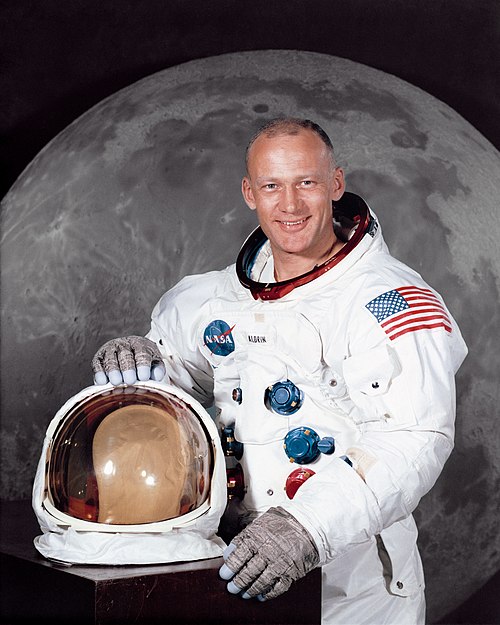
An Air Force fighter pilot in Korea with a doctorate from MIT. He was the second person on the Moon.

Circled the Moon alone in Columbia, out of contact with Earth every time he passed behind it.

Set the goal of landing a man on the Moon by the end of the 1960s, but did not live to see it.

Calculated spaceflight paths by hand and checked the computer math for John Glenn’s orbit and Apollo.

Spoke to the astronauts on the Moon by radiotelephone and greeted them on USS Hornet.
Why it mattered
After the giant leap
Five more Apollo crews landed on the Moon between 1969 and 1972; only Apollo 13 failed to land, after an oxygen tank exploded. In all, twelve Americans have walked on the Moon, and they brought back 842 pounds of rock that taught scientists how the Moon formed. Then the program ended, as public interest and NASA’s budget faded.
Apollo’s legacy reaches far beyond the Moon. The push for small, reliable guidance computers helped launch the microchip industry. The 1968 “Earthrise” photo from Apollo 8 helped start the environmental movement. Today NASA’s Artemis program aims to send astronauts back to the Moon, including the first woman.
Two ships, one mission
The spacecraft of Apollo 11
Apollo 11 was really three machines stacked on top of a giant rocket.
Year by year
The race to the Moon, 1957–1972
“That’s one small step for [a] man, one giant leap for mankind.”
Neil Armstrong
Stepping onto the Moon, July 20, 1969
The bigger story
Modern America, 1946 to today
Our U.S. History era page puts this in context: the Cold War, the civil rights movement, the space race and the new century.
Go deeper
Books and sources
- Carrying the Fire: An Astronaut’s Journeys, by Michael Collins (1974)
- First Man: The Life of Neil A. Armstrong, by James R. Hansen (2005)
- A Man on the Moon, by Andrew Chaikin (1994)
- More recommended books