
Home › US History › Modern America › Brown v. Board of Education
Modern America · The Supreme Court · May 17, 1954
Brown v. Board of Education (1954)
Brown v. Board of Education was the landmark Supreme Court case that ruled, on May 17, 1954, that separating children in public schools by race was unconstitutional. All nine justices agreed that “separate educational facilities are inherently unequal,” overturning the “separate but equal” rule of 1896. The decision, argued by Thurgood Marshall of the NAACP, launched the modern civil rights movement, though it took years of struggle to make it real.

Thurgood Marshall, chief lawyer of the NAACP Legal Defense Fund, argued Brown before the Supreme Court
Quick facts
Brown v. Board of Education at a glance
| Court | Supreme Court of the United States, Chief Justice Earl Warren | |
| Decided | May 17, 1954 (Brown I); Brown II, on how to desegregate, May 31, 1955 | |
| Vote | 9–0, a unanimous decision written by Earl Warren | |
| Overturned | Plessy v. Ferguson (1896) and its rule of “separate but equal” | |
| Cases joined | Five cases from Kansas, South Carolina, Virginia, Delaware and Washington, D.C. | |
| Plaintiffs | Oliver Brown and 12 other Topeka parents, and about 200 plaintiffs in all | |
| Lawyers | Thurgood Marshall, Robert L. Carter, Spottswood Robinson III, Constance Baker Motley and the NAACP team | |
| Affected | 17 states and Washington, D.C., which required segregated schools by law |
The big picture in 30 seconds
Why Brown v. Board matters
- It ended legal segregation in public schools.
- It used the Fourteenth Amendment’s promise of “equal protection.”
- It encouraged the bus boycotts, sit-ins and marches that followed.
- It made Thurgood Marshall a hero; he became the first Black Supreme Court justice in 1967.
9–0
unanimous decision
17 states
plus D.C. required segregated schools
5
cases combined into one
58 years
after Plessy v. Ferguson
Separate but equal
Why the NAACP went to court
After Reconstruction ended, Southern states passed Jim Crow laws that separated Black and white Americans in schools, trains, restaurants and even cemeteries. In 1896 the Supreme Court approved these laws in Plessy v. Ferguson, as long as the separate facilities were “equal.” They almost never were. In 1950, Southern states spent far less on each Black pupil than on each white pupil, and many Black children walked miles to crowded, unheated schools while buses carried white children past them.
The NAACP’s lawyers, led first by Charles Hamilton Houston and then by his student Thurgood Marshall, chose a careful strategy. They began by winning cases against segregated law schools and graduate schools in the 1930s and 1940s, then decided to attack school segregation itself.
Linda Brown’s walk
In Topeka, Kansas, third-grader Linda Brown had to walk through a rail yard and ride a bus to a Black school about a mile away, though a white school stood seven blocks from her home. In 1951 her father, Oliver Brown, a welder and assistant pastor, tried to enroll her there with the NAACP’s help. Because his name came first in alphabetical order among the plaintiffs, the case was called Brown v. Board of Education of Topeka.
Where schools were separated
A nation of separate schools
In 1954, seventeen states, mostly in the South, and the District of Columbia required Black and white children to go to different schools. Four more states, including Kansas, allowed cities to choose segregation. Kansas let cities with more than 15,000 people separate elementary schools, which is how Topeka’s case began.
The five cases the Supreme Court combined came from very different places: rural Clarendon County, South Carolina; Prince Edward County, Virginia, where 16-year-old Barbara Johns led a student strike; Delaware; Washington, D.C.; and Topeka. Together they showed that segregation was a national problem, not just a Southern one.

From Topeka to the Supreme Court
The road to the decision
It took three years, two rounds of argument and a new chief justice to reach a unanimous ruling.
Parents in four states and D.C. sue, with NAACP lawyers, to end segregated schools.
Thurgood Marshall argues before the Court. The justices are divided and ask for a second argument.
Chief Justice Fred Vinson dies. Eisenhower appoints Earl Warren, former governor of California.
Warren works quietly to persuade every justice to sign a single opinion.
Warren reads the unanimous ruling: school segregation violates the Fourteenth Amendment.
The Court orders desegregation “with all deliberate speed,” words that let states delay for years.
Little Rock, Arkansas, September 1957
Nine students and the 101st Airborne
Many Southern leaders promised “massive resistance.” In 1956, 101 members of Congress signed the Southern Manifesto against Brown. Prince Edward County, Virginia, closed its public schools for five years rather than integrate them.
The biggest test came in Little Rock. In September 1957, nine Black students were chosen to enter Central High School. Governor Orval Faubus sent the Arkansas National Guard to keep them out, and a screaming mob surrounded the school. President Dwight D. Eisenhower, who had never spoken out strongly for Brown, would not let a governor defy the Constitution. He sent 1,000 paratroopers of the 101st Airborne Division and put the Arkansas Guard under federal command. On September 25, soldiers escorted the “Little Rock Nine” into the school.
Ruby Bridges
In New Orleans in November 1960, six-year-old Ruby Bridges became the first Black child at William Frantz Elementary. Federal marshals walked her past crowds every day, and for a year she was the only pupil in her class.

The people behind Brown
The people behind Brown
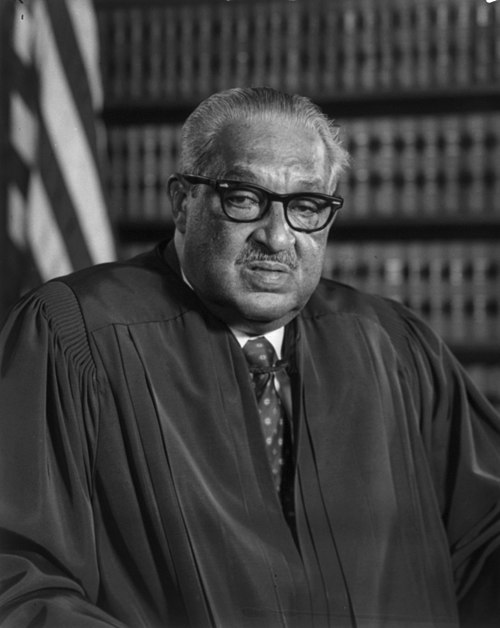
Won 29 of the 32 cases he argued before the Supreme Court, including Brown.

Persuaded all nine justices to agree, so the South could not claim the Court was divided.

Appointed Warren and sent federal troops to Little Rock to enforce the Court’s ruling.
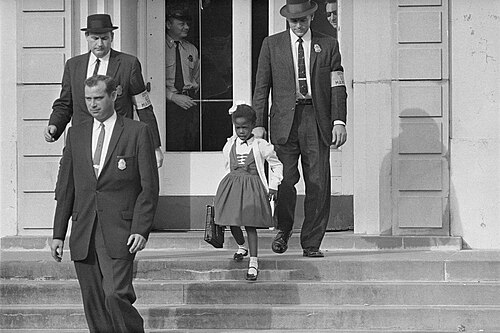
Integrated an all-white elementary school in 1960, guarded by U.S. marshals.

Inspired in part by Brown, she refused to give up her bus seat in Montgomery in 1955.

Led the Montgomery Bus Boycott a year after Brown and became the movement’s voice.
Why it mattered
The case that started a movement
Brown did not integrate schools overnight. Ten years later, only about 2 percent of Black children in the South attended school with white children. Change finally came after the Civil Rights Act of 1964 let the government cut off money to segregated schools, and after the Supreme Court ruled in 1968 that districts had to desegregate at once. By the 1970s, Southern schools were the most integrated in the country.
Brown’s greatest effect was on hope. It showed that the Constitution could be used to tear down Jim Crow. Within two years came the Montgomery Bus Boycott, and soon sit-ins, Freedom Rides and the March on Washington. Brown v. Board of Education is still taught as one of the most important Supreme Court decisions in American history.
Five cases, one decision
The cases behind Brown
The Supreme Court heard five cases together under Oliver Brown’s name.
Year by year
From Plessy to integration, 1896–1971
“Separate educational facilities are inherently unequal.”
Chief Justice Earl Warren
Brown v. Board of Education, May 17, 1954
The bigger story
Modern America, 1946 to today
Our U.S. History era page puts this in context: the Cold War, the civil rights movement, the space race and the new century.
Go deeper
Books and sources
- Simple Justice, by Richard Kluger (1976)
- Brown v. Board of Education: A Civil Rights Milestone and Its Troubled Legacy, by James T. Patterson (2001)
- Warriors Don’t Cry, by Melba Pattillo Beals (1994)
- More recommended books