
Home › People › US Presidents › Jimmy Carter
39th President · 1977–1981 · Democrat
Jimmy Carter: From Peanut Farmer to Peacemaker
Jimmy Carter was a Georgia peanut farmer and former Navy submarine officer who won the presidency in 1976 by promising to be honest with Americans after Watergate. He brought Egypt and Israel together at Camp David, but an energy crisis, high inflation and the Iran hostage crisis cost him a second term. He went on to the longest post-presidency in history and won the Nobel Peace Prize.
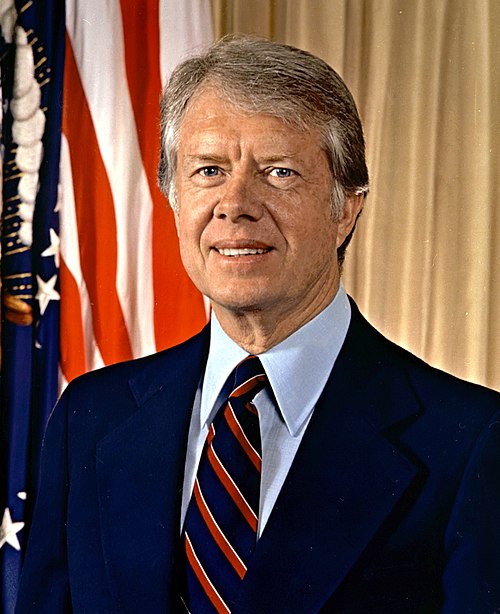
Jimmy Carter, official portrait photograph
Quick facts
Jimmy Carter at a glance
| Born | October 1, 1924, in Plains, Georgia | |
| Died | December 29, 2024, in Plains, Georgia, aged 100 | |
| President | 39th, from January 20, 1977, to January 20, 1981 | |
| Vice president | Walter F. Mondale | |
| Party | Democratic | |
| Education | US Naval Academy, Annapolis, class of 1947 (graduated 1946) | |
| Military | US Navy submarine officer, 1946–1953, in Admiral Hyman Rickover's nuclear submarine program | |
| Before the White House | Peanut farmer, Georgia state senator (1963–1967), governor of Georgia (1971–1975) | |
| Wife | Eleanor Rosalynn Smith, married July 7, 1946 | |
| Children | Three sons, Jack, Chip and Jeff, and a daughter, Amy | |
| Elections | Won in 1976 over Gerald Ford; lost in 1980 to Ronald Reagan | |
| Buried | At his home in Plains, Georgia, beside Rosalynn |
The big picture in 30 seconds
Why he matters
- Brought Egypt and Israel to the Camp David Accords in 1978, leading to a peace treaty that still holds.
- Made human rights a central goal of American foreign policy.
- Created the Departments of Energy and Education and protected more than 100 million acres of Alaska wilderness.
- Returned the Panama Canal to Panama by treaty and opened full relations with China.
- Struggled with high inflation, gas shortages and the 444-day Iran hostage crisis.
- Won the 2002 Nobel Peace Prize for decades of work for peace, democracy and health, and became the first president to live to 100.
13 days
of talks at Camp David that produced the 1978 accords
444 days
that 52 Americans were held hostage in Iran
2002
the year he won the Nobel Peace Prize
100 years
the longest life of any president
Early years
Growing up in Plains
James Earl Carter Jr. was born on October 1, 1924, in Plains, Georgia, the first American president born in a hospital. He grew up on a farm in nearby Archery, in a house with no electricity or running water for much of his childhood. Most of his playmates were the children of Black farmworkers. At five he was selling boiled peanuts on the streets of Plains.
The Navy
Carter dreamed of the Navy from boyhood. He graduated from the US Naval Academy in 1946 and served on submarines. Admiral Hyman Rickover chose him for the new nuclear submarine program, and in 1952 Carter helped shut down a damaged nuclear reactor at Chalk River in Canada, being lowered into it for 90 seconds at a time.
Back to the farm
When his father died in 1953, Carter left the Navy and went home to save the family peanut business, even though Rosalynn did not want to leave. The business grew, and he became a local leader who refused to join the segregationist White Citizens’ Council.

Into politics
“Jimmy Who?”
Carter won a seat in the Georgia Senate in 1962, after a court case exposed vote fraud against him. He lost the race for governor in 1966 but won in 1970. In his inaugural address he declared that “the time for racial discrimination is over,” surprising many Georgians, and hung a portrait of Martin Luther King Jr. in the state capitol.
The 1976 campaign
When Carter announced he was running for president in 1974, few people outside Georgia knew who he was. He campaigned for two years, staying in supporters’ homes and promising, “I’ll never lie to you.” After Watergate, voters liked an outsider with a big smile who taught Sunday school. He narrowly beat President Gerald Ford.
Election of 1976
The outsider wins
Electoral votes: 538 electors; 270 needed to win. Popular vote: Carter 40.8 million (50.1%), Ford 39.1 million (48.0%)
Election of 1980
Swept out
Electoral votes: 538 electors; 270 needed to win. Popular vote: Reagan 43.9 million (50.7%), Carter 35.5 million (41.0%)
Peace at Camp David, 1978
Thirteen days in the mountains
Egypt and Israel had fought four wars since 1948. In September 1978 Carter invited Egyptian President Anwar Sadat and Israeli Prime Minister Menachem Begin to Camp David, the presidential retreat in Maryland. The two leaders could barely stand to talk to each other, so Carter carried proposals back and forth between their cabins, drafting 23 versions of the agreement. On the 13th day, September 17, 1978, they signed the Camp David Accords at the White House. Six months later Egypt and Israel signed a peace treaty that has lasted ever since.

1977–1978
The Panama Canal treaties
Carter signed treaties to hand the canal to Panama by the end of 1999. The Senate approved them by one vote more than the two-thirds needed.
January 1, 1979
Relations with China
Building on Nixon’s opening, the United States formally recognized the People’s Republic of China.
1977–1981
Human rights
Carter criticized governments, friendly or not, that jailed and tortured their people, and cut aid to some of them.
The energy crisis
The price of oil
The United States imported nearly half its oil, and prices jumped after the 1979 revolution in Iran. Drivers waited in long lines for gas. Carter called the energy problem “the moral equivalent of war,” created the Department of Energy, put solar panels on the White House roof and urged Americans to turn down their thermostats. In July 1979 he gave a speech about a national “crisis of confidence” that critics nicknamed the “malaise” speech.
Source: US Energy Information Administration, domestic crude oil first purchase price (not adjusted for inflation). Carter's years shown in red.
1979–1980
The hostage crisis
In January 1979 a revolution overthrew the Shah of Iran, a US ally. When Carter let the sick Shah into the United States for cancer treatment, Iranian students stormed the US Embassy in Tehran on November 4, 1979, and took 66 Americans hostage. Fourteen were released early, but 52 were held for 444 days. Every night the TV news counted the days.
In April 1980 Carter approved a secret rescue mission. It was called off in the desert after helicopters broke down, and eight American servicemen died when a helicopter crashed into a transport plane. Carter took full responsibility. The hostages were finally freed minutes after he left office on January 20, 1981.
Afghanistan
In December 1979 the Soviet Union invaded Afghanistan. Carter stopped grain sales to the Soviets, began aiding the Afghan resistance and led a boycott of the 1980 Moscow Olympics.
Inflation
Prices rose more than 13 percent in 1980. Carter appointed Paul Volcker to head the Federal Reserve, and Volcker’s steep interest rates eventually broke inflation, but not before a painful recession.
“War may sometimes be a necessary evil. But no matter how necessary, it is always an evil, never a good.”
Jimmy Carter, Nobel Peace Prize lecture
December 10, 2002
After the White House
The longest post-presidency
Carter went home to Plains at 56, deep in debt because his peanut business had been in a blind trust. In 1982 he and Rosalynn founded the Carter Center in Atlanta. It has monitored more than 100 elections around the world and led the campaign against Guinea worm disease, which fell from about 3.5 million cases a year in 1986 to just a handful.
For more than 30 years the Carters spent a week each year building homes with Habitat for Humanity. He taught Sunday school in Plains into his 90s and wrote more than 30 books. In 2002 he won the Nobel Peace Prize.
Rosalynn died in November 2023 after 77 years of marriage. Jimmy Carter entered hospice care at home in February 2023 and died there on December 29, 2024, at 100.
How he is remembered
Many historians rank Carter’s presidency in the middle or lower half, pointing to the economy and the hostage crisis. Others argue that Camp David, his energy and environmental policies and his choice of Volcker look better with time. Almost everyone agrees he was one of the most admired former presidents.
His life at a glance
Life timeline
People
Who's who in Carter's story


Visit
Atlanta and Plains
The Jimmy Carter Presidential Library and Museum shares a campus with the Carter Center in Atlanta. In Plains, Jimmy Carter National Historical Park includes his boyhood farm, his school and the depot where he ran his 1976 campaign. Maranatha Baptist Church, where he taught Sunday school, is nearby.