
Home › People › US Presidents › Gerald R. Ford
38th President · 1974–1977 · Republican
Gerald R. Ford: Healing a Nation After Watergate
Gerald R. Ford was a college football star and longtime Michigan congressman who became the only person to serve as both vice president and president without being elected to either office. He took over when Richard Nixon resigned in 1974, pardoned Nixon a month later, and spent two and a half years fighting inflation and restoring trust in the White House.

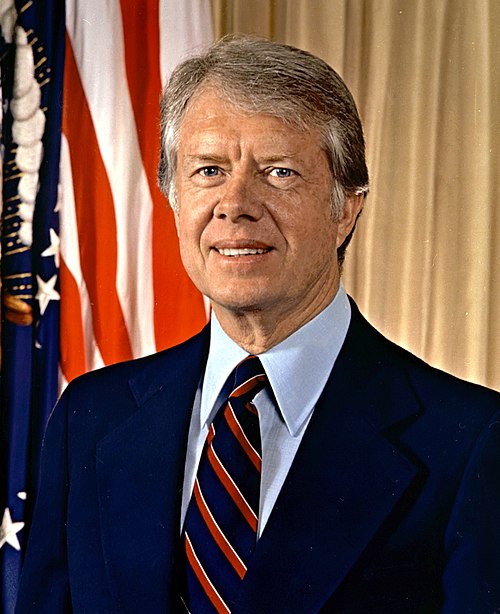
Gerald R. Ford, official portrait photograph, 1976
Quick facts
Gerald R. Ford at a glance
| Born | July 14, 1913, in Omaha, Nebraska, as Leslie Lynch King Jr. | |
| Died | December 26, 2006, in Rancho Mirage, California, aged 93 | |
| President | 38th, from August 9, 1974, to January 20, 1977 | |
| Vice president | Nelson A. Rockefeller (from December 1974) | |
| Party | Republican | |
| Education | University of Michigan, 1935; Yale Law School, 1941 | |
| Military | US Navy lieutenant commander aboard the aircraft carrier USS Monterey in World War II | |
| Before the White House | US representative from Michigan (1949–1973), House minority leader, vice president (1973–1974) | |
| Wife | Elizabeth “Betty” Bloomer Warren, married October 15, 1948 | |
| Children | Michael, John, Steven and Susan | |
| Election | Lost narrowly to Jimmy Carter in 1976 | |
| Buried | Grounds of the Gerald R. Ford Presidential Museum, Grand Rapids, Michigan |
The big picture in 30 seconds
Why he matters
- The first vice president chosen under the 25th Amendment, and the only president never elected president or vice president.
- Took office after Watergate and worked to restore honesty and openness to the presidency.
- Pardoned Richard Nixon, a decision that was hugely unpopular then and is more widely respected now.
- Was president when Saigon fell in 1975 and helped bring more than 100,000 Vietnamese refugees to the United States.
- Signed the Helsinki Accords, which committed the Soviet bloc to respect human rights.
- Survived two assassination attempts within three weeks in 1975.
895 days
in office, one of the shortest presidencies of the 1900s
25 years
in the House of Representatives before becoming vice president
66
bills vetoed, most of them spending bills from a Democratic Congress
2
national football championships he won as a Michigan player, 1932 and 1933
Early years
Leslie King becomes Jerry Ford
He was born Leslie Lynch King Jr. on July 14, 1913, in Omaha, Nebraska. His mother left his abusive father when he was a baby and moved to Grand Rapids, Michigan, where she married a paint salesman named Gerald R. Ford. The boy took his stepfather’s name and learned only as a teenager that Ford was not his birth father.
Football star
Jerry Ford was an Eagle Scout and a star center on the University of Michigan football team, which won national titles in 1932 and 1933. He turned down offers from the Detroit Lions and Green Bay Packers to go to Yale Law School, paying his way by coaching football and boxing there.
World War II
Ford joined the Navy after Pearl Harbor and served on the light aircraft carrier USS Monterey in many Pacific battles. In a typhoon in December 1944, he was nearly swept overboard while a fire raged below decks. He came home convinced that the United States could no longer stay out of world affairs.
Into politics
A congressman's congressman
In 1948 Ford ran for Congress from Grand Rapids and won. He married Betty Bloomer Warren, a former dancer and department store fashion coordinator, three weeks before the election. He was reelected 12 times, earned a reputation for honesty and friendliness across party lines, and in 1965 became the Republican leader in the House. His dream was to be Speaker.
The Warren Commission
In 1963 President Johnson named Ford to the Warren Commission, which investigated the assassination of John F. Kennedy.
Vice president
When Vice President Spiro Agnew resigned in October 1973, Nixon used the new 25th Amendment to nominate Ford, who was trusted by both parties. Congress confirmed him, and he was sworn in on December 6, 1973. Eight months later, as the Watergate scandal closed in, Nixon resigned.

The pardon
“Our long national nightmare is over”
Ford became president at noon on August 9, 1974. “I assume the Presidency under extraordinary circumstances,” he said, and promised openness and candor. Americans liked his plain manner; he toasted his own English muffins in the morning. His approval rating started at about 71 percent.
Then, on Sunday morning, September 8, 1974, he announced a “full, free, and absolute pardon” for Richard Nixon for any crimes he may have committed as president. Ford said a long trial would keep the country stuck in Watergate for years. Many Americans were furious and suspected a secret deal, which Ford denied. He even testified about it before a House committee, the first sitting president to do so. His approval fell to about 50 percent almost overnight.
Second thoughts
Over time many people, including some of his harshest critics, came to agree with Ford. In 2001 the John F. Kennedy Library Foundation gave him its Profile in Courage Award for the pardon.

The Ford presidency
Hard times at home and abroad
Ford faced a Congress with large Democratic majorities, a weak economy and the end of the Vietnam War. He used the veto often and tried to keep détente with the Soviet Union alive.
October 1974
“Whip Inflation Now”
Ford asked Americans to save energy and spending and to wear red WIN buttons. The campaign was mocked, and a deep recession soon followed. He then signed a tax cut to revive the economy.
April 30, 1975
The fall of Saigon
North Vietnamese forces captured Saigon. Helicopters lifted the last Americans and thousands of Vietnamese from the city. Ford welcomed Vietnamese refugees to the US.
May 1975
The Mayaguez
When Cambodian communists seized the US merchant ship Mayaguez, Ford sent Marines. The crew was freed, but 41 American servicemen died in the rescue.
August 1, 1975
The Helsinki Accords
The US, Canada, the Soviet Union and nearly every European nation accepted Europe’s borders and promised to respect human rights. Dissidents in the Soviet bloc later used those promises against their governments.
The economy
The great inflation
An Arab oil embargo in 1973–74 quadrupled oil prices, and inflation reached double digits in 1974. Unemployment rose to 9 percent in May 1975. Inflation eased in 1976, but too slowly to help Ford in the election.
Source: US Bureau of Labor Statistics, Consumer Price Index. Ford's full years in office shown in red.
1975–1976
Two attempts and a close election
In September 1975, two women tried to kill Ford in California within 17 days of each other. On September 5 in Sacramento, Lynette “Squeaky” Fromme, a follower of cult leader Charles Manson, pointed a pistol at him, but no bullet was in the firing chamber. On September 22 in San Francisco, Sara Jane Moore fired a shot that missed after a bystander, a former Marine named Oliver Sipple, grabbed her arm.
The 1976 campaign
Ford barely beat former California governor Ronald Reagan for the Republican nomination. In the fall he trailed Democrat Jimmy Carter, a former Georgia governor who promised never to lie to the American people, by more than 30 points, then nearly caught up. In a debate Ford wrongly said there was “no Soviet domination of Eastern Europe,” and the remark hurt him. Carter won by about two percentage points.
Election of 1976
So close
Electoral votes: 538 electors; 270 needed to win. Popular vote: Carter 40.8 million (50.1%), Ford 39.1 million (48.0%)
“My fellow Americans, our long national nightmare is over. Our Constitution works; our great Republic is a government of laws and not of men.”
Gerald R. Ford, remarks on taking the oath of office
August 9, 1974
Final years
A long retirement
The Fords retired to Rancho Mirage, California, and Vail, Colorado. He played golf, gave speeches and served on corporate boards. In 1982 Betty Ford, who had spoken openly about her addiction to alcohol and painkillers, founded the Betty Ford Center to treat addiction.
He received the Presidential Medal of Freedom in 1999. Ford died on December 26, 2006, at 93, at the time the longest-lived president. He was buried in Grand Rapids beside his museum.
How he is remembered
Historians usually rank Ford near the middle of the presidents. His time in office was short and his record on the economy mixed, but he is widely credited with calming the country after Watergate and returning decency to the White House.
His life at a glance
Life timeline
People
Who's who in Ford's story



Visit
Grand Rapids and Ann Arbor
The Gerald R. Ford Presidential Museum stands on the Grand River in Grand Rapids, Michigan, where Gerald and Betty Ford are buried. The Gerald R. Ford Presidential Library, which holds his papers, is in Ann Arbor at the University of Michigan. His birth site in Omaha is marked by a small park and garden.