
Home › US History › The Civil War › Shiloh
The Civil War · Pittsburg Landing, Tennessee · April 6–7, 1862
The Battle of Shiloh
At dawn on April 6, 1862, more than 40,000 Confederates burst out of the woods into the camps of Ulysses S. Grant’s army near a log meeting house called Shiloh Church. The Battle of Shiloh raged for two days. The Union army was driven back to the Tennessee River on the first day and won on the second, but nearly 24,000 men were killed, wounded or missing, more than in all of America’s earlier wars put together.
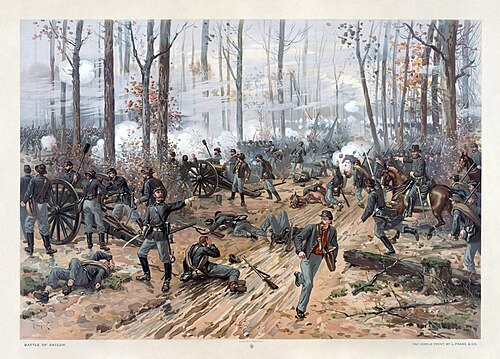
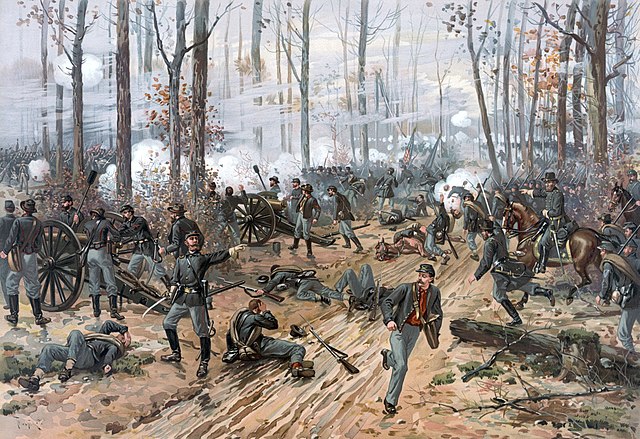
Battle of Shiloh, Thure de Thulstrup for L. Prang & Co., 1888
Quick facts
Shiloh at a glance
| When | April 6–7, 1862 | |
| Where | Around Shiloh Church and Pittsburg Landing on the Tennessee River, Hardin County, Tennessee | |
| Other name | Also called the Battle of Pittsburg Landing | |
| Union leaders | Maj. Gen. Ulysses S. Grant (Army of the Tennessee); Maj. Gen. Don Carlos Buell (Army of the Ohio) | |
| Confederate leaders | Gen. Albert Sidney Johnston (killed April 6), then Gen. P.G.T. Beauregard | |
| Troops | About 66,000 Union (with Buell’s army) vs. about 44,000 Confederates | |
| Casualties | About 23,700: Union 13,000 (1,754 killed), Confederate 10,700 (1,728 killed) | |
| Result | Union victory; the Confederates retreat to Corinth, Mississippi |
The big picture in 30 seconds
Why Shiloh matters
- Its losses shocked the nation: Americans now saw how bloody the war would be.
- Albert Sidney Johnston was the highest-ranking officer killed in the whole war.
- The Confederate attempt to win back Tennessee failed.
- Grant kept his nerve, and Lincoln kept Grant.
23,700
killed, wounded or missing in two days
110,000
soldiers on the field in all
About 50
Confederate guns massed against the Hornet’s Nest
6 hours
the Hornet’s Nest held out
After Fort Donelson
A surprise in the woods
After the fall of Fort Donelson, General Albert Sidney Johnston pulled the Confederate armies in the West back to Corinth, Mississippi, a key railroad crossing. Grant’s army steamed up the Tennessee River and camped at Pittsburg Landing, 22 miles away, to wait for General Don Carlos Buell’s army marching from Nashville. Then together they would attack Corinth.
Johnston decided to strike first, before Buell arrived. His army of mostly untrained soldiers was slow on the march and noisy in camp, but the Union generals did not believe an attack was coming. Grant’s camps had no trenches, and many of his troops were as green as the enemy.
“Place of peace”
Shiloh Church was a small log Methodist meeting house. Its name comes from a Hebrew word often translated as “place of peace.” By the evening of April 6 the ground around it was covered with dead and wounded men.
Where it happened
Between the creeks
Grant’s camps sat on a rough plateau of woods, small fields and ravines, bounded by the Tennessee River on the east, Owl and Snake Creeks on the north and Lick Creek on the south. Johnston planned to turn the Union left, cut Grant off from the landing and pin him against the creeks. Instead the attack drove the Union army straight back toward the river, where Buell’s troops and Union gunboats were arriving.
On April 7 Grant and Buell attacked south from the landing and drove the Confederates back past Shiloh Church. Simplified map.
How the battle unfolded
Two days at Shiloh
A near disaster on Sunday became a Union victory on Monday.
Confederate lines sweep into the Union camps near Shiloh Church. Sherman’s and Prentiss’s divisions are driven back with heavy losses.
Union troops in an old sunken road beat back about a dozen charges. The bullets were so thick, men said, it sounded like a nest of hornets.
Near the Peach Orchard a bullet cuts an artery in Johnston’s leg. He bleeds to death in minutes. Beauregard takes command.
About 50 Confederate cannon blast the Hornet’s Nest and General Prentiss surrenders about 2,200 men. Grant forms a last line of guns near the landing, helped by two gunboats.
Beauregard calls off the attack, thinking he has won. In a cold rain, Buell’s army crosses the river and Lew Wallace’s lost division finally arrives.
Grant and Buell attack with fresh troops. By afternoon the Confederates are retreating to Corinth. Sherman follows briefly, then stops.
Night of April 6, 1862
“Lick ’em tomorrow, though”
That night rain poured down on the wounded and the living. Grant tried to sleep under a tree near the landing, but his ankle, hurt in a fall from his horse a few days earlier, kept him awake. He moved into a cabin, but surgeons were operating there and he could not stand the sight, so he went back out into the rain.
Late that night William T. Sherman found him there. Sherman later said he had come to suggest a retreat across the river, but something in Grant’s manner stopped him. “Well, Grant,” he said, “we’ve had the devil’s own day, haven’t we?” Grant puffed his cigar. “Yes,” he answered. “Lick ’em tomorrow, though.”
After the battle, newspapers blamed Grant for being surprised, and some called for his removal. According to a Pennsylvania politician who visited the White House, Lincoln answered: “I can’t spare this man; he fights.”

Commanders and soldiers
Who led the fight

Surprised on the first day, he refused to retreat and won on the second.

Jefferson Davis thought him the South’s finest general. He was killed leading the attack.

His camps took the first blow. Wounded in the hand and with horses shot under him, he held his men together.

Took over when Johnston fell and called off the attack at dusk, a decision argued over ever since.

His fresh divisions crossed the river during the night and led the attack on April 7.

Stood by Grant when newspapers and politicians demanded he be fired after Shiloh.
Why it mattered
The end of innocence
Shiloh’s casualty lists stunned both sides. Grant wrote that after Shiloh he “gave up all idea of saving the Union except by complete conquest.” The Confederates had lost their best chance to win back western Tennessee, and in late May they gave up Corinth too. The Union now controlled the railroads and rivers of the region, and the way was open down the Mississippi toward Vicksburg.
“I saw an open field … so covered with dead that it would have been possible to walk across the clearing, in any direction, stepping on dead bodies, without a foot touching the ground.”
Ulysses S. Grant
Personal Memoirs, 1885
The bigger story
The Civil War
Our Civil War hub has every battle in order, the causes of the war, its leaders and a full timeline. For the whole era, from westward expansion to Reconstruction, see Expansion and Civil War.
Go deeper
Books and sources
- Shiloh: The Battle That Changed the Civil War, by Larry J. Daniel (1997)
- Shiloh, 1862, by Winston Groom (2012)
- Personal Memoirs of U.S. Grant (1885)
- More recommended books