
Home › People › US Presidents › Donald Trump
45th and 47th President · 2017–2021 and 2025– · Republican
Donald Trump: The 45th and 47th President
Donald Trump was a New York real estate developer and television star who won the presidency in 2016 in his first run for any office. He lost his bid for reelection in 2020, then won again in 2024, becoming only the second president, after Grover Cleveland, to serve two terms that were not back to back. He is one of the most popular and most divisive figures in modern American politics. This page covers events through mid-2026.

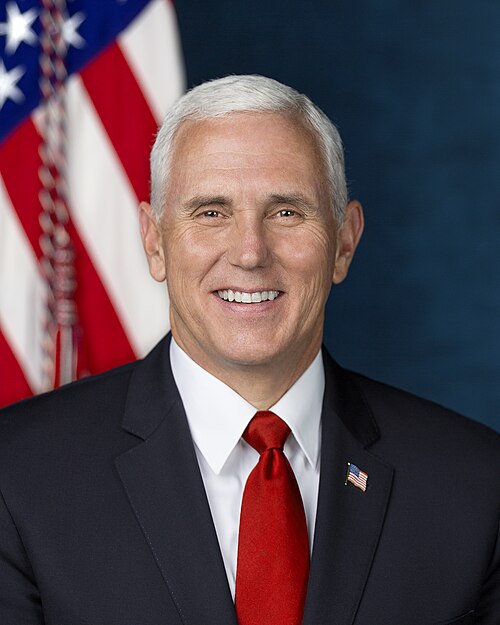
Donald Trump, official presidential portrait, 2025
Quick facts
Donald Trump at a glance
| Born | June 14, 1946, in Queens, New York City | |
| President | 45th (January 20, 2017, to January 20, 2021) and 47th (from January 20, 2025) | |
| Vice presidents | Mike Pence (2017–2021); JD Vance (from 2025) | |
| Party | Republican | |
| Education | Wharton School, University of Pennsylvania, 1968 (economics) | |
| Career | Real estate developer and head of the Trump Organization; host of TV's The Apprentice (2004–2015) | |
| Before the White House | No earlier government or military service, the first president without either | |
| Wives | Ivana Zelníčková (1977–1990); Marla Maples (1993–1999); Melania Knauss, married January 22, 2005 | |
| Children | Donald Jr., Ivanka, Eric, Tiffany and Barron | |
| Elections | Won in 2016 over Hillary Clinton; lost in 2020 to Joe Biden; won in 2024 over Kamala Harris | |
| Impeachments | Impeached twice by the House (2019 and 2021) and acquitted both times by the Senate | |
| Age | At 78, the oldest person to take the presidential oath, in 2025 |
The big picture in 30 seconds
Why he matters
- Only the second president to win two non-consecutive terms, after Grover Cleveland in 1884 and 1892.
- Reshaped the Republican Party around his “America First” approach to trade, immigration and foreign policy.
- Appointed three Supreme Court justices in his first term, creating a 6–3 conservative majority.
- Signed major tax cuts in 2017 and 2025, and put large tariffs on imports.
- The only president impeached twice, and the first former president convicted of a crime, in a New York state case in 2024.
- Survived an assassination attempt at a campaign rally in Butler, Pennsylvania, in July 2024.
3
presidential elections as his party’s nominee: 2016, 2020 and 2024
3
Supreme Court justices appointed in his first term
21%
the new corporate tax rate under the 2017 tax law, down from 35%
132 years
between Cleveland’s return in 1893 and Trump’s in 2025
Early years
From Queens to Trump Tower
Donald John Trump was born on June 14, 1946, in Queens, New York, the fourth of five children of Fred Trump, a builder of middle-class apartments, and Mary Anne MacLeod, an immigrant from Scotland. At 13 he was sent to the New York Military Academy. He studied at Fordham University and then the Wharton School of the University of Pennsylvania.
Real estate
Trump joined his father’s company and moved its focus from Queens and Brooklyn to Manhattan, renaming it the Trump Organization. He rebuilt the old Commodore Hotel as the Grand Hyatt, opened the 58-story Trump Tower on Fifth Avenue in 1983, and bought casinos in Atlantic City, an airline and the Plaza Hotel. Several of his businesses, especially the casinos, went through bankruptcy in the 1990s and 2000s, but he rebuilt his brand by licensing his name for hotels, golf courses and products.
Television fame
His 1987 book The Art of the Deal was a best seller. From 2004 to 2015 he hosted the NBC reality show The Apprentice, famous for his catchphrase “You’re fired!”, which made him known to millions of viewers.

2016
An outsider wins
Trump announced his campaign in June 2015, riding down the escalator at Trump Tower. Promising to “Make America Great Again,” build a wall on the Mexican border and renegotiate trade deals, he beat 16 other Republicans for the nomination. Most polls showed Hillary Clinton ahead, but Trump won the Rust Belt states of Pennsylvania, Michigan and Wisconsin by small margins and captured the presidency, while Clinton won the national popular vote.
Election of 2016
The upset
Electoral votes: 538 electors; 270 needed to win. Popular vote: Clinton 65.9 million (48.2%), Trump 63.0 million (46.1%)
Election of 2020
Defeated
Electoral votes: 538 electors; 270 needed to win. Popular vote: Biden 81.3 million (51.3%), Trump 74.2 million (46.8%)
Election of 2024
The comeback
Electoral votes: 538 electors; 270 needed to win. Popular vote: Trump 77.3 million (49.8%), Harris 75.0 million (48.3%)

First term, 2017–2021
“America First”
With a Republican Congress for his first two years, Trump moved quickly on taxes, judges and regulations, and broke with many longtime American trade and foreign policies.
December 2017
Tax cuts
The Tax Cuts and Jobs Act cut the corporate tax rate from 35 to 21 percent and lowered most individual rates. Critics said it favored the wealthy and raised the deficit.
2017–2020
Three justices
Trump appointed Neil Gorsuch, Brett Kavanaugh and Amy Coney Barrett. In 2022 the new majority overturned Roe v. Wade.
2018–2020
Trade wars
He put tariffs on steel, aluminum and many Chinese goods, and replaced NAFTA with the US-Mexico-Canada Agreement in 2020.
December 2018
The First Step Act
A bipartisan criminal justice reform that shortened some federal prison sentences and expanded job training for prisoners.
2018–2020
Diplomacy
He met North Korea’s Kim Jong Un three times and helped broker the Abraham Accords between Israel and several Arab nations. He pulled out of the Paris climate agreement and the Iran nuclear deal.
December 2019
Space Force
He created the US Space Force, the first new branch of the armed forces since the Air Force in 1947.
2020
The pandemic
In early 2020 the COVID-19 pandemic reached the United States. Trump restricted travel from China and Europe and launched Operation Warp Speed, which helped deliver vaccines in less than a year, far faster than ever before. He was also criticized for playing down the virus and clashing with health experts. By the time he left office, about 400,000 Americans had died of COVID-19, and the economy suffered its sharpest drop since the Great Depression before beginning to recover. Trump himself was hospitalized with the virus in October 2020.
The economy
Unemployment before and during COVID-19
Unemployment kept falling during Trump’s first three years and reached 3.5 percent, a 50-year low, before the pandemic shut down much of the economy in 2020.
Source: US Bureau of Labor Statistics. Trump's first-term years shown in red. Monthly unemployment hit 14.8 percent in April 2020.
Impeachments and January 6
Two impeachments
A special counsel, Robert Mueller, investigated Russia’s interference in the 2016 election. His 2019 report did not find enough evidence to charge a conspiracy between the campaign and Russia, and did not reach a conclusion on whether Trump had obstructed justice.
In December 2019 the Democratic-led House impeached Trump for pressuring Ukraine’s president to investigate Joe Biden. The Senate acquitted him in February 2020.
January 6, 2021
After losing the 2020 election, Trump insisted it had been stolen. On January 6, 2021, as Congress met to count the electoral votes, he told a rally near the White House to march to the Capitol. A crowd of his supporters broke into the building, forcing lawmakers and Vice President Pence to flee. A week later the House impeached Trump a second time, for incitement of insurrection. In the Senate, 57 senators, including seven Republicans, voted to convict, short of the 67 needed.

2021–2024
Between terms
Trump moved to his Mar-a-Lago club in Florida and kept control of the Republican Party. He faced four criminal cases. In May 2024 a New York jury found him guilty of 34 felony counts of falsifying business records to hide a payment to an adult film actress before the 2016 election, making him the first former president convicted of a crime. He was sentenced to an unconditional discharge, with no jail or fine. He called the cases political persecution. The federal cases were dropped after he won the 2024 election, and the Georgia case was later dismissed.
Butler, Pennsylvania
On July 13, 2024, a gunman opened fire at a Trump rally in Butler, Pennsylvania. A bullet grazed Trump’s ear, and a volunteer firefighter in the crowd, Corey Comperatore, was killed. Trump rose with his fist in the air, shouting “Fight!” In September a second man was arrested after hiding with a rifle near Trump’s golf course in Florida.
Second term, 2025–
Returning to power
Trump returned to the White House with Republican control of both houses of Congress and acted quickly, signing more executive orders in his first months than any recent president. Supporters praised his speed in keeping campaign promises; critics, and many court rulings, challenged whether he was going beyond a president’s legal powers. These are some of the main events through mid-2026.
2025
Immigration
He declared a national emergency at the southern border, where illegal crossings fell sharply, and launched a large deportation campaign. Raids and detentions drew protests and lawsuits.
April 2025
Tariffs
Trump announced tariffs on imports from nearly every country, saying they would bring back factories and fair trade. Stock markets fell sharply before he paused many of them to negotiate deals.
2025
Cutting the government
A new Department of Government Efficiency, first led by businessman Elon Musk, cut federal programs, grants and jobs. Whole agencies, such as the US Agency for International Development, were largely shut down.
July 4, 2025
The “One Big Beautiful Bill”
A major law that made the 2017 tax cuts permanent, added new tax breaks and funding for border enforcement, and reduced future spending on Medicaid and food aid.
June 2025
Strikes on Iran
American bombers struck three Iranian nuclear sites during a war between Israel and Iran, followed by a ceasefire.
October–November 2025
The longest shutdown
A budget fight in Congress led to a 43-day government shutdown, the longest in American history.
“From this day forward, it’s going to be only America first.”
Donald Trump, first inaugural address
January 20, 2017
Legacy
How he is seen
Because Trump is still serving, historians cannot yet judge his presidency as a whole. Few presidents have divided Americans so sharply. Supporters credit him with a strong pre-pandemic economy, tax cuts, conservative judges, tougher border enforcement, the Abraham Accords and standing up to China and to what they see as a distant political establishment. Critics fault his attacks on the press, the courts and his opponents, his handling of the pandemic, his refusal to accept the 2020 election result and the January 6 attack, and what they see as damage to democratic norms and alliances.
Whatever one’s view, his comeback in 2024 made him one of the most important political figures of the 21st century.
His life at a glance
Life timeline
People
Who's who in Trump's story


Visit
Learn more
Trump’s first-term records are kept by the National Archives as the Trump Presidential Library, with much of the material online. Because his second term is still under way, many events on this page are recent history, and new information will keep coming out.