
Home › US History › Revolutionary War › Bunker Hill
Revolutionary War · Charlestown, Massachusetts · June 17, 1775
The Battle of Bunker Hill
Two months after Lexington and Concord, New England soldiers dug in overnight on a hill across the harbor from Boston. The British attacked straight up the slope and were thrown back twice with terrible losses. They took the hill on the third try, but at a cost so high that one British general called it “a dear bought victory.”

The Death of General Warren at the Battle of Bunker’s Hill, John Trumbull, 1786
Quick facts
Bunker Hill at a glance
| When | June 17, 1775 (the redoubt was dug the night before) | |
| Where | Breed’s Hill and Bunker Hill, on the Charlestown peninsula across the harbor from Boston | |
| Sides | New England provincial army (Massachusetts, Connecticut, New Hampshire) vs. British regulars | |
| American leaders | Col. William Prescott; Gen. Israel Putnam; Col. John Stark; Dr. Joseph Warren | |
| British leaders | Maj. Gen. William Howe (in the field); Brig. Gen. Robert Pigot; Gen. Thomas Gage in Boston | |
| Troops | About 2,400 Americans vs. about 2,600 British | |
| Casualties | British 1,054 killed and wounded (226 dead); Americans about 450 (115 dead, 305 wounded, 30 captured) | |
| Result | British tactical victory; they hold the peninsula, but lose almost half the men who attacked |
The big picture in 30 seconds
Why Bunker Hill matters
- It showed that untrained colonial soldiers could stand up to the British Army.
- The terrible British losses made Gen. Howe cautious for the rest of the war.
- It ended any hope in London that the rebellion would collapse quickly.
- Patriot leader Dr. Joseph Warren died, becoming one of the Revolution’s first martyrs.
1 night
to dig the redoubt
3
British assaults up the hill
1,054
British killed or wounded
About 100
British officers killed or wounded
After Lexington
The siege of Boston
After April 19, thousands of militiamen camped in a ring around Boston, trapping General Gage’s army in the city. In May, three more British generals arrived: William Howe, Henry Clinton and John Burgoyne. They planned to break out by seizing the hills around the city, starting with Dorchester Heights to the south.
The Americans learned of the plan and moved first. On the night of June 16, Colonel William Prescott led about 1,200 men onto the Charlestown peninsula. They were sent to fortify Bunker Hill but, for reasons still argued about, dug in on Breed’s Hill, lower and closer to Boston. Working quietly through the short summer night, they built an earthen redoubt about 130 feet on a side with walls six feet high.
Dawn
At first light, sailors on HMS Lively spotted the new fort and opened fire. Soon warships and the batteries on Copp’s Hill in Boston were pounding the hill. Gage decided on a direct attack: Howe would ferry troops across the harbor, land at Moulton’s Point and march up the hill. More Americans hurried in to extend the line with a breastwork and a rail fence stuffed with hay running down to the Mystic River.

Where it happened
The Charlestown peninsula
Boston and Charlestown were both small peninsulas, joined to the mainland by narrow necks. British boats landed at Moulton’s Point. Pigot’s men attacked the redoubt from the front while Howe struck at the rail fence along the Mystic River, hoping to get behind the Americans. British shells set Charlestown on fire, and most of the village burned.
Simplified map; shorelines of 1775.
How the battle unfolded
Three attacks up the hill
The battle lasted about two hours, from mid-afternoon to about 5 p.m.
Light infantry charge along the Mystic beach while grenadiers and Pigot’s men advance on the fence and redoubt. Close-range American volleys cut them down and they fall back.
The British reform and attack again, with the same result. Some companies lose most of their men. Charlestown is in flames behind them.
With reinforcements, and with packs dropped, the British storm the redoubt. The Americans run out of powder and fight with musket butts and stones. Warren is killed.
The Americans fall back across Charlestown Neck, covered by Stark’s and Knowlton’s men at the fence. The British hold the peninsula, but are too battered to pursue.
“The whites of their eyes”
Holding fire
The Americans had little gunpowder, and many had only a few rounds each. Officers told the men to wait until the British were very close before firing, and to aim low, at the officers’ fancy waistcoats. The famous order “Don’t fire until you see the whites of their eyes!” has been credited to both Putnam and Prescott, though nobody wrote it down at the time. It was an old military saying even then.
Whoever said it, the tactic worked. Volleys at 50 yards or less shattered the British lines. Among the dead was Major John Pitcairn, who had led the advance guard at Lexington. In the final assault, Dr. Joseph Warren, newly made a major general but fighting as a volunteer in the redoubt, was shot in the head. His death shocked the colonies.
Commanders and soldiers
Who led the fight

Boston doctor and Patriot leader who refused a command and fought in the ranks. Killed in the redoubt.

“Old Put,” a tough veteran of the French and Indian War, rode back and forth urging men onto the field.
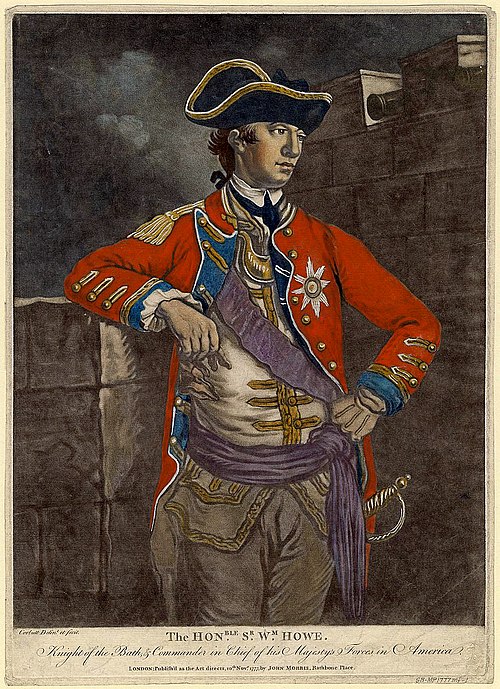
Led the attack in person and saw every officer on his staff hit. He became British commander in chief that October.

Ordered the frontal assault. The losses ended his career; he was called home that autumn.
Why it mattered
A costly lesson
Britain won the hill but lost the argument. Nearly half of the roughly 2,200 British soldiers who went up the slope were killed or wounded, including about 100 officers. The army never again risked a frontal assault on dug-in Americans if it could avoid it. Two weeks later George Washington arrived in Cambridge to take command, and in March 1776 cannon hauled from Fort Ticonderoga drove the British out of Boston for good.
“A dear bought victory, another such would have ruined us.”
Gen. Henry Clinton
Writing in his diary about Bunker Hill, 1775
The bigger story
Revolution and Founding, 1770–1819
Our U.S. History era page puts the war in context: the road to independence, the Constitution and the first presidents.
Go deeper
Books and sources
- Bunker Hill: A City, a Siege, a Revolution, by Nathaniel Philbrick (2013)
- 1776, by David McCullough (2005)
- The Whites of Their Eyes, by Paul Lockhart (2011)
- More recommended books